727
Posts
552
Followers
Pasadena Media Foundation is dedicated to saving local news. Our publications feature provocative reporting about the Greater Pasadena and Greater Southern California areas.
Preserving memory in stone
By Karine Armen,
3 days ago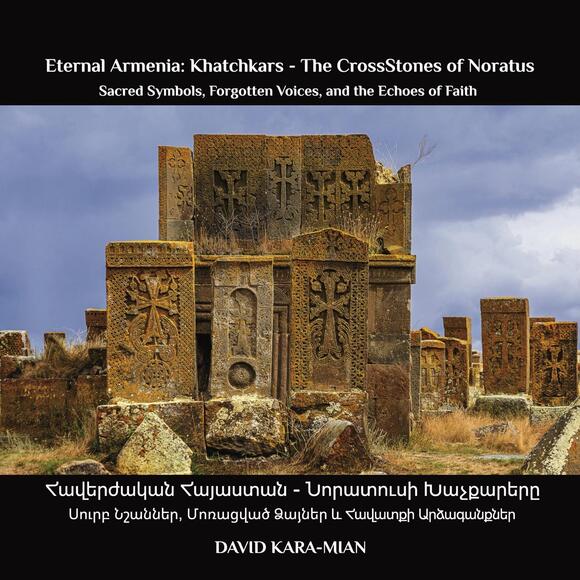
Cemeteries can be fields of silence and rest, where stones stand as guardians of those who came before us. For Armenians, one of the most distinctive forms of carved stone is the khachkar, or cross-stone. These upright stone monuments are centered on the image of the cross, often surrounded by elaborate patterns of vines, rosettes, interlacing forms, and symbols of life and eternity. Rather than emphasizing suffering, the Armenian khachkar often expresses spiritual life, renewal, and the hope of eternity.
Photographer, author, and publisher David Kara-Mian is an Armenian-American whose long career in engineering, design, and corporate leadership led him to pursue his passion for photography, publishing, and documenting Armenian cultural heritage. A contributing writer to Black & White Photography Magazine, he has dedicated himself to projects that preserve Armenia’s artistic and spiritual legacy. He lives in the San Francisco Bay Area with his wife, artist and art educator Angela Kara-Mian.
Kara-Mian will present his new book, Eternal Armenia: Khatchkars – The CrossStones of Noratus, on Sunday, October 4th at 5 p.m. at the Tekeyan Cultural Association Beshgeturian Center, 1901 N. Allen Avenue in Altadena. This is Kara-Mian’s third book on Armenia, independently published through NorArtGallery Publishing.
The culmination of nearly three years of photography, research, writing, and design, Eternal Armenia is an ambitious photographic and cultural study of the ancient cemetery of Noratus, near Lake Sevan in Armenia. The 264-page, large-format bilingual English-Armenian volume features nearly 200 photographs, including expansive panoramic views of the cemetery, intimate studies of individual khatchkars, carved grave monuments, and the landscape where these centuries-old stones have endured.
Noratus Cemetery, near Lake Sevan, is home to the world’s largest surviving concentration of Armenian khachkars, intricately carved monuments that embody centuries of Armenian Christian faith, artistry, memory, and craftsmanship. Yet despite its extraordinary significance, Noratus remains surprisingly unfamiliar to many people, including within the Armenian diaspora. The stones of Noratus have survived centuries of weather, upheaval, and change—and their survival into the future cannot simply be assumed.
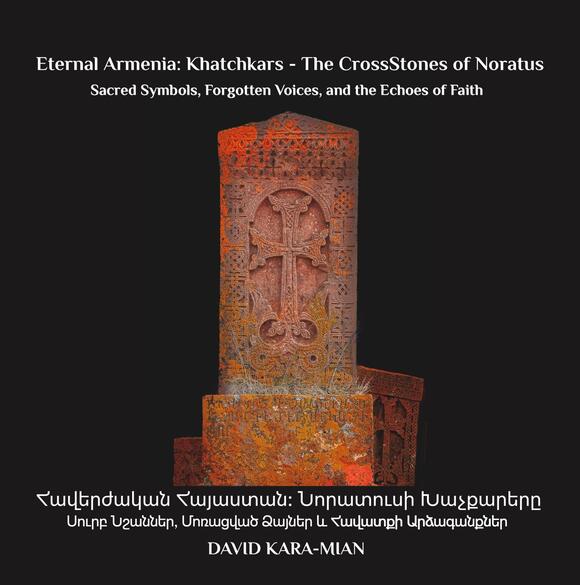
For Kara-Mian, documenting the khachkars and advocating for their preservation has become an important purpose of his photography. Over repeated visits to Noratus, he sought to document not only its most beautiful or historically significant khachkars, but also its weathered stones, graves, inscriptions, details, and broader landscape. For him, this is where photography moves beyond artistic interpretation and becomes documentation.
“Photography cannot physically protect a stone from erosion, destruction, or disappearance,” Kara-Mmian said. “It can, however, preserve a record of what existed at a particular moment. A photograph can travel where the monument cannot. It can enter a library, museum, university, classroom, church, archive, or home. It can introduce Noratus to someone who may never have the opportunity to walk among its stones.”
With Eternal Armenia, Kara-Mian concentrates on a single place and examines it in depth. The photographs celebrate the imagination and craftsmanship of Armenian stone carvers, with crosses emerging from intricate geometries, rosettes, vines, interlacing patterns, and symbols of life and eternity. At the same time, the book records the quieter presence of stones softened by centuries of weather, their inscriptions and carvings slowly surrendering their sharpness to time.
For Kara-Mian, bringing attention to Noratus means taking the work beyond the pages of the book and before Armenian and non-Armenian audiences and into libraries, museums, universities, churches, and cultural organizations. Through presentations, publications, and public conversations, he hopes to draw greater attention to Noratus and to the broader importance of Armenian cultural preservation.
“We have already seen the destruction of Armenian khachkars at Julfa, and most recently the destruction of historic Armenian cemeteries and medieval khachkars in Shushi,” Kara-Mian said. “Noratus still survives. We have a responsibility to protect it while we still can.”
“I hope that Noratus will eventually receive the international recognition it deserves, including serious consideration for UNESCO World Heritage status. Greater recognition can bring greater attention, and that attention is an important step toward long-term preservation.”
The cultural purpose behind Eternal Armenia has received the endorsement of Archbishop Hovnan Derderian, Primate of the Western Diocese of the Armenian Church of North America.
“We especially appreciate that the khachkars of Noratus are presented not only as works of art and historical monuments, but also as living witnesses to Armenian identity and Christian faith,” Archbishop Derderian wrote. “Through your work, the reader is invited to understand more deeply the richness of Armenia’s spiritual heritage and the responsibility we bear to preserve it and pass it on to future generations.”
Event details
The Tekeyan Cultural Association (TCA) Metro Los Angeles chapter organized the book presentation. Founded in August 2018, it is the newest Tekeyan chapter and the third in the greater Los Angeles region. It has a comparatively younger demographic and has been energetically organizing activities including comedy nights, concerts, and lectures. The Kara-Mian program will conclude with light refreshments. For more information: Tekeyan Cultural Association: info@tekeyanla.org or David Kara-Mian: davidkaramian@gmail.com.
Comments
YOU MAY ALSO LIKE
CJ Coombs
The Baby Jane Doe, who was abandoned in 1998 in Northeast Washington D.C. is still a mystery
Baby Jane Doe was found abandoned in Washington, D.C., on March 20, 1998. She would now be 28, according to the National Center for Missing and Exploited Children (NCMEC). As of today, seven missing children from Washington, D.C. are listed with the NCMEC, and the oldest case dates back to 1961. Notably, not all missing children are reported to the NCMEC, but they should be.
CJ Coombs
Dianna Carney
Three Gentle Giants Found Wandering Together: Now They Just Need Someone to Choose Them
Three Mastiff-mix dogs, Chance, Duncan and Isabel, are ready to trade their wandering days for permanent homes, according to the Scituate Animal Shelter of Massachusetts. The shelter recently introduced them with an invitation to adopters: “Meet Chance, Duncan + Isabel… three VERY big reasons to fall in love,” adding that each dog arrived after being found roaming together in Stoughton and is now looking for “a home of their own.”
CJ Coombs
A mother and her two sons vanished in 2022, after boarding a boat in Honolulu, Hawaii
Koa Kai Bernstein has been missing from Honolulu, Hawaii, since October 12, 2022, according to the National Center for Missing and Exploited Children (NCMEC). His age-progressed photo (above, far right) shows what he may have looked like at 12, though he would now be 13.
Thomas Smith
Jack Beavers
US Coast Guard Intercepts 200+ Migrants at Sea
The US Coast Guard has intercepted or repatriated more than 200 migrants involved in more than half a dozen cartel smuggling attempts this month off both US coasts. The latest smuggling run they interrupted occurred on September 13, 2026 21 miles west of San Diego.
Pasadena Media Foundation is dedicated to saving local news. Our publications feature provocative reporting about the Greater Pasadena and Greater Southern California areas.
727
Posts
552
Followers