693
Posts
537
Followers
Pasadena Media Foundation is dedicated to saving local news. Our publications feature provocative reporting about the Greater Pasadena and Greater Southern California areas.
‘Determine the law, apply it, call balls and strikes, and move on.’ – David DeJute
By Sheryl Turner,
4 hours ago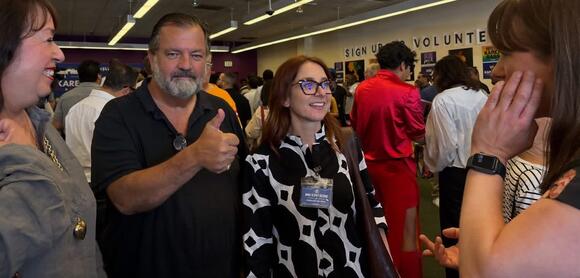
We discussed the importance of interviewing judicial candidates.
DeJute: A vibrant democracy depends heavily on communication, both from voters to candidates and from candidates to voters. Judges are a unique subset of that, because I’m not running on policies I want to implement.
I am a Democrat, just as I have a gender and an ethnicity; you can’t erase those things. What you have to do is recognize them and not let any inherent bias take over. You’re always coming from a certain perspective. I happen to be a Democrat, but the job of a judge isn’t Democratic or Republican; it’s about the facts, the law, and a fair application of one to the other.
Experience for the judiciary
DeJute: I’ve had a lot of experience, and I think it’s made me well suited to be a judge. I went to Notre Dame for undergrad, in the Great Books program, then Harvard Law School. At Harvard, I worked at the Harvard Legal Aid Bureau, the oldest student-run legal aid organization in the country, and I was on its board. That was a great experience because access to justice tends to break down at both ends of the spectrum. If you’re very wealthy, money is no object. You can afford excellent lawyers. It’s more tragic at the other end, where people don’t have the money to pay court fees, let alone hire a lawyer, and they can really get taken advantage of. That’s been a real commitment of mine ever since. I’ve represented hundreds of clients pro bono over my career, and I encourage my students to do the same because most of us went to law school to make a difference. It’s very rewarding to help someone who can’t help themselves.
Teaching, a reward in a legal career
DeJute: I teach at Pepperdine Caruso School of Law. I was asked to start up and run a disaster relief clinic that provides free legal help to people harmed by the Palisades and Eaton fires. I’d been asked to do something similar after the Woolsey Fire, too, so I took a leave of absence from my firm. I still have a few clients, but this was a significant financial sacrifice. I was asked to do it, and people who’d lost their homes were underinsured and dealing with major problems. I’d already been teaching antitrust, ethics, entertainment law and copyright at Pepperdine, so I talked with my law partner, and we agreed this was a good use of my time. It’s been very rewarding: you represent fire victims for free and show students what the practice of law actually looks like, which is very different from what it looks like in the classroom.
Price gouging is a good example. After a fire, some executive orders and ordinances say you can’t raise prices more than about 10 percent. But we were seeing landlords charging double. And it doesn’t matter that it’s “just” insurance money, because it’s still the client’s money, and it runs out much faster if they’re overcharged.
One of my students researched a case, prepared a beautifully done IRAC memo (issue, rule, analysis, conclusion), and correctly determined that this was price gouging. I told her, “That’s great, but this isn’t an academic exercise.” That conclusion might be enough for a class assignment, but it’s just the beginning. Now that we’ve determined this is against the law, what do we do with that information? Show the other side the memo; maybe they reduce the rent immediately. If not, what’s your job? Figure it out. Do we file a lawsuit against the state to fix this? Do we seek an injunction? Let’s think it through together.
In a fire, your house is often your greatest asset; you think you have a few hundred thousand or a million dollars in equity, but then the fire destroys it, and you’re underinsured. It’s very difficult to know what to do. We work to maximize the return from the insurance company, and it’s awful when an insurer denies claims it should accept. At the end of the day, it’s very hard to get an insurance company to rewrite a policy. We’ve done it and exceeded the stated policy limits in some cases, but that’s the exception, not the rule, and it takes a very significant set of facts to get there.
Judicial temperament and both sides of the bench
DeJute: My opponent has been a public defender for most of his career. As for me, I’ve had experience on both sides, which I think is very helpful. I’ve represented plaintiffs and defendants, handled civil and criminal matters, and worked in both the private and government sectors. I’ve come to believe judges are generalists, not specialists. My father was a judge who could pull disparate ideas from many sources to determine what was appropriate in a given case and what was the best course of action in that particular instance. I want to think I can bring the same thing, and I think experience across different areas of practice helps you do that.
But a judicial campaign is a strange kind of campaign. We have six million registered voters in LA County, and there’s really no way to reach a majority of them.
Door-knocking in LA County
DeJute: What better use of a Saturday is there? The difference of 50 or 100 votes one way or the other isn’t going to be determinative unless you’re running in a very small town, or it’s a unified school district race, where 100 or 200 votes really can swing things.
Applying the law: a lesson from clerking
DeJute: Early in my career, I clerked for a very good federal judge. He’d been a minor leaguer in the Chicago Cubs’ system and had been called up to the Cubs. But then World War II broke out, and he had to defend his country. By the time he came back, he was too old to play. He ended up a two-time Reagan appointee, and I was a Democrat. We disagreed on policy, but we never disagreed on the law, because he tried to be fair – determine the law, apply it, call balls and strikes, and move on. The job is difficult, time-consuming, and full of pressure, but you’re not trying to overthink it; you’re trying to be fair on the issue in front of you, every time, and call it a ball or a strike.
Running a dignified and respectful courtroom
DeJute: My dad ran a dignified, respectful courtroom. A judge generally isn’t there to determine who wins and who loses, unless he or she is the trier of fact. The judge’s job is to create a fair playing field so that, through advocacy, the jury decides or the motion is ruled on, and the person walks away feeling they had a fair process. It’s entirely possible to lose in court and still believe you got a fair shake; maybe the judge got it wrong, maybe he didn’t believe certain witnesses, but that’s different from a judge who is biased, or didn’t do his homework, or doesn’t understand the law.
I saw people walk out of my dad’s courtroom saying, “I don’t like this result, but I like the judge.” That’s a win for society. We provide a forum where, instead of fighting physically, we resolve our differences according to rules and laws, and there’s no guarantee you’ll win. Sometimes you’re wrong, and you should lose.
I saw this firsthand as a U.S. Attorney, back when that meant something. I could go to court and make a representation, and it was believed that the goal was to win cases properly. It was fine to lose a case because we didn’t have the facts or the law on our side; what wasn’t fine was making things up. If I came back and said, ‘I found out these facts; we have a terrible case, we should settle or resolve it,’ that was the job. Lying in court to win, or lying to a grand jury, would have gotten me fired.
We live in very divisive times, and we don’t want to win at all costs; we want to move through the process in a way that recognizes we have a lot in common, even when we have a legal dispute, rather than complete animosity. I believe courts and court officers can play a large role in building that kind of civility among litigants.
Reducing court backlogs
DeJute: There’s a lot of inefficiency in the court system. That’s easy for me to say, but from a trial lawyer’s perspective, I’ve watched judges deal with everyone appearing at the same time, a “cattle call” where counsel shows up unprepared, or doesn’t show up at all, and things get continued again and again. I’ve also seen judges push through an overburdened docket and actually get things done, but it takes real commitment. It means holding lawyers’ feet to the fire so there isn’t this continual pattern of delay.
There has to be better case management; it can’t be that the first time a judge actually looks at the papers is on the day of the hearing, and they’re incomplete or wrong. I think there also needs to be pre-filing review, so hearings and trials can move more efficiently and we’re not facing large delays getting something right that should have been done the first time correctly.
‘Determine the law, apply it, call balls and strikes, and move on.’
Jury reform and civic participation
DeJute: Jurors, in theory, should be our peers, and I think we’re already drifting away from that. It’s very difficult for people to serve when their employer doesn’t pay them for jury duty, because juror pay is already inadequate. You end up with an overabundance of government employees on juries. There’s nothing wrong with government employees, but you want a diverse jury pool. The jury system actually works fairly well to my surprise. Juries get it right far more often than they get it wrong, both criminally and civilly. You have to be careful in civil cases especially, because things can get very complex, and it takes real effort from the judge and the parties to make the issues accessible to a jury. The judge rules on points of law; the jury determines credibility and the facts.
I don’t have a great solution to the underlying problem, which is really about our society’s ethos. We’re growing more distant from each other: fewer civic clubs, less church attendance, less community involvement overall, and, I think, less participation in civic duties. Jury duty is seen as a burden to get out of, rather than a civic duty to embrace. A lot of these issues would be helped if we changed the underlying theory of why we do them, so they’re seen as a good thing rather than a burden. I don’t know how to make that cultural shift happen.
Mostly, it’s a funding problem. It’s the same issue with rehabilitation programs, which are an excellent option for nonviolent, first-time offenders instead of prison. There isn’t enough funding, even though many more people are eligible for it than the system can currently support. It’s similar with enforcing jury summonses: once you’re in front of the court, you can ask to be excused, but by the time you’re ignoring a summons altogether, it’s a time-consuming and expensive thing to chase down.
It’s a bit like how, historically, taxes in this country have largely been paid voluntarily. There’s never been a widespread refusal to pay, as there is in some countries, because if everyone stopped paying, it would be very difficult for the government to enforce compliance. Much of the law rests on voluntary compliance. Traffic laws are a good example: people mostly stop at red lights not because there’s a police officer watching, but because it’s a reasonable rule and also for their own safety. In many ways, Americans are quite compliant with reasonable rules. The jury system could work the same way if we had that same civic attitude.
‘I want to be a judge for the right reasons.’
Hard or soft on crime?
DeJute: Both. I’m soft on young, nonviolent, first-time offenders who want to rehabilitate themselves, and hard on older offenders who are set in their ways and have committed something unjustifiable, like murder. If you’ve committed murder, you shouldn’t be released just because you’ve served a certain amount of time; if you’re a juvenile who’s made a mistake, you should be given a path to rehabilitation. That’s just common sense to me.
Campaign fundraising
DeJute: Based on the number of attorneys I know and the enthusiasm people showed when I announced I was running, I thought people would chip in $50, $100, a couple hundred dollars. Some have given $1,000 or more. If everyone did that, it would be great, but they don’t, and I think I’ve come to understand why: unlike a typical politician, I can’t really promise donors anything. In fact, there’s a disincentive: law firms are barred from appearing before a judge for a year or two after they’ve contributed to that judge’s campaign. The honest reason to donate to a judicial candidate is simply that you think they’d be a good judge and that the community would be served by having them on the bench. People agree with that in principle. So a lot of this ends up being self-funded.
There’s no number that guarantees a win. Plenty of wealthy candidates have spent much more than others and lost. But just getting name recognition out to six million voters takes far more money than I can raise or contribute on my own. Most of us aren’t natural politicians or natural salespeople.
Identity, diversity, and judging fairly
DeJute: I think I’d be a very good judge, and I want to be a judge for the right reasons. I want to serve the community. In every job I’ve had, I’ve tried not just to do the job well, but to reach out beyond it. I can’t do this for every person who comes across my desk, but for some of them, I can take the time to find the real help they need, without bending any rules.
I think I have the education to understand the law and the breadth of experience to understand people’s differences. I’m also a gay man. I don’t think every gay man is automatically free of intolerance or bias. Still, my own experience with discrimination being treated poorly because I belonged to a group some people don’t like has shaped how I see fairness. It’s not fair to be treated badly because of your gender, your race, or your ethnicity, and it wasn’t fair when it happened to me. Because I’m not visibly part of a minority group in the way people expect, I’ve heard things said in locker rooms and elsewhere that people wouldn’t have said if they’d known. That experience has made me more tolerant, more inclusive, and more compassionate, and you don’t have to be gay to be compassionate. Still, I do believe that experience helps make a good judge.
The Stonewall Democratic Club, an LGBTQ Democratic club, endorsed me, and I told them I think I’ve earned that endorsement. As a Democrat, I believe in the rule of law, equal protection, due process, fair treatment, opposition to discrimination, and human rights. As a gay man, I actually expect my sexual orientation to be completely irrelevant in my courtroom. The ultimate goal is for none of it to matter to the outcome of a case. My being gay, or someone else being a woman, a Roman Catholic, a Jew, or transgender, has nothing to do with whether a contract was breached or someone ran a red light. I believe that as strongly as I believe anything, and I think we need more of that approach, not less.
Character, humility, and why these races matter
DeJute: We call ourselves a democracy, but we really live in a representative democracy, where we elect people less for a detailed platform and more for their character. We’re trusting them to make the right calls on things we can’t fully anticipate. I think that’s especially true for judges. No judicial candidate is ever going to stand up and say, ‘I plan to do things illegally.’ You have to vote for the candidate you believe will do the right thing when nobody’s looking; someone who will exercise judicial power responsibly, who will sometimes get it wrong, but who also has the humility to say so.
I tell my students this all the time: saying ‘I don’t know’ isn’t a confession of stupidity; it’s often a sign of intelligence. It means you’re interested enough to find the answer. If you insist you know when you don’t, all you’re doing is defending a wrong opinion.

Comments
YOU MAY ALSO LIKE
Jim O’Rear
Florida Man’s Poop Fight Goes Completely Off the Rails.
Folks, I’ve said it before and I’ll say it again: Florida is the only place where a disagreement over dog poop can apparently escalate into a felony case, an assault with a scooter, and enough body-cam footage to make Netflix start taking notes.
CJ Coombs
CJ Coombs
CJ Coombs
CJ Coombs
Pasadena Media Foundation is dedicated to saving local news. Our publications feature provocative reporting about the Greater Pasadena and Greater Southern California areas.
693
Posts
537
Followers