undefined
Posts
undefined
Followers
Charter schools may be given access to state grants
By Owen Houtakker,
3 days ago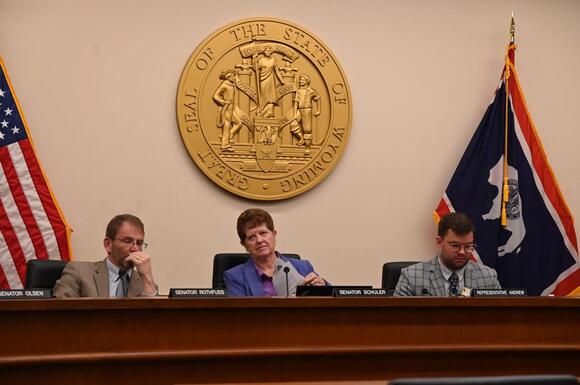
CHEYENNE — Charter schools across Wyoming may experience changes in how they count enrollment, and may gain the ability to apply for grants available to public schools if two bills passed Tuesday by the Legislature’s Joint Education Committee become law.
The first bill the committee discussed would extend the years during which a charter school’s average daily membership, or ADM, is calculated. Currently, that number is based on the previous year’s ADM up to the school’s third year of existence, then based on a two-year rolling average after that point. The bill would extend the year-by-year ADM calculation to the school’s seventh year.
The appropriation amount was not yet determined, because the state uses each school’s ADM to determine how much funding each school should receive.
Committee co-chair Sen. Wendy Schuler, R-Evanston, asked Matthew Willmarth, the budget fiscal deputy administrator for the Legislative Service Office, if the new timeline was reasonable. He said that decision was ultimately a policy choice for the committee, but suggested a cautious approach, as it is impossible to predict what enrollment will be year to year.
Willmarth also said that a school could be put in a deficit if enrollment stopped growing in years six or seven.
Christian Winger, the CEO of Prairie View Community School, voiced his support for increasing the timeline because his school was still experiencing growth due to it offering grades K-12.
He acknowledged that there was a risk to his school if enrollment dipped, but he believed the benefits outweighed that risk.
“As a school is starting and it’s a brand new school, then your enrollment should be going up for the first five to seven years,” Winger said.
Sen. Chris Rothfuss, D-Laramie, asked why charter schools should be treated differently from non-charter schools, and whether the bill should cover all schools.
Winger explained his belief that the legislation would allow the state to fund a school during its period of growth, and would then shift to the two-year rolling average used for other schools.
He also noted that his school operated differently from most new schools, because he had to hire staff to serve grades K-12, whereas other schools add staff as they add grade levels each year.
Sen. Charles Scott, R-Casper, said a major difference between charter schools and non-charter schools is that non-charter school districts have ongoing schools that build up capital over the years.
Rothfuss responded by saying that mechanism was included in the original charter school bill, before being eliminated, which he described as a political decision, based on the belief that the schools would fund themselves.
He returned to his earlier point that this bill should encompass all schools and not just charter schools.
“If there is a problem that needs to be resolved, we should be resolving it for all schools that have dramatically increasing enrollment, not for charter schools with dramatically increasing enrollment,” Rothfuss said, though he did acknowledge many public schools have not seen such an increase.
Jessica LeNeave, the director of operations for Academia Mountain West, said she believes the extended timeline would allow charter schools to grow responsibly and consistently with their operating expenses.
“A seven-year provision would provide a reasonable defined period for new charter schools to expand grade levels, establish enrollment patterns and stabilize operations without being financially penalized for growing responsibly,” she said.
She stressed that this would ensure the school’s funding is being adjusted to reflect the students served.
Janine Bay Teske, who serves on the Wyoming Charter School Authorizing Board, thanked Scott for explaining the financial situation of the charter schools compared to non-charter schools.
“You open a new elementary school or a new school within a school district,” she said, “you’ve got the backbone of the district and the finances of the district to help get you through that period. These schools have nothing.”
Carrie Klein of the Wyoming Public Charter Schools Association touched on why a seven-year timeline would be most advantageous.
“I think seven makes sense in that if you’re starting K-4, and your charter is for K-12, you know, seven years gets you to that full enrollment period,” she said.
During the committee’s discussion of the bill, Rothfuss again relayed his concerns about the bill treating charter schools differently from public schools, adding that he would prefer a bill that addressed all schools.
Committee co-chair Rep. Ocean Andrew, R-Laramie, said he believed the specific language was necessary, because at this point charter schools were the only ones impacted, and said that if public schools had similar issues, they would be addressed.
Rothfuss was the only one who did not vote in favor of the bill.
The next bill the committee discussed would allow charter schools to apply for state grants through their resident school district.
Dicky Shanor, chief of staff for the Wyoming Department of Education, voiced the support of state Superintendent of Public Instruction Megan Degenfelder, but did note that this would impose an additional burden on the districts.
Teske, who participated in the working group that helped draft the bill, expressed her concern about potentially creating friction between public schools and charter schools.
“The last thing I personally want to do is to create a situation where we’re creating friction with the traditional K-12 system,” she said. “That is not our intent at all.”
She also stressed the need to change the language in each individual grant, which currently prohibits charter schools from applying for state grants at all.
Sen. Jared Olsen, R-Cheyenne, agreed, and committed to working on a bill during the next interim that would change each grant’s language to allow charter schools to apply individually.
Sen. Evie Brennan, R-Cheyenne, acknowledged that this bill doesn’t fix the issue permanently, but it does provide an option for charter schools to access state grants.
Rothfuss concurred with Olsen and Brennan.
“This is an appropriate step,” he said. “Again, perhaps not perfect, but I think it’s thoughtfully done, and I honestly think it will solve the problem.”
The bill was unanimously passed by the committee.
 Add to Preferred Sources