undefined
Posts
undefined
Followers
Moonshot AI Unveils Kimi K2.5 Open-Source Model, Claiming to Beat Claude Opus 4.5 on Agentic Benchmarks
By Markus Kasanmascheff,
2026-01-27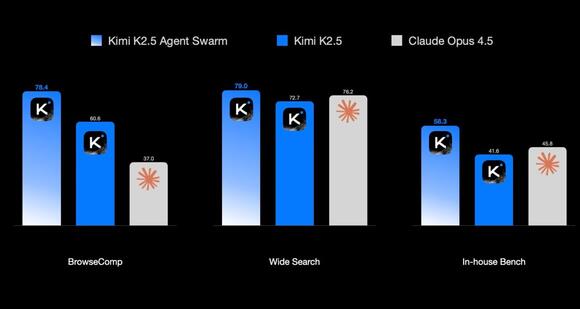 TL;DR
- New Release: Moonshot AI launched Kimi K2.5, an open-source model with coding, image, and video capabilities alongside Kimi Code tool.
- Key Technology: The model coordinates up to 100 specialized agents in parallel and achieved an 80.9% resolution rate on SWE-Bench Verified.
- Market Position: Kimi K2.5 competes with subscription-based tools like Anthropic’s Claude Code by offering comparable capabilities without usage fees.
- Availability: Developers can deploy the model locally or access it through Moonshot’s API with free Kimi Code integration for VSCode, Cursor, and Zed.
Chinese AI startup Moonshot AI released Kimi K2.5 Tuesday, an open-source model that handles coding, image, and video tasks alongside a new coding tool called Kimi Code.
The dual launch positions Moonshot AI as a cost-effective alternative provider in the billion-dollar AI coding tools market, where Anthropic’s Claude Code recently crossed $1 billion in annual recurring revenue. Moonshot AI developed Kimi K2.5 to compete with frontier models from OpenAI, Google, and Anthropic while maintaining open-source accessibility.
Multimodal Features and Agent Swarm
At the technical foundation, Kimi K2.5 processes both text and visual inputs through what Moonshot AI calls Native Multimodal architecture. This allows it to generate code from screenshots, diagrams, and video content. The AI lab trained the model on 15 trillion visual and text tokens across 11 different modalities, according to official documentation.
This native multimodal training distinguishes K2.5 from models that bolt vision capabilities onto text-only foundations. Moonshot AI describes the release as “not just a version iteration, but a major step towards Artificial General Intelligence (AGI)” in its official announcement. Whether K2.5 represents genuine progress toward AGI remains debatable, though the model demonstrates broad capability across multiple domains.
Building on this foundation, Kimi K2.5 deploys an agent swarm that coordinates up to 100 specialized agents working in parallel. Each agent handles specific subtasks like code generation, testing, debugging, or documentation while the primary model maintains overall orchestration. Moonshot AI claims this parallel processing approach delivers a 4.5x speed improvement over single-agent execution for large-scale coding projects.
Agent coordination happens autonomously, with the swarm dynamically allocating resources based on task complexity. The combination of native multimodal training and agent swarm coordination positions Moonshot AI to challenge proprietary models on technical merit rather than just pricing. This architectural approach addresses two key limitations of earlier open-source models: fragmented vision capabilities and single-threaded execution that bottlenecks on complex coding tasks.
Competitive Benchmarks
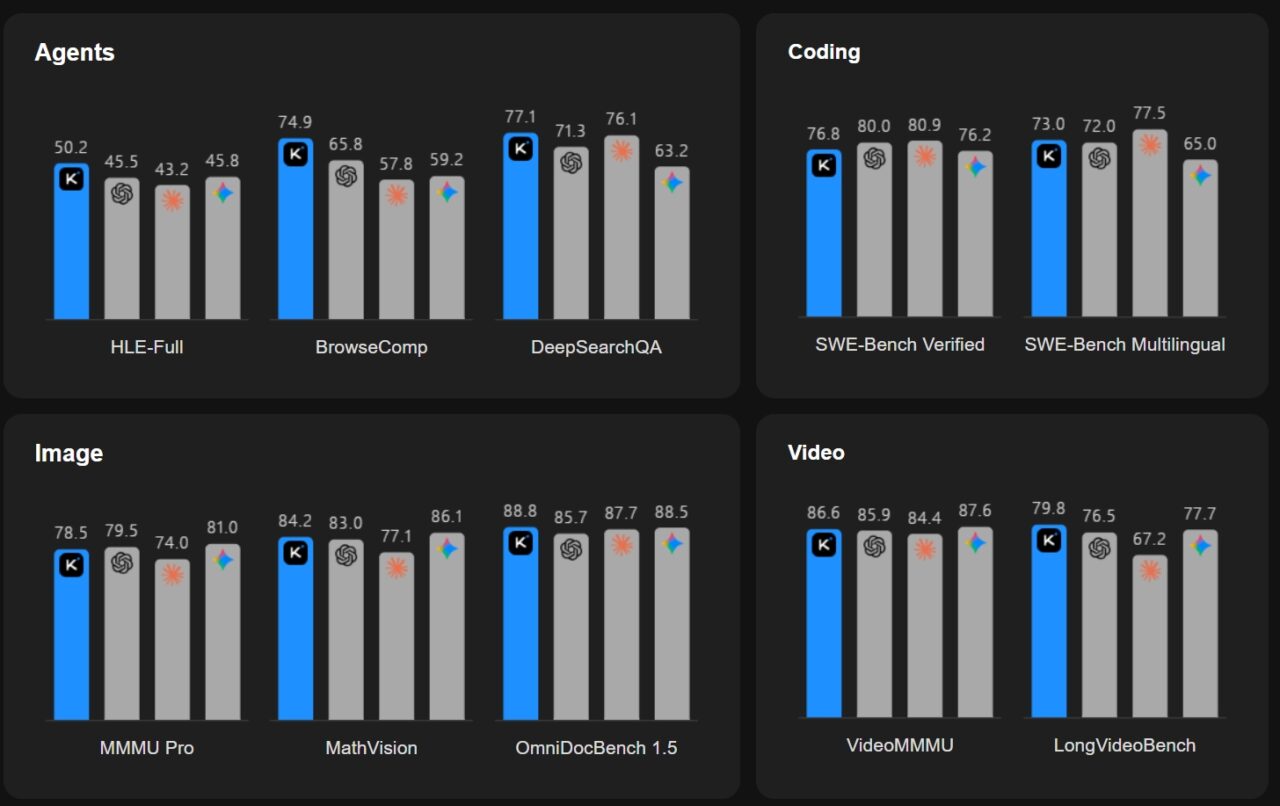
These technical capabilities translate to measurable performance gains in industry-standard testing. In benchmark testing across HLE, BrowseComp, and SWE-Verified, the model demonstrates competitive performance while maintaining cost efficiency compared to frontier proprietary models, according to Constellation Research analysis.
On SWE-Bench Verified, a coding benchmark, Kimi K2.5 achieved an 80.9% resolution rate, surpassing open-source model performance though trailing OpenAI’s o3-mini.
Kimi K2.5 also demonstrated strong performance on additional benchmarks according to Moonshot AI’s testing. In video understanding tests, Kimi K2.5 beats both GPT 5.2 and Claude Opus 4.5 on the VideoMMMU benchmark.
Market Positioning
Beyond benchmarks, the release signals a broader strategic shift in AI economics. Independent analysts from Constellation Research view Kimi K2.5’s launch as part of this transformation in AI model economics.
“The lead between frontier models is quickly collapsing versus open source options. Enterprises need to pay attention to what’s happening as LLMs commoditize quickly.”
Constellation Research (via Constellation Research)
Moonshot AI positions its offering to compete with proprietary coding assistants. Anthropic’s Claude Code reached the previously mentioned ARR milestone just months after launch, with projections showing the company adding $100 million monthly through 2025. Chinese competitors like Moonshot AI identify an opening by offering comparable capabilities without subscription costs or API usage fees.
The Beijing-based company has developed products including Kimi Chat, a consumer chatbot with a 200,000-token context window.
Companion Coding Tool
To operationalize this market strategy, Moonshot AI paired the model release with a practical developer tool. Kimi Code works with VSCode, Cursor, and Zed editors as a free coding assistant. The tool accepts text prompts, screenshots, and video input to generate code suggestions and automate repetitive development tasks.
Developers can deploy the K2.5 model locally or access it through Moonshot AI’s API. Kimi Code competes directly with Anthropic’s Claude Code and Google’s Gemini CLI in the AI coding assistant space. Unlike subscription-based alternatives, Kimi Code operates with no usage fees for developers running the model locally.
The clustering of open-source coding model launches from Chinese AI firms creates pressure on established subscription-based tools to justify premium pricing. Alibaba Cloud and other major Chinese tech companies have also released coding-focused models in recent weeks, intensifying competition in the region’s AI development tools market.
This positions enterprise development teams to reevaluate coding assistant budgets as capable free alternatives proliferate.
The post Moonshot AI Unveils Kimi K2.5 Open-Source Model, Claiming to Beat Claude Opus 4.5 on Agentic Benchmarks appeared first on WinBuzzer.
 Add to Preferred Sources