undefined
Posts
undefined
Followers
Google DeepMind Launches D4RT AI Model for Real-Time 4D Reconstruction
By Markus Kasanmascheff,
2026-01-24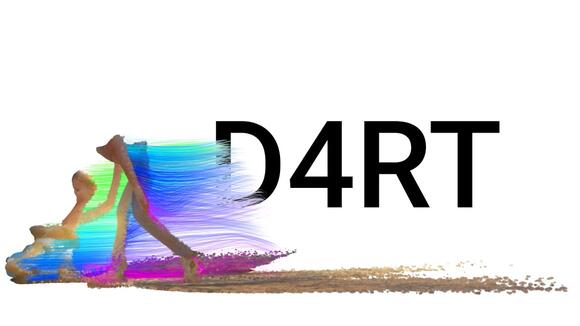 TL;DR
- Major Release: Google DeepMind released D4RT on Friday, a unified AI model for 4D scene reconstruction that runs 18 to 300 times faster than comparable methods.
- Performance Leap: The model processes a one-minute video in about five seconds on a single TPU chip, while previous methods took up to ten minutes.
- Industry Timing: The release coincided with NVIDIA’s competing physical AI announcements at CES 2026 in Las Vegas, with both companies targeting robotics and AR applications.
Google DeepMind released D4RT on Friday, a model for 4D scene reconstruction that combines depth estimation, spatiotemporal correspondence, and camera parameters into a single system.
4D reconstruction is the process of capturing the shape and appearance of real objects along a temporal dimension.
Google says the model runs 18 to 300 times faster than comparable methods, representing a shift from fragmented multi-model pipelines to a unified AI model for 4D scene reconstruction and tracking across space and time. A one-minute video that used to take ten minutes to process now takes five seconds.
Performance Benchmarks
D4RT processes a one-minute video in about five seconds on a single TPU chip, while previous methods took up to ten minutes. For camera pose estimation, the model achieves over 200 frames per second, nine times faster than Visual Geometry Grounded Transformer (VGGT) and a hundred times faster than MegaSaM.
The performance gains stem from architectural choices that eliminate redundant computation and enable parallel processing. The 120x speed improvement positions D4RT for real-time applications that were previously impractical, creating headroom for on-device deployment in battery-constrained hardware.

Technical Architecture
These speed gains rest on fundamental architectural changes. D4RT is based on the Scene Representation Transformer architecture, operating as a unified encoder-decoder Transformer architecture.
Unlike previous approaches that relied on multiple specialized models handling separate tasks like depth estimation, motion segmentation, and camera pose estimation, D4RT uses a single decoder for point tracks, point clouds, depth maps, and camera parameters.
Earlier multi-model pipelines required intermediate data transfers between depth estimation, motion tracking, and camera pose modules, with each handoff introducing latency and consistency errors.
The model uses a query-based approach centered on a fundamental question: “Where is a given pixel from the video located in 3D space at an arbitrary time, as viewed from a chosen camera?” These queries are independent and can be processed in parallel on modern AI hardware, making the system fast and scalable.
Capabilities
Beyond processing speed, D4RT introduces capabilities that address longstanding challenges in spatial tracking. The model can predict where objects are even when not visible in other frames, addressing a persistent challenge in spatial tracking.
The model handles both static and dynamic scenes with moving objects, adapting to different real-world environments without requiring separate training for different scenarios. The system’s efficiency makes on-device deployment realistic, opening possibilities for robotics and AR applications that require real-time processing without cloud dependence.
For robotics applications, D4RT provides the spatial awareness necessary for navigation and object manipulation. Robots can maintain consistent understanding of their environment even as objects move or lighting conditions change.
The occlusion prediction capability distinguishes D4RT from vision systems that lose track of objects behind obstacles, preventing collision scenarios where a robot proceeds as if an obscured person no longer exists.
Industry Context on World Models
This technical development fits within a broader shift in AI research priorities. D4RT advances Google DeepMind’s broader world models initiative.
World models differ from language models by focusing on physical space rather than text patterns, building systems that can simulate and predict real-world environments.
The approach represents a shift in AI research from systems that process text and images in isolation to models that maintain coherent representations of physical reality across time.
Spatial understanding presents challenges that humans solve intuitively but machines find difficult. “Humans are incredibly good at nuance. Lighting changes, a kid throws a blanket on a chair, a new chair appears. Humans instantly know it’s the same space. For computers, that’s actually really challenging,”says Kirin Sinha, founder and CEO of Illumix.
Physical AI requirements extend beyond geometry and depth to contextual meaning and relevant action, demanding spatial perception, scene understanding, and contextual intelligence. D4RT’s temporal coherence mechanisms attempt to bridge this gap by maintaining state across frames.
“World models are more focused on physical space: ingesting and simulating the real-world environment. You can see obvious applications for this. For example, with gaming, how can we create these highly expansive, complex worlds in a whole different way with a single continuous model? I think that’s really interesting. Robotics is the other big one you tend to hear about. How can we simulate all of these different environments so that robots can learn more effectively how to operate in the real world?”
Kirin Sinha, founder and CEO of Illumix (via Forbes)
Edge intelligence becomes important when AI systems control physical hardware in human environments. “You don’t want a device to say, ‘Hold on, I’m querying ChatGPT,’ and then ten seconds later you get an answer,” Sinha emphasizes.
Physical AI needs to orchestrate a blend of on-device and cloud processing, balancing real-time response with long-term memory and ambient intelligence. D4RT’s efficiency addresses this need by running on single chips, making millisecond-level response times achievable without network latency.
Competing Announcements
The timing of D4RT’s release reflects competitive dynamics in the physical AI space.
Last year NVIDIA announced NVIDIA Cosmos world models including Cosmos Transfer 2.5 and Cosmos Predict 2.5, which enable physically based synthetic data generation and robot policy evaluation.
During CES 2026, NVIDIA introduced Cosmos Reason 2, a reasoning vision language model, and Isaac GR00T N1.6, a vision-language-action model purpose-built for humanoid robots.
“The ChatGPT moment for robotics is here. Breakthroughs in physical AI — models that understand the real world, reason and plan actions — are unlocking entirely new applications,”NVIDIA founder and CEO Jensen Huang stated already in 2025.
The parallel releases suggest both companies see physical AI as the next major AI application area after large language models.
Boston Dynamics and other robotics companies used CES 2026 to demonstrate new robots powered by these AI advances, with Boston Dynamics, Caterpillar, Franka Robotics, Humanoid, LG Electronics, and NEURA Robotics all leveraging NVIDIA technologies.
Both companies chose the same week to unveil production-oriented models, signaling shared assessment that hardware capabilities and algorithmic maturity have reached deployment thresholds.
Practical Applications
D4RT’s speed enables applications previously impractical with existing 4D reconstruction methods. Autonomous vehicles require real-time understanding of dynamic environments, tracking multiple moving objects while maintaining awareness of static infrastructure.
The model’s ability to process scenes in near real-time makes it viable for vehicle perception systems that must respond within milliseconds.
AR headsets face similar constraints, needing to anchor virtual objects in physical space while users move and environments change. Previous methods required either cloud processing with noticeable latency or simplified on-device models with reduced accuracy.
D4RT’s efficiency makes high-quality 4D reconstruction viable on mobile hardware, enabling responsive AR experiences without cloud dependence. Manufacturing robotics represents another application area where spatial consistency matters, with robots working alongside humans tracking both static workspace elements and moving people while adjusting their behavior to avoid collisions.
Future Implications
D4RT addresses a fundamental AI challenge: consistency in spatial understanding. World models aim to give machines spatial understanding comparable to human perception, where we maintain a steady grasp of space and time despite changing conditions.
The model’s efficiency enables deployment scenarios previously limited by computational constraints, particularly for robotics and AR systems that need to interpret physical environments in real time without constant cloud connectivity.
The convergence of improved world models and efficient hardware creates conditions for broader physical AI deployment. Systems that previously required specialized computing infrastructure can now run on commodity chips, lowering barriers to adoption.
As these models improve, robots operating in warehouses, hospitals, and homes gain the spatial awareness to navigate safely around people, while AR devices deliver immersive experiences that anchor virtual objects to real-world surfaces without perceptible lag.
The shift from cloud-dependent to edge-based spatial intelligence positions physical AI systems to respond instantly when collision avoidance or precise object placement determines whether technology serves or endangers the humans around it.
The post Google DeepMind Launches D4RT AI Model for Real-Time 4D Reconstruction appeared first on WinBuzzer.
 Add to Preferred Sources