undefined
Posts
undefined
Followers
Portside II Puts Port Casks on Iowa Bourbon
By Menachem Kossowsky,
5 hours ago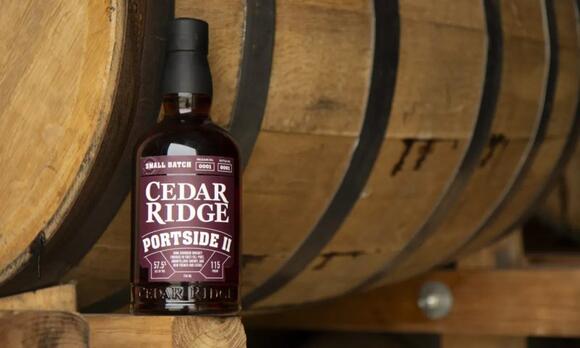
A Single Malt Idea Moves to the Bourbon Shelf
Cedar Ridge Distillery has put out a bourbon called Portside II, and the name is a hint about where it came from. In 2023 the Swisher, Iowa distillery released a limited single malt called the QuintEssential Special Release Portside, a six-year-old finished in port, sherry and virgin French oak. Now the same cask thinking has been applied to the bourbon that Iowa drinkers buy more of than any other 750 mL bourbon on the shelf. The Manual reported the release on November 7, 2026, describing it as a limited, small-batch Iowa bourbon that the distillery has just released.
The numbers are straightforward. Portside II is bottled at 115 proof, which is 57.5 percent alcohol by volume, in a 750 mL bottle priced at $59.99. The base is Cedar Ridge's flagship Iowa bourbon, aged in new American oak, with a mash bill of 74 percent corn, 14 percent rye and 12 percent malted barley. After that primary aging, the whiskey is finished in three kinds of wood: new French oak, first-fill Amontillado sherry casks, and first-fill port casks sourced from Portugal, California and Cedar Ridge's own estate.
That last detail is the interesting one. Most port-finished bourbons name a single port, or just say "port cask" and leave it there. Cedar Ridge is describing three origins for the port alone, which suggests a blending exercise rather than a simple extra-aging step. The distillery's product page describes the bottle as a limited-time offering inspired by its 2023 QuintEssential Special Release of the same name, and the shop listing was showing the bottle as sold out when it was checked, so availability may already be tight.
What the Original Portside Set Up
To understand the bourbon, it helps to look at the whiskey it borrows from. The 2023 QuintEssential Portside was an American single malt made from 100 percent two-row pale malted barley and distilled entirely at Cedar Ridge. It spent six years in the distillery's ex-bourbon barrels, then moved into first-fill ruby port casks, first-fill Amontillado sherry casks and virgin French oak. The casks were married together and bottled at true cask strength, 117.2 proof, or 58.6 percent ABV, at a suggested retail price of $99.99.
Murphy Quint, who handles blending and distilling for the family, told Fred Minnick at the time of the 2023 release: "For this release in particular, I wanted to do something with a lot of Port influence." He added: "The end result is definitely Port-dominated, but it has a nice twist to it due to the Sherry and French Oak influence." Those two quotes essentially describe the design brief, and the new bourbon appears to follow the same logic: lead with port, season with sherry, and use French oak to add structure.
The single malt was well received. The distillery lists a 97-point score from Wine Enthusiast and a 90 from Whisky Advocate, both from 2024. Reviewers who sampled it described a fruit-forward nose with notes of cherry, marzipan and oak, and one suggested adding a splash of water to open up the concentrated red grape flavors at full strength.
The Manual points out a pricing angle that matters for buyers. The single malt special releases usually cost roughly $100, which makes Portside II the cheapest way yet to try one of Quint's cask experiments. At $59.99, it costs about 40 percent less than the original Portside's suggested retail price, and it is bottled at a similar strength.
Why Port, Sherry and French Oak Work Together
The Port Side of the Blend
Ruby port is the youngest and most fruit-driven style of port, and whiskey makers who use its casks usually chase the same thing: bright red fruit and a jammy sweetness. General cask-finishing guides describe port casks as adding dark cherry, red berry and plum, sometimes with a slight tartness. On a bourbon base that already carries caramel and vanilla from new charred oak, that fruit tends to read as a sweet, berry-forward layer.
The Amontillado Twist
Amontillado sherry is less common as a finishing cask than oloroso or Pedro Ximénez. It starts life under a layer of yeast, then ages in contact with air, which gives the wine a nutty, drier, more savory profile. In whiskey, Amontillado casks are generally associated with almond and leather notes plus a touch of dried fruit. Placing it alongside port should, in theory, cut some of the sweetness and give the finish a drier edge.
French Oak for Structure
French oak is typically tighter-grained than American oak and tends to contribute spice and firmer tannin rather than coconut and vanilla. That makes it a logical partner for wine-seasoned casks, where the goal is to add structure without piling on more sweetness. None of this is a measured result for Portside II itself, since the distillery and The Manual have not released tasting notes, so these are expectations drawn from how those woods behave generally.
The finishing time has not been disclosed in the sources available, and neither has the age of the base bourbon. Cedar Ridge's standard Iowa bourbon has been described as aged a minimum of three years, but that is the core expression, not a statement about this limited bottling. Buyers who care about an age statement will have to wait for more detail from the distillery.
Where This Fits in Cedar Ridge's Wine-Cask Run
Portside II is not the first time Cedar Ridge has pushed its bourbon through wine casks. The Manual notes that the last two Anniversary Editions were both wine-cask-finished bourbons. The first, released in August 2025 to mark the distillery's anniversary, was reported as a blend of Iowa bourbon finished in Tokaji, ruby port and Amontillado sherry casks plus second-fill American oak, bottled at 110 proof for $59.99. The 2026 edition, covered separately on WhiskeyPulse in the post on the distillery's most ambitious anniversary bourbon yet, widened the cask list further. Those details come from trade coverage and should be checked against the distillery's own pages before anyone quotes them.
Seen against that background, Portside II looks like a more focused project. Where the anniversary bottlings pile up many cask types, this one sticks to three kinds of wood and treats port as the lead voice. It also keeps the proof at 115, a notch above the 2025 anniversary bottling, which gives the finishing casks more room to show through.
The distillery has had other recent bourbon projects, including the Iowa Athletics and Indiana Fever collaborations and the Nine and Three Quarters rye, which WhiskeyPulse has covered. Portside II sits in a different lane, closer to the cask-experiment end of the lineup than the team-partnership end.
The Iowa Distillery Behind the Bottle
Cedar Ridge likes to point out that it was the first licensed distillery in Iowa after Prohibition, and the timeline backs up how unlikely the start was. Jeff and Laurie Quint began in 2003 after learning that newer grape varieties could survive Iowa winters. They bought land between Cedar Rapids and Iowa City and had 5,000 vines planted by 2005, the year the operation was licensed to distill. The focus shifted from wine to spirits, and the first whiskey was released in 2010.
Early state rules limited spirit sales at the site, so the Quints opened a tasting location in Cedar Rapids near a liquor store. The 2008 Cedar Rapids flood destroyed that store. After law changes, the family moved operations to the Swisher vineyard property, where the distillery operates today. Their son Murphy returned in 2014 to help expand production and develop the American single malt, and he is now master distiller and director of operations. Jeff stays on as CEO.
The grain-to-glass pitch is not just marketing. The distillery says it stores and mills its corn and grain on site, and early batches used corn grown on the Quint family farm in Winthrop, Iowa. As volume grew, the farm was outgrown, and Cedar Ridge now says it uses only Iowa corn. Jeff Quint summed up the logic for a local news interview in 2025: "Iowa grows more corn than any state in the country," and, on the state's earlier reliance on outside bourbon, "Yet before Cedar Ridge, we were importing all the bourbon we drank."
The results have been commercial as well as critical. In 2020, Cedar Ridge's Iowa Straight Bourbon became the top-selling 750 mL bourbon in the state, ahead of Maker's Mark and Jim Beam, and the distillery says it has held that spot for five years. It has won American Distilling Institute honors, was named craft distillery of the year in 2017, and took Best American Single Malt at the 2024 World Whiskies Awards. The visitor center draws roughly 100,000 guests a year.
One quirk worth knowing for anyone who thinks about aging: the distillery says its barrels sit in rickhouses that are not temperature-controlled, and credits Iowa's weather with speeding up maturation. It reports losing about 18 percent of the whiskey to evaporation, compared with the industry standard of 12 percent. A bourbon finished in port and sherry on top of that kind of climate-driven extraction is going to taste concentrated, though again, no official notes have been published for this particular bottling.
How and Where to Find It
According to The Manual, Portside II is sold in Iowa, Illinois, Minnesota, Indiana, South Dakota, California and Florida, and ships directly from Cedar Ridge to 45 states. Direct shipping rules vary, so buyers should check the distillery's online store for their state. As noted above, the shop listing showed the bottle as sold out at the time of writing, though the page also showed an add-to-cart button, so it is worth checking back rather than assuming it is gone.
At $59.99, the bottle sits in the same range as the previous Anniversary Edition, which makes it an easy comparison for anyone who tried that one. For drinkers who skipped the $99.99 single malt in 2023, it is a lower-risk way to find out whether Quint's port-forward approach suits their taste. The main open questions are the ones the sources do not answer: how long the bourbon sat in each finishing cask, how old the base whiskey is, and how port, sherry and French oak balance on the palate. Independent reviews of Portside II had not turned up yet, so those answers will probably come from the first round of bottle reviews.
For now, the facts that are on the record make a clear enough case: a flagship Iowa bourbon, a three-wood finish led by port, 115 proof, and a price that undercuts the single malt it was modeled on. For a distillery that began as a vineyard project and ended up with the best-selling bourbon in its home state, it is a logical next experiment.
 Add to Preferred Sources
