undefined
Posts
undefined
Followers
Commentary: Fixing WA’s housing crisis won’t be easy, but predictable policy would help
By Trevor Johnson,
4 hours ago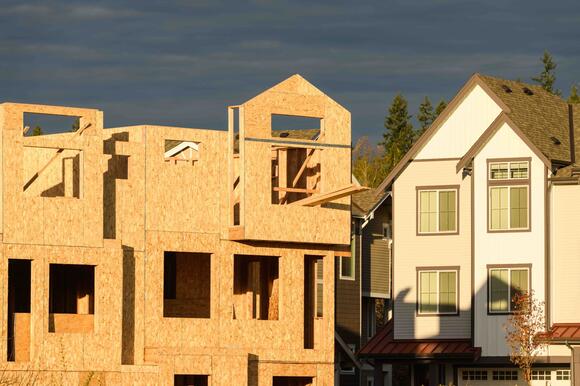
Housing construction in Duvall, Washington in 2021. (Ian Dewar Photography/Shutterstock)
As lawmakers plan for the 2027 legislative session, they will do so amid significant economic uncertainty and difficult choices about the state budget. Meanwhile, Washington’s housing crisis remains unresolved. These challenges are interconnected. A strong economy depends on having enough homes for the people who work here, while homebuilding generates jobs and ongoing tax revenue that support state and local services.
Homebuilders play an important role in supporting our state’s economy, but that contribution cannot be taken for granted. Building homes requires significant private investment, and investment decisions depend on whether projects are financially feasible. Policymakers’ decisions can either encourage investment in new housing or drive it elsewhere.
Good housing policy is essential to economic development. There are practical, tangible policy tools our Legislature can advance in 2027 to expand housing choices, improve affordability and support economic growth. Chief among them are simplifying land division for housing and stabilizing building codes. But just like the tools in any carpenter’s toolbox, nothing will happen unless we pick them up and use them effectively. We don’t need more process because policymakers must make progress decisively on the plans already in place. Washington’s workers and businesses cannot afford to wait for more housing to effectively compete economically.
SUBSCRIBE: GET THE MORNING HEADLINES DELIVERED TO YOUR INBOX.
I am encouraged by Governor Ferguson’s convening of his Economic Development Council and former Governor Gregoire’s leadership at Challenge Seattle, together with the engagement of other state and local leaders. These efforts give me hope that housing will remain central to Washington’s economic conversation.
The benefits of common-sense housing policy extend beyond the walls of a new home. Aneconomic analysis found that every 100 new single-family homes built in Washington generate on-going benefits totaling $6.8 million in income for residents and $2.5 million in state and local tax revenue. The benefits are similar for multifamily construction. Homebuilding not only provides the housing our communities and workforce need; it supports jobs, generates public revenue and contributes to our economic vitality.
As a homebuilder, I focus on building the homes our region needs while navigating an ever-shifting patchwork of regulatory requirements. A major choke point is land. It is very expensive, especially in existing communities near jobs, transit and schools. We must use limited buildable land efficiently. Yet despite recent reforms, the processes governing land division remain unnecessarily complex and often duplicate other requirements.
The Legislature should simplify land division to create a streamlined process that encourages more opportunities for housing within urban growth areas. One practical change would raise the short plat threshold to 30 lots, allowing streamlined land division in urban areas – which have already undergone extensive planning and environmental review under the Growth Management Act – to be approved administratively. This would not change the underlying zoning or how much development is allowed. It would simply make it easier for new homes, including middle housing, to reach the market sooner.
Modernizing the land division process would complement existing state efforts to streamline environmental review, improve permitting efficiency, lower development costs, and accelerate delivery of new homes.
SUPPORT: YOU MAKE OUR WORK POSSIBLE
That commitment to predictability should extend to building codes. Constant code update cycles add cost and uncertainty. A period of stability would give builders, local governments, and consumers greater predictability while allowing time to evaluate the costs and impacts of existing requirements. Five other states have already delayed or adjusted their code adoption cycles to improve affordability and ease implementation. Washington should do the same.
More broadly, policymakers should consider any new regulatory standards for housing in the context of existing requirements. Too often, it is not any single regulation that prevents a home from being built, but the cumulative effect of fees, regulatory requirements, delays, and uncertainty that drives up housing costs and can make otherwise viable projects financially infeasible.
Washington faces difficult choices in 2027. We need more homes people can afford, an economy that continues to create opportunities and sustainable revenues to support the public services our communities rely on. Homebuilding can contribute to all three, but only if we create the conditions that make investment in new housing possible
Builders are ready to do their part. Now we need lawmakers to do theirs by making practical policy decisions that reduce unnecessary costs, restore predictability, and give builders the confidence to invest in Washington’s future.
We have the tools. It’s time to put them to work so everybody has a place to call home.
Trevor Johnson is the CEO & Co-founder of Blackwood Homes, a local homebuilder. He currently serves on Governor Ferguson’s Economic Development Council and is a past president of the Master Builders Association of King and Snohomish Counties.
 Add to Preferred Sources