undefined
Posts
undefined
Followers
Districts around Vermont consider school closures
By Charlotte Oliver,
1 hours ago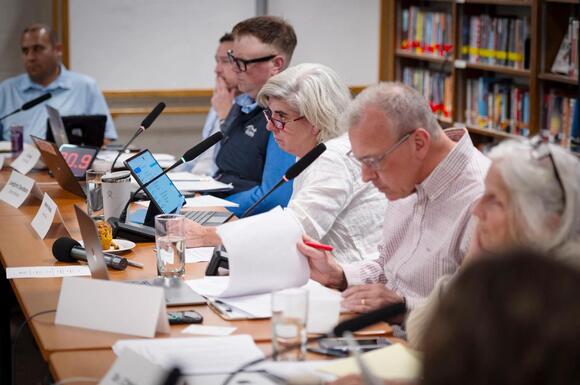
DUXBURY— The Mad River Valley could lose two elementary schools before the next school year due to declining enrollment and state pressure to curb school district spending.
School board members of the Harwood Unified Union School District decided to move forward with possibly closing elementary schools in Fayston and Moretown on Nov. 18. Four board members were brought to tears during the more than three hours of deliberation.
“It is exhausting. Every day I walk into work wondering, ‘Am I going to lose my job?’” said Liz Harris, who works at Moretown Elementary School, during the meeting.
Harris was one of 175 community members who packed the library at Harwood Middle and High School, filling rows of seats and leaning against bookshelves. Dozens of parents, teachers and local business owners begged board members to spare their local schools from closure during a public comment period that stretched on for 90 minutes.
This year, a stricter state mandate for school districts to rein in costs or face tax penalties is driving difficult budget decisions in many districts, according to Cheryl Charles, chair of the steering committee for the Rural School Community Alliance, a Vermont organization that advocates for keeping rural schools open. That pressure, combined with declining enrollment, is leading a handful of districts across the state to consider closing schools.
The process of studying district mergers, as mandated by this year’s education reform law, is just getting off the ground. But a handful of districts offer evidence that districts might opt to close schools regardless of the merger process.
The Hartford School District is considering closing an elementary school. The Paine Mountain School District, which serves Northfield and Williamstown, is considering a plan to close both its high schools. Voters in Cabot will decide this winter whether to close their high school. And the Oxbow Unified Union School District, serving Bradford and Newbury, is seeking community feedback on its school configurations. Toren Ballard, a spokesperson for the Vermont Agency of Education, did not have information on which districts in the state are considering closures.
READ MORE
Twenty schools across Vermont have closed since the 2019-2020 school year, according to data from the Agency of Education.
Vermont isn’t the only state grappling with school closures. More than 100 public schools across the country have closed since last year as districts are confronting dramatic declines in enrollment, according to The New York Times. There are fewer kids in public schools because Americans are having fewer children. And amid the nationwide decline, Vermont has outstandingly low birth rates.
In Vermont schools, K-12 enrollment has declined 26% over the past 23 years, according to data from the state Education Agency. And the state is in the process of transitioning to a new education funding model, which requires high-spending districts to cut costs year over year for the next four years — or risk property tax penalties.
A board under pressure
The Harwood Unified Union School District enrolls about 1,500 kids from Duxbury, Fayston, Moretown, Waitsfield, Warren and Waterbury. This year, the district estimates it needs to make $3.3 million in cuts to its proposed budget to avoid tax penalties.
Schools in the district have seen a 10% decline in enrollment over nine years, according to data from September. Its schools enrolled 37 fewer students this year compared to last year, the data shows.
Vermont is in the process of transitioning to an education funding model that’s directed by the state rather than districts. As part of that transition, the state is compelling districts to rein in spending through a cost containment mechanism called the excess spending threshold.
The state currently sets the excess spending threshold at 118% of the average per-pupil cost of education in Vermont. If districts spend above the per-student cap, the state double taxes residents on the amount spent per-student above the threshold.
Legislation passed this year lowers that spending threshold year after year, putting high-spending districts on track to spend less and less annually to avoid tax penalties.
The Harwood district currently operates elementary schools in Waterbury, Warren, Waitsfield, Moretown and Fayston. During the Wednesday board meeting, dozens of locals made their case for how the district should make its budget cuts.
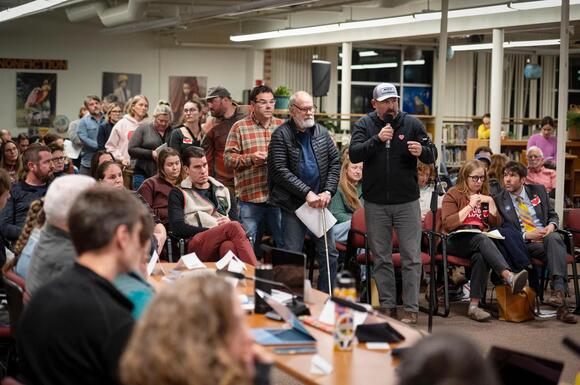
Matt Williams said that Moretown Elementary School’s environmental programs have had a huge impact on his son’s learning. His son comes home from school excited and talking about the history of the land, he said, and when they go on hikes he enjoys examining stone walls.
“That connection in Moretown is really special,” Williams said.
Residents and board members also heard a cautionary tale from someone outside the district. Tom Frazier, of Roxbury, said the closure of the Roxbury Village School in 2024 has rattled his community in the years since.
“In Roxbury there are no people having kids,” Frazier said. A handful of families with young kids moved to Montpelier after the school closed, he said, and the town’s lack of an elementary school deters young families from moving in. Some young families who remain in town have chosen to homeschool their kids to avoid long bus rides, he said.
“You should just pay the penalty, keep the schools open,” Frazier said as the room erupted in applause.
Deliberating closures
The board spent more than three hours debating the pros and cons of closing each elementary school.
Early in the conversation, there was consensus that Fayston Elementary School, which enrolls the fewest kids and is the most geographically isolated, was the most obvious choice for closure. But board members had a harder time deciding on a second school to propose closing. They debated whether it was better to close schools in Moretown or Waitsfield, which have similar numbers of classrooms and students.
After hours of discussion, a majority of board members said they favored keeping the Waitsfield school open because it has a full kitchen, its building is easier to expand and it’s in a walkable village hub.

Board members also considered the Waitsfield school’s resilience to natural disasters, namely flooding.
The Moretown school was more practical to close, board members said, because it’s in a FEMA flood plain. The building lacks a backup generator, and its structure would be difficult to upgrade, board members said.
Having chosen the Moretown and Fayston schools for potential closure, the board is required by the district’s articles of agreement to hold a series of community meetings before taking a vote on school closures.
The board plans to hold meetings in Moretown, Fayston and Waterbury in the first two weeks of December to hear from community members. The school board needs two-thirds of its members to approve of any closures.
Read the story on VTDigger here: Districts around Vermont consider school closures .
 Add to Preferred Sources
