undefined
Posts
undefined
Followers
CDBIA builds on session's success
By STAFF REPORT,
2025-08-06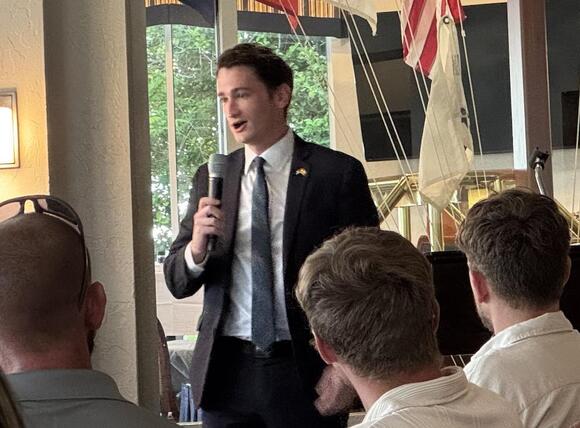
PORT CHARLOTTE — More than 150 business leaders, public officials and community advocates gathered Tuesday night at the Charlotte Harbor Yacht Club for the Charlotte-DeSoto Building Industry Association’s general membership meeting, where lawmakers and industry leaders provided an update on Florida’s 2025 legislative session.
The event reflected the mission of the Florida Home Builders Association and its local affiliates — like the CDBIA — which promote homeownership and foster an environment where the building industry can thrive.
Tuesday’s gathering showcased the area’s building industry encompassing more than builders and contractors. It included educators, bankers, lawyers, engineers, nonprofit organizations, local government and more.
“For local communities such as ours, the availability of attainable housing is foundational to solving other social challenges,” Charlotte-DeSoto Building Industry Association President Jaha Cummings said.
The CDBIA is a coalition of public, private and philanthropic members working together to shape the future of Charlotte and DeSoto counties.
The evening’s program featured speeches from FHBA President Ryan Benson, state Sen. Jonathan Martin and state Reps. Vanessa Oliver and Danny Nix, who emphasized how decisions made in Tallahassee this year have driven regional investment and opportunity.
Benson emphasized the need to streamline building permitting, eliminate bureaucratic hurdles and protect the rights of licensed professionals to work without excess government interference.
“Contractors are the only dually licensed state professionals that have to wake up every morning and ask the government if they’re allowed to do their job,” Benson said. “That is ridiculous.”
Martin, whose district includes coastal Lee County, commended the builders and industry advocates for staying involved.
“I applaud you all for being involved in your building organization. If it wasn’t for you, I wouldn’t hear from your lobbyists and government relations people in Tallahassee about the issues that are affecting you,” Martin said. “You are making a difference.”
Reps. Oliver and Nix showcased the tangible local results of this legislative session, where the state government made more than $10 million in direct investments to Charlotte County for infrastructure, housing, education and emergency response.
They spoke of some 2025 Legislative Session highlights for Charlotte and DeSoto counties.
Led by Nix, $8.175 million was secured for infrastructure and safety upgrades that include:
Upgrades to traffic signals near Education WayTwo high-water rescue vehicles, each capable of transporting 25 people and emergency gearReplacement of the temporary South Gulf Cove Boat Lock with a permanent structure
Led by Oliver, additional funding include:
$1.75 million for the Southwest Florida Advanced Training Center to train students in high-tech manufacturing careers. This is part of a broader CDBIA mission to keep talent in Charlotte County and strengthen the workforce pipeline.$2.5 million for the Charlotte County Flood Monitoring and Response Network to provide real-time storm and flood data$2 million for the Akerman Septic-to-Sewer Conversion (Phase 2), improving water quality$581,000 for a high-water rescue vehicle for the city of Punta Gorda$36,307,690 for DeSoto County High School$5 million for DeSoto County effluent disposal$3 million for the expansion of Kings Highway$1 million for the DeSoto County fire training tower
FHBA priority issues signed into law by Gov. Ron DeSantis, include:
Impact Fee Accountability (SB 1080 / HB 579). Local governments must now justify large impact fee increases with a unanimous vote and phase them in over time. This change seeks to prevent sudden, unpredictable fee hikes that may make housing less affordable.
Expanded Access to Mitigation Banking (SB 492 / HB 1175). Developers will be able to access wetland mitigation credits from adjacent service areas if none are available locally.
Platting Process Overhaul (SB 784 / HB 381). Local governments are now required to quickly review and administratively approve plats and replats, eliminating delays and uncertainty in the land development process.
Emergency Recovery Provisions (SB 180 / HB 1535). After natural disasters, homeowners can now rebuild without paying new impact fees if they are not increasing infrastructure demand. The bill also prevents local governments near a storm event from blocking or stalling recovery efforts.
Live Local Act Expansion (SB 1730 / HB 943). Affordable housing developers can now build on religious institution land and within flexible zoning districts. The law also restricts moratoriums that cities could use to delay multifamily housing — further supporting housing supply and affordability.
Construction Regulation Modernization (SB 712 / HB 683). This broad bill simplifies construction rules by: standardizing synthetic turf regulations, limiting financial paperwork required for permits, requiring faster responses to change order requests and expanding the role of private building inspectors.
Protection from Utility Fees (SB 1002 / HB 1137). Local governments and utilities are now prohibited from charging extra fees based on the energy source (like natural gas) that a builder or homeowner chooses — preserving energy freedom and cost transparency.
 Add to Preferred Sources