undefined
Posts
undefined
Followers
Talking tarpon: Bonefish & Tarpon Trust work to restore habitats
By JESSICA ORLANDO,
2025-01-29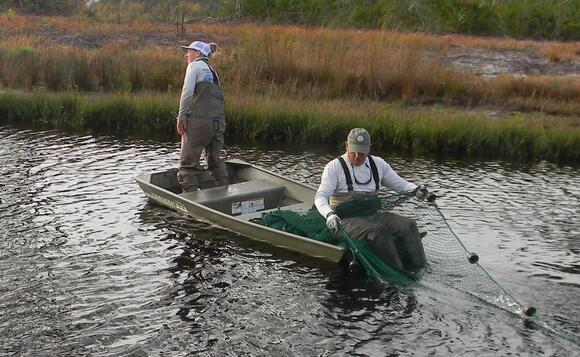
ENGLEWOOD — The Bonefish & Tarpon Trust dedicates its time and resources to conserving the habitats of tarpon, bonefish, snook, red drum (redfish), permit and other species of fish across the southeastern Gulf of Mexico and Caribbean Sea.
In and around Lemon Bay, Charlotte Harbor and Boca Grande, JoEllen Wilson helps with restoration efforts as a part of the trust’s Juvenile Tarpon Habitat Initiative.
Wilson talked about habitat research and restoration efforts.
“BTT is a nonprofit organization,” Wilson said. “Everything we do is science and research based for the sole purpose of conservation.”
Wilson has an angling background. She grew up fishing in Charlotte Harbor, thinking she would be a fishing guide.
“They get up way too early," Wilson joked, "and they also don’t do a ton of fishing.”
Her experience as a homegrown Charlotte County native provided Wilson with familiarity with the local habitats that she uses daily for the Juvenile Tarpon Habitat Initiative.
TARPON LIFECYCLE
It makes sense to be concerned about the area’s local waters, especially when they’re an important aspect of the area’s economy and tourism.
“Florida’s recreational saltwater fishery generates over $11 billion each year, but this depends on how healthy and available habitat,” she said. “Florida has already lost about 44% of wetlands.”
Additionally, Wilson said, 50% of mangrove habitats have been lost around the state. That’s pretty important when tarpon rely on mangroves for food and habitat.
“Tarpon actually spawn offshore,” Wilson said. “Because we have the continental shelf, they have to move about 80 to 100 miles offshore, and this is in the summer during the full and new moons.”
A female tarpon can actually lay around a trillion eggs in her lifetime. Tarpon larvae pretty much just go with the flow since they have minimal swimming abilities, spending about 30 days in that larval stage.
“Then they’re moving back into the estuary and up into these tidal creek systems, as far as they can move up,” she said.
Transitioning into a juvenile tarpon means they’re sticking around hot, buggy and sometimes stinky waters, said Wilson.
“This is my office where I’m spending most of my time,” Wilson said. “Tarpon are catch-and-release, so they’re not managed by our state fisheries management agencies.”
HABITAT THREATS
Juvenile tarpon habitats face several different threats.
“These habitats are most vulnerable, because they’re closest to us,” she said.
Nutrient runoff, septic leaching, altered freshwater flows, habitat degradation or alteration and total habitat loss are threats to juvenile tarpons, according to Wilson.
“The Bonefish & Tarpon Trust has spent a lot of time researching pharmaceuticals within our fish,” she said.
They found, statewide, two to four different pharmaceuticals in redfish.
“Some of those were at a full-strength dosage and quite a bit was in the muscle tissue that we’re eating,” she said. “That kind of stuff matters — not just to the fish, but also to us.”
The Trust takes a look at fishery management in a different way. Whereas state and federal agencies focus on restricting harvest rather than increasing stock, the Trust does the opposite, focusing on habitat conservation.
In that solution framework, Wilson said the trust looks at restricting all those concerns mentioned above.
PROTECT AND RESTORE
“If we’re going to conserve these habitats, first we have to identify the habitat,” she said. “Since 2016, we’ve been working with anglers and residents really to find these locations.”
The tarpon in question are 12 inches or less. Several of those habitats are mapped around Charlotte County, including sites recommended for protection and degraded sites prioritized for habitat restoration.
When looking at habitat restoration, Wilson uses the fish as a quantifying metric.
The Lemon Bay Conservancy owns and manages the Lemon Creek Wildflower Preserve in Enlgewood, which is a former 18-hole golf course. It's just off Placida Road near Rotonda West
Wilson looked at early life history metrics of fish to measure the habitat there.
“Growth rates are arguably one of the most important features for juvenile fish,” she said. “The faster you grow, the more things you can eat — and the fewer things can eat you.”
The preserve had extremely slow growth rates, and the fish were moving out of the system at a much smaller size then they should be. According to Wilson, tarpon should be growing eight to 10 inches a year, but these fish were growing at one inch a year — if that.
“Not all habitat is good habitat,” she said.
The Trust looked at nearby Coral Creek, which flows south of Rotonda and into Gasparilla Sound at Placida, for habitat restoration designed to test habitat characteristics.
Data from the organizations sampling will help future restoration projects.
“This was a collaboration with several different agencies, which is happening more and more,” Wilson said.
From their sampling and research, The Trust came up with three treatments.
One involved still access with a deep hole used by the fish as a temperature refuge. This treatment can only be accessed at high tide or during certain times of the year.
The second is the same thing, but with open passage, meaning constant fish passage.
The third treatment is basically just a shallow meandering marsh with limited passage.
“We would sample monthly,” Wilson said. “Every fish would get a tag. And if it already had a tag, we could scan it and see when we tagged it before.”
The team did 16 months of monitoring and sampling, noticing that all treatment options doubled the growth of both snook and tarpon.
“We know effectively that we can restore nursery habitat,” she said.
The isolated shallow meandering marsh had the fastest growth out of all options, while that open access with a deep hole saw the most immigration. In future studies those two treatment options will be combined.
So, what’s next?
With a map that tells the Bonefish & Tarpon Trust where to protect and where to restore along with nursery restoration research, Wilson said it’s time to apply the knowledge by restoring six additional sites in Charlotte County, all on the Cape Haze peninsula.
“Ultimately, without healthy habitats, we don’t have healthy fisheries,” she said.
 Add to Preferred Sources
