undefined
Posts
undefined
Followers
Metra asks STB to require infrastructure projects, on-time protection as part of merger
By David Lassen,
18 hours ago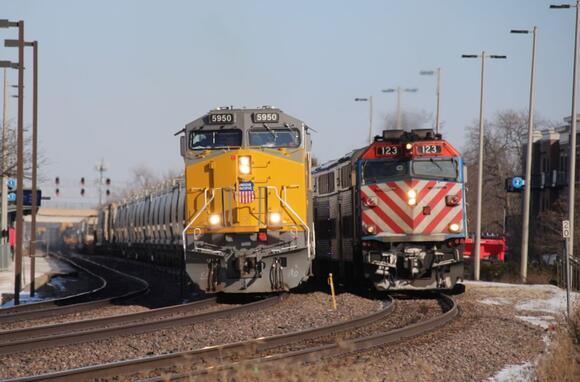
WASHINGTON — Chicago-area commuter operator Metra has asked regulators to reject the Union Pacific-Norfolk Southern merger, saying the merger application does not show that the combined railroad could handle additional freight traffic without adversely affecting passenger service.
Metra’s filing says the merger application’s contention that existing infrastructure can handle increased freight and commuter traffic reflects “significant errors, omissions, and unsupported assumptions;” that the UP and NS analysis of capacity is insufficient; and that the application’s failure to include the Chicago area in plans for infrastructure improvements is significant. If the merger is approved, Metra seeks conditions including two major infrastructure projects and a requirement for 95% on-time performance on its UP West and SouthWest Service lines.
Other commuter operators have also raised concerns. NJ Transit says the merger does not meet the public-interest standard unless it includes conditions to protect service on its Raritan Valley Line, while the Southeastern Pennsylvania Transportation Authority seeks conditions addressing service on its Norristown Line.
Metra challenges capacity estimates
Metra’s filing shows restraint by not referencing the commuter operator’s long-running and contentious contract dispute with UP, a matter currently before the board. But it is highly critical of how UP and NS arrived at the conclusion that they have sufficient capacity for both commuter operations and expanded freight traffic.
UP and NS “used a capacity planning tool, not an operational simulation, in their impact analysis,” Metra says, adding that Rail Traffic Controller modeling, a standard industry tool, can address operating factors while the UP-NS method cannot. Metra notes that the STB highlighted this deficiency in its review of the original merger application and called for a dispatching plan and “train modeling evidence showing passenger rail impacts (or the lack thereof),” but that UP and NS did not provide that material.
Metra says the UP-NS approach “create[s] the illusion of unused capacity” through measures such as blending of weekday and weekend service and use of average rather than peak freight conditions. It also does not account for future Metra service growth, although Metra has helped fund a third-track project on the UP West line with the goal of increased service.
Metra’s filing also notes that while the merger application calls for $932 million in improvements to address merger-related growth, none is in Chicago, which the commuter operator says “is not a spoke in this proposed transaction; it is the operational center.” That decision is a factor in its request that conditions for merger approval include a flyover at Proviso Yard to separate passenger and yard freight movements, and the lowering of one track of the UP West line at West Chicago, where UP and Canadian National main lines cross.
Metra notes that the merger plan calls for 14 daily trains between Proviso and Kedzie, just west of downtown Chicago; five more between Proviso and Elburn, the western terminus of UP West commuter service; and increased traffic at the Global 2 intermodal terminal at Proviso. At West Chicago, an agreement between CN and UP would see 10 to 12 trains routed between the UP line and CN’s Elgin, Joliet & Eastern route via a low-speed connection that Metra estimates could block the UP main line for approximately 20 minutes per train.
The two capital projects, Metra says, “are narrowly tailored solutions for two demonstrated choke points that Applicants’ proposed traffic would exacerbate. … [B]oth would facilitate freight movement while protecting Metra and its riders from the resulting congestion and service risks.” UP has previously proposed and developed the Proviso flyover concept with Metra, which says it is willing to participate in “reasonable cost-sharing.” The provision requiring 95% on-time performance should be “mandatory and enforceable on a permanent basis,” Metra says.
NJ Transit concerns
NJ Transit seeks conditions protecting its operations on the Conrail-dispatched Lehigh Line, used by its Raritan Valley Line between Roselle Park, N.J., and Newark. The route is shared with NS, CSX, and Conrail trains. NJ Transit says it carries 14,150 passengers on that route on a typical day and 4.4 million per year.
The merger application calls for three new pairs of daily intermodal trains on that segment, which NJ Transit says represent an almost 50% increase in NS traffic and a nearly 30% increase in overall freight moves, excluding locals. Also, trains on the less-used Port Reading Secondary will increase from 2.6 to 6 per day, and those trains may frequently require rerouting via the Lehigh Line.
As a result, NJ Transit says, the merger will cause “severe delays” to Raritan Valley Line passengers. The agency also points to the lack of operational modeling by UP and NS; says they have no backup plans for service deterioration; and that they “have refused to mitigate or address” the impact of those delays. It therefore seeks five conditions to protect commuter operations, including:
- Restrictions on freight operations by the merged railroad between the peak periods of 6-10 a.m. and 4-8 p.m.
- Establishment of performance standards and enforcement mechanisms.
- UP-NS funding of capacity improvements, or financial support of improvements undertaken by NJ Transit, such as two additional tracks in the shared trackage area.
SEPTA’s Norristown Line
SEPTA does not take a position on whether the merger should be allowed, but is critical that the application does not address delays that will occur because of longer trains after the merger.
“Applicants should not be allowed to ignore this issue now only to railroad SEPTA later into enduring deteriorated service and limits on future growth of its passenger rail service,” the agency says in its filing. It asks for conditions that would initially limit longer freight trains to a 12:30-5 a.m. window, while in the long term requiring the merged railroad to fund capital improvements creating physical separation of freight and passenger traffic.
SEPTA’s concern focuses on its Norristown Line, which currently handles 53 weekday and 38 weekend Regional Rail trains and also carries NS traffic via a trackage-rights agreement. The merger application indicates that this route will carry 61% more carloads with no additional trains.
— To report news or errors, contact trainsnewswire@firecrown.com.
 Add to Preferred Sources
