undefined
Posts
undefined
Followers
Switch installation celebrated at Pullman historic park
By David Lassen,
2 days ago
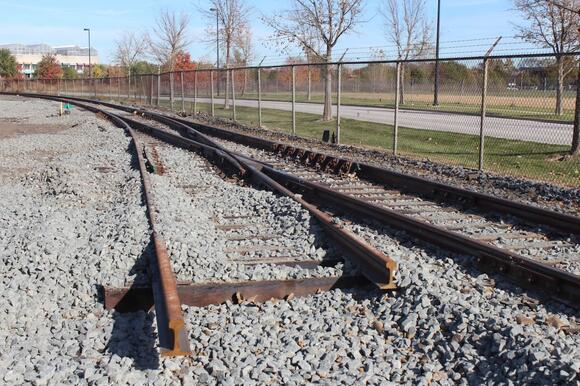
CHICAGO — Visitors to the 19th-century Pullman factory complex on Chicago’s South Side frequently ask, “Where are the railcars?” The first step in eliminating that question took place when Norfolk Southern recently reinstalled a switch on an industrial lead two blocks east of the site that was once the conduit in and out of the sprawling plant.
Next, a track will be relaid from there along the north side of 111th Street, now a grassy parkway, to a planned building to display vintage Pullman equipment. Norfolk Southern is contributing $250,000 to the venture.
On Monday, Nov. 9, Friends of the Pullman National Historical Park staged a “Setting the Spikes” event. Local dignitaries were invited to don protective gear before bringing sledgehammers down on a track slab NS placed in a parking lot nowhere near where the real track will be constructed. The ceremonial spike driving kicked off what will likely be at least a decade of fundraising to again link the factory site with the U.S. rail network and restore vintage railcars more than 100 years old.
“Simply allowing a switch to be installed off of a [Class I railroad] — these are the type of things that just don’t happen; it’s a really big deal,” Joe Szabo explained to the group while presiding as emcee for local political, labor, and Friends speakers.
Szabo, the former Federal Railroad Administration administrator and president emeritus of the nonprofit group, says the connection will terminate at a glass-enclosed display building with up to five tracks on a grassy area in front of the still-damaged Rear Erecting Shop. “There was no building back then,” he says, “but this is where George Pullman used to show off just-completed railcars.”
Long-term plans call for reconstructing the transfer table that moved cars between buildings. Those tracks, long overwhelmed by vegetation, are still visible.
Szabo tells Trains the initial Pullman products slated for repatriation include:
- The Glen Ayr. The 1928 sleeper owned by the Friends group that was among the first all-room sleepers built when Pullman was transitioning away from open sections.
- A wooden 1899 Rock Island parlor car. Tentative plans being coordinated by the Illinois Department of Natural Resources and National Park Service call for this car to return to the North Wing venue where it was constructed rather than the planned display building.
- 1911 open-platform business car Advance. It was used by Pullman president Robert Todd Lincoln, who assumed the company’s leadership role following the 1894 strike that helped trigger the U.S. labor movement. Owned by Illinois, Szabo says it is currently stored at Railroading Heritage of Midwest America’s former Rock Island shops in Silvis, Ill. “We are assisting the state with grant applications, and our consultant David Duncan is giving guidance in getting historic [details] right,” Szabo says.
Szabo estimates that equipment restoration efforts may run as high as $4 million per car. More information about the Friends group is available at its website.
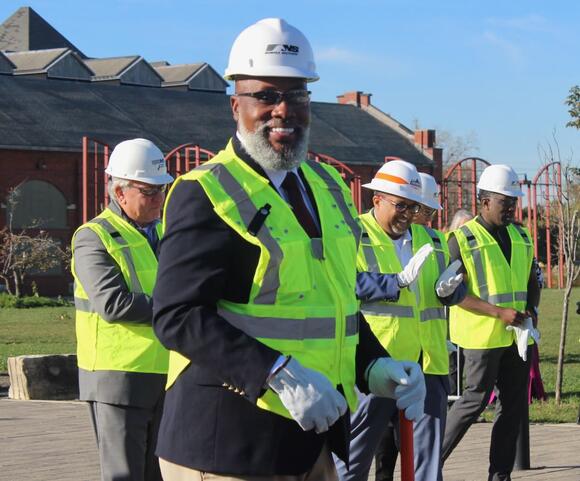
Norfolk Southern’s representative at the event was Chicago-based senior road manager Willie Mills. He grew up just west of Pullman and studied electrical engineering at Chicago State University before being hired as a railroad clerk, moving to operations as a conductor at NS, and rising to 20 years as a locomotive engineer. Qualified on the railroad’s former Nickel Plate Road as far east as Bellevue, Ohio, he also handled Chicago transfer runs to all western connections.
“The tracks and spikes we see today represent a vision becoming a reality,” Mills told the group, adding, “A railroad spike may be small, but what it helps secure can last for generations.”
— To report news or errors, contact trainsnewswire@firecrown.com.
 Add to Preferred Sources
