undefined
Posts
undefined
Followers
Amtrak's Mardi Gras more than doubles predicted patronage after one year: Analysis
By David Lassen,
2026-08-18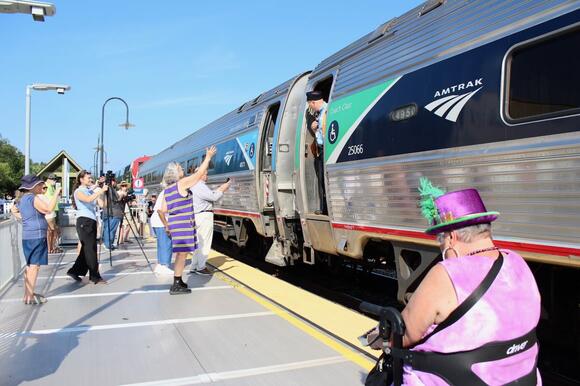
NEW ORLEANS — When two New Orleans-Mobile, Ala., round trips began on Aug. 18, 2025, many observers wondered whether the enthusiasm from the previous Saturday’s raucous inaugural events would translate into strong and sustained daily patronage.
Guess what? It did.
Southern Rail Commission and Amtrak personnel are celebrating the one-year anniversary of Amtrak’s Mardi Gras Service by announcing that the trains have more than doubled pre-launch estimates of 71,000 annual riders. First-year ridership is projected at more than 150,000. Along with staging media events along the route today (Aug. 18, 2026), the company is giving out commemorative pins, cups, and anniversary certificates to passengers on morning train Nos. 23 and 24.
Elements of success
The Mardi Gras’ early success has been previously reported [see “Trains’ top stories of 2025, No. 4: Mardi Gras service debuts,” Trains.com, Dec. 28, 2025, and “The Mardi Gras phenomenon,” Trains Magazine, May 2026]. Generally limited to two Amfleet II coaches and a cafe/business class Amfleet I, the trains immediately filled a public transportation void. Tourist bureau promotion helped drive customers, many from out of the region or the country, while friendly crews exuding a local flavor made everyone aboard feel welcome.
Credit must go to Amtrak mechanical, operating, and onboard service teams in New Orleans and Mobile directed by District Manager Richard Hullender. The trains have consistently led the pack in high company-wide Customer Service Index scores.
Knox Ross, chairman of the Southern Rail Commission — the Gulf Coast organization that has been advocating for passenger trains since 1982 and now evaluates day-to-day operations — says the service has benefitted from extraordinary word of mouth.
“Along with the three major tourism organizations,” Ross told Trains, “I think the social media ‘Friends of Amtrak Mardi Gras’ Facebook page is the thing that’s made the biggest difference. They answer questions like, ‘Where do I park my car?’ or ‘Where do I get off at the various stations?’ And then vendors start posting their offerings, such as golf-cart rentals or van services to go the last mile. It’s real-time information, all right there. I can’t overstate how much that has helped the service.”
Lessons learned
That’s not to say there haven’t been challenges or that some strategy might have been handled differently.
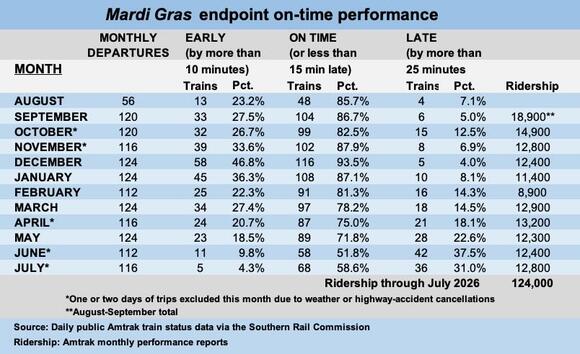
The table above shows one notable dip in monthly ridership — during the month of the carnival season that gives the service its name. With sold-out trains taking fans to New Orleans Saints home games providing proof of surging demand, the SRC requested an additional coach during Mardi Gras season [see “Amtrak’s Mardi Gras gains capacity …,” Jan 9, 2026]. Meanwhile, Amtrak strategists initially raised advance pricing on major event days. It didn’t take long to see that bookings were falling short, and ticket costs were soon adjusted downward, then rose again as individual trains sold out.
Jay McArthur, Southern Rail Commission’s executive director who served as an Amtrak regional manager for decades, admits, “If you add another coach you add allocated equipment cost. I don’t think the revenue outpaced the added cost; what you can do is revenue-manage up the ticket prices as you get higher demand. States can then consider adding capacity if it’s available.”
Another challenge: highway crossing collisions. As Brightline experienced when it launched passenger service on previously freight-only South Florida tracks, the presence of fast passenger trains speeding across the route’s more than 170 public and private crossings four times per day has resulted in incidents that disrupt service.
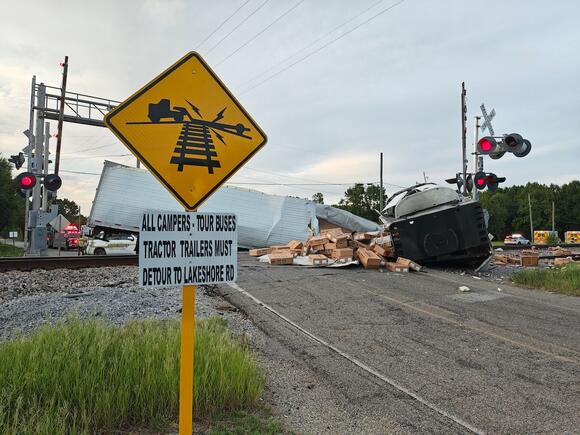
Amtrak embarked on a public information campaign before service began, and as late as Aug. 7, the company held a “Safety Train the Trainers” briefing hosted by Amtrak police at Gulfport’s Mississippi Gulf Coast Community College. Later that afternoon, a semi-truck driver ignored warning signs and abandoned his trailer of frozen beef hearts on the raised Claremont Boulevard crossing in rural Hancock County, where it was decimated by New Orleans-bound train No. 25. Though there were no serious injuries, buses had to be called, and Saturday morning train No. 23 from Mobile also required a bus substitution.
On-time performance
Aside from driver errors, perhaps one reason those crossing collisions occur is that CSX’s New Orleans-Mobile main handles relatively infrequent freight trains.
As the table shows, the railroad’s dispatchers were able to keep the Amtrak trains on time, even early, through most of the past year. This was achieved by not sending out miles-long freights too long for sidings during the two daily four-hour periods when the passenger trains operate in each direction, Amtrak and SRC sources tell Trains, although CSX did not confirm, that the schedules (which allow three hours, 43 minutes for a 145-mile trip) added generous amounts of recovery time. This was to ensure punctuality during the period before capacity improvements take place. That $240 million in federally financed infrastructure work before construction of $240 million of federally financed capacity improvements was agreed upon by all parties as part of a still-unreleased agreement.
Evidence that the schedules work is confirmed by on-time performance of 80% or greater through February. During the same period, 22% to 46% of trains arrived 10 or more minutes early at their endpoints.
Timekeeping slips
The table also shows that on-time performance has deteriorated over the last few months. Anecdotal evidence obtained by Trains from Amtrak daily operations reports shows that passenger trains are delayed the most when they are forced to follow or meet a CSX freight. The SRC’s McArthur, who tracks each train’s arrivals and departures from Amtrak data, has also seen delays increase into and out of New Orleans and Mobile.
In a statement to Trains, CSX says, “Service variability is influenced by seasonal operating conditions, including heat-related restrictions and weather events, especially around larger terminals. These are industrywide challenges that can influence service performance across multiple rail corridors. However, the service period mentioned does not have a baseline comparison to last year.”
The railroad has proposed schedule adjustments in which all of the recovery time is placed at the end of the run, giving the railroad the option to hold an ahead-of-schedule arriving train to perform switching moves. That would allow CSX to earn an on-time performance bonus, but these are the kind of delays that infuriate passengers. This is especially problematic at the New Orleans end, where congestion caused by a disabled train on the “Back Belt” between Gentilly Yard and the station can crop up.
As SRC’s McArthur says, “Amtrak has given CSX a workable schedule and the railroad has shown they can run the trains on time.”
Improvements coming
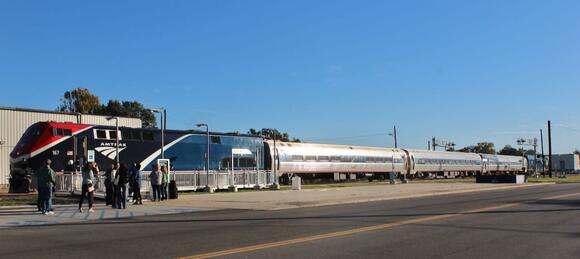
According to CSX, design on all infrastructure projects is 30% complete, and timeline for their completion remains tentative, since Amtrak only awarded the contract for environmental assessments on July 31. Five of those investments will create a Gentilly bypass and lengthen four intermediate passing tracks up to 14,000 feet.
Despite the recent blip in on-time performance, patronage remains resilient. Most trains continue to arrive early at stations. Construction of permanent platforms and weather-shielding canopies is progressing under Amtrak’s direction, which will improve the customer experience. After a year of operation, Mardi Gras’ momentum is poised to continue.
— To report news or errors, contact trainsnewswire@firecrown.com.
 Add to Preferred Sources
