undefined
Posts
undefined
Followers
Wyoming Valley Interfaith Council honors 3
By Mary Therese Biebel[email protected],
5 days ago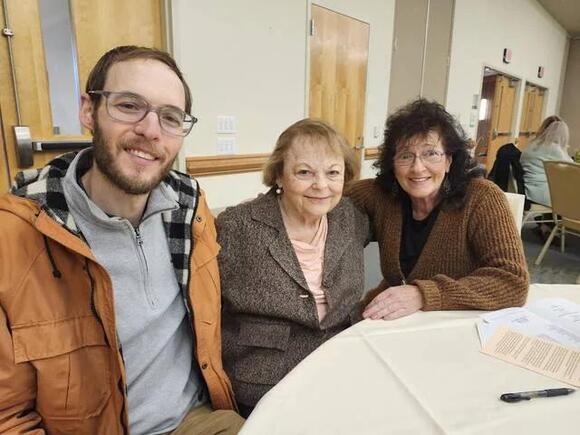
Namita Penugonda and her sister, Sarita Hanchate, listened enrapt early Monday afternoon as their one-time neighbor, Sandy Platsky of Wilkes-Barre, told them a story about their father that they had never heard before.
“My husband had to be out of town for eight out of 10 weeks, and I was home alone with the children,” Platsky said, looking back over the decades. “Every single night that my husband was away, Dr. (Haragopal) Penugonda would call me at 8 o’clock to make sure that I was all right, that the children were all right, and ask did I need him to come over and do anything.”
“We didn’t know that until 20 minutes ago,” said Namita Penugonda, who was touched to hear yet another example of her father’s kindness.
Moments later, Penugonda accepted a citation of distinction, awarded posthumously to her dad, during the Wyoming Valley Interfaith Council’s 46th annual Community Interfaith Luncheon.
Held at the Friedman Jewish Community Center in Kingston, the luncheon was a time of sharing many stories, sometimes by speakers at the podium, sometimes by families and friends sitting at round tables.
This year the Interfaith Council honored three individends who lived their faith — community leaders Penugonda and Howard Grossman and Rabbi Daniel Swartz of Temple Hesed in Scranton.
“Should I be worried?” Swartz said with gentle humor, acknowledging that he was the only one of the three honorees to still be alive.
As Miriam “Tobi” Grossman of Pittston prepared to accept a citation of distinction on behalf of her late husband, she recalled meeting Howard Grossman in the 1950s.
“I met him when I was 16,” the former Tobi Balin said, recalling how she worked as a children’s counselor at the same summer resort where her future husband was a waiter working his way through Rutgers University. “We waited until I was 19 to get married.”
While she didn’t attend college at a traditional age, her husband, “always a teacher at heart,” encouraged her to earn a degree in art from Misericordia University later in life.
Howard Grossman, who shared close to 70 years with Tobi before his death in January, held many leadership roles in the community, not only with the Grandparents Raising Grandchildren organization, which he founded; but also with the Pittston Memorial Library, the Wyoming Valley Art League and many others.
He served as executive director of the Economic Development Council of Northeastern Pennsylvania, spearheaded efforts in the 1990s to advocate for keeping Tobyhanna Army Depot open in the face of budget cuts, and later served as executive director of Jewish Family Service of Greater Wilkes-Barre.
In speaking about Grossman, Rabbi Larry Kaplan from Temple Israel talked about how “tradition tells us we will someday face a series of questions” about how we lived our lives, and he joked that the honoree had raised the bar.
Now, Kaplan suggested, people giving an account of their lives might have to say, “Well, I’m no Howard Grossman, but I tried.”
Another award winner who set a high standard was Dr. Haragopal Penugonda, a well-known local urologist and former member of the Interfaith Council who had grown up in India.
It was his father, who had been a judge and ran a brick company, who instilled in him “an openness to embracing people of all faiths,” Namita Penugonda said, noting that her grandfather entertained Western missionaries, who wanted to spread Christianity in India, in his home, offering “coffee, tea, a meal, friendship,” while holding fast to his own Hindu faith.
Her father, in turn, was a role model for his children, always “very kind, very compassionate, dedicated to his patients” and generous to charities in the United States and in India, Penugonda said.
The third honoree of the day was Rabbi Daniel Swartz, spiritual leader of Temple Hesed in Scranton who, as Ed Snitko introduced him, is well-known for his work in interfaith affairs, support for the LGBTQ+ community, and protection of the environment, “with sincerity and love for all God’s creatures.”
Recognized as an expert on faith and the environment. Rabbi Swartz has participated in interfaith climate change dialogues at the Vatican and has spoken at global environmental gatherings. He is the author of the children’s book “Bim and Bom: A Shabbat Tale” and the lead author and editor of “To Till and To Tend: A Guide for Jewish Environmental Study and Action.”
Swartz, in his remarks, alluded to the continuing need to work for social justice, quoting 19th-century orator Frederick Douglass who criticized churches in 1850, “with fractional exceptions,” for not actively opposing the Fugitive Slave Act which forbade helping runaway slaves in any way.
 Add to Preferred Sources