undefined
Posts
undefined
Followers
Coastal Caucus hosts economic summit
By Will Chappell,
1 days ago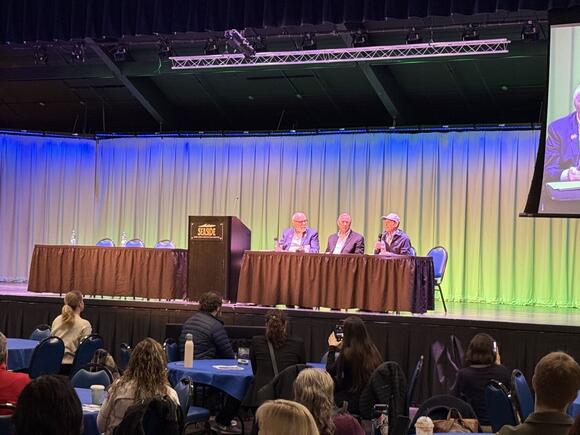
More than 200 local, state and federal elected officials, government agency staffers and businesspeople gathered at the Seaside Convention Center on October 29, for the Oregon Coastal Caucus Economic Summit.
Throughout the day, presenters discussed different aspects of the coast’s economy, ranging from tourism to mariculture in keynote speeches, while discussing challenges to and opportunities for future innovation.
Coastal Caucus Vice Chair Senator David Brock Smith welcomed attendees to the summit on behalf of Representative Court Boice, the caucus’s chair, who was unable to attend the conference due to illness. Smith read a statement recognizing Senator Suzanne Weber and Representative Boomer Wright, both of whom are leaving the legislature at the end of the year and recognized the dozen or so state legislators who were in attendance, including Senate President Rob Wagner.
Smith then pivoted to the summit’s purpose, saying that the coast is not merely a postcard for the state but a meaningful contributor to its economy. The state’s fish economy brought in $517 million in household income for more than 10,000 Oregonians statewide last year, Smith said, with total economic activity topping $1 billion, while the tourism economy, to which the coast is a major contributor, generated $14.5 billion in economic activity statewide.
Workforce shortages, infrastructure challenges and other issues particular to the coast face local economies, Smith said, with the summit convened annually to give policy makers and industry leaders a chance to step outside Salem to identify what’s working and what isn’t when it comes to advancing the coastal economy. Smith said the coastal caucus had a long history of achieving results on a bipartisan basis, pointing to the Pacific Coast intermodal Port project in Coos Bay receiving $205 million in federal funding as an example.
Smith then turned the stage over to Weber, who introduced Travel Oregon Executive Director Kate Sinner to discuss the economic impact of tourism on the coast.
Tourism
Sinner introduced herself, saying that she had grown up in Washington taking trips to explore the Oregon Coast with her family and would be discussing the impact of tourism and the support Travel Oregon provides to local communities.
Travel Oregon is the state’s official tourism office, formed in 2003 to establish Oregon as a destination for business and leisure travel. The organization receives funding from the statewide transient lodging tax (TLT) and aims to bring tourists into the state while helping communities be the best they can, Sinner said.
Of the organization’s approximately $40 million annual budget, 30% of funding is invested in Oregon communities, with 65% of funding going to other efforts, mostly promotion and asset development, Sinner said. Travel Oregon sends around $2.2 million to the Oregon Coast Visitors Association annually to help with those efforts on the coast.
Since Travel Oregon was founded in 2003, Sinner said that travel spending in the state has more than doubled, with the tax revenue generated nearly tripling, positively impacting the state, with an outsize benefit to the coast.
The $14.5 billion in statewide economic activity generated by visitors last year helped to support 123,000 jobs, with the coast accounting for $2.6 billion in activity and 26,000 jobs. Broken down further, the north coast, consisting of Clatsop and Tillamook Counties saw $941 million in visitor-generated economic activity and 9,800 jobs generated by tourism, the central coast, Lincoln and Lane Counties, saw $1.07 billion and 10,880 jobs, and the south coast, Douglas, Coos and Curry Counties, saw $579 million and 6,070 jobs.
Out of $5 billion in direct travel spending across the state in 2025, Oregonians accounted for 37%, other Americans accounted for 57% and international visitors comprised the remaining 6%. Sinner said the last figure represented a drop from the pre-pandemic era, when international visitors regularly made up 10-12% of spending.
In terms of visitor numbers, the 558,000 international tourists that visited the state last year represented 14% fewer than in 2024 and 25% fewer than in 2019. Canadian visitors, by far the largest cohort, were down 25% from 2024, with coastal Canadian visitor numbers down 43% year over year.
Sinner then broke down visits seasonally, saying that 32% of tourism spending had occurred in the summer, with 25% in the fall, 24% in the spring and 19% in the winter. Sinner said that Travel Oregon was focused on increasing visits in the shoulder seasons, with one example being a focus on promoting king tides that occur in the late fall and winter at the coast.
Travel Oregon uses a destination stewardship approach when considering its spending, working to balance economic benefits, environmental conservation and engaging experiences, Sinner said.
Sinner touted Oregon’s recent designation by Wheel the World as the first accessibility verified state in the nation, achieved by working with over 800 businesses across the state to assess their accessibility and create itineraries designed around accommodating specific travelers’ needs. Sinner also said the organization focused outreach on improving visitor behavior and shared several spots from a new campaign promoting tourism in the state that she said have driven a 23% increase in traffic to the organization’s website.
Opportunities for coastal mariculture
Following Sinner’s presentation, the group split into several breakout sessions, with one focused on mariculture moderated by Tyson Rasor, the director of coastal communities and fisheries at Ecotrust.
Rasor introduced the panel by saying that its members worked for organizations that are part of the Oregon Coastal Mariculture Collaborative. Consisting of Ecotrust, the Oregon Aquaculture Association, the Oregon Kelp Alliance, Oregon Sea Grant and the Nature Conservancy. The collaborative focuses on restorative mariculture, which Rasor explained is a subset of aquaculture consisting of the cultivation of marine organisms for food in seawater, with a focus on shellfish and seaweed. Rasor said that mariculture could be used to both restore maritime ecosystems and create economic opportunities.
Tom Calvanese, director of the Oregon Kelp Alliance, said that between 2010 and 2022, the Oregon coast had lost 70% of its kelp forest, consistent with worldwide trends.
Calvanese then discussed a restoration project the alliance undertook at Macklyn Cove near Port Orford, which consisted of removing some 600,000 urchins from a 3.5-acre area, allowing wild kelp to return before releasing more than 100 sunflower sea stars. Calvanese also discussed efforts by his organization to grow kelp spores and remove them from crab gear before using them to reseed areas where kelp has disappeared.
These efforts also provide economic opportunities as some urchins removed from kelp beds can be fattened up in onshore “ranches” and marketed as Uni, popular in Japanese cooking, while farmed kelp generates marketable products and restored forests provide habitat for rockfish.
Alexandra Kaminski, a master’s student in marine resource management at (OSU) University, discussed her research into funding mechanisms for mariculture endeavors. Kaminski said that mariculture farms provide quantifiable benefits for biodiversity that could be translated into a dollar figure and used to sell credits to buyers seeking to meet corporate responsibility pledges or support environmental sustainability. Kaminski said that a government agency or nonprofit could create the program and manage the credits, with 87% of growers she had interviewed saying they would be interested in participating in such a program.
Kaminski clarified that such a program would be the first of its type in the country and acknowledged it would create lots of questions but said it was an idea she felt held promise to promote mariculture.
Dick Vander Schaaf, associate conservation director of the Oregon coast and marine program at the Nature Conservancy, discussed opportunities for expanding mariculture on the Oregon coast. Vander Schaaf said that his organization had looked at 15 bays in the state as well as offshore areas and evaluated their suitability for harvesting 11 different species, including six shellfish and five species of seaweed to identify which locations would be best suited to which species. Vander Schaaf focused on Tillamook Bay as an example, saying that Olympia oysters would be a strong candidate for cultivation there.
Oregon Sea Grant Director Karina Nielsen discussed the hurdles in the way of achieving those projects, explaining that farmers are currently allowed to cultivate just two types of oysters, neither Olympia, nor can they cultivate other types of shellfish. Nielsen said that there was also no framework for permitting kelp or seaweed cultivation in seawater and that a legal analysis of administrative rules and statutory requirements would be needed before crafting a leasing framework for mariculture enterprises to make use of state-owned waters. Nielsen said Oregon Sea Grant was looking into that process as well as establishing pilot mariculture programs in the state.
Federal delegation panel
After the breakout sessions ended, the whole group reconvened in the main assembly hall for an update on federal developments impacting the coast, with Senators Ron Wyden and Jeff Merkley speaking first, before Representatives Suzanne Bonamici and Val Hoyle addressed the crowd.
In response to a question about healthcare on the coast, Wyden said that healthcare was the most important issue and that rural Oregon had been hit by a wrecking ball in last year’s spending bill passed by Republicans. Wyden said that he had recently started an investigation into insurance companies’ response with the bill with Senator Bernie Sanders of Vermont and was sponsoring a bill to provide support to keep obstetrics departments open in rural hospitals. Wyden said he was also working on a bill to create a long-term care system for elderly adults that would provide homecare and lessen the reliance on nursing homes.
Asked about the economy, Wyden said President Donald Trump’s tariffs need to go and touted the $205-million grant to the Pacific Coast Intermodal Port project, encouraging other mayors, city councilors and local elected officials to contact his office with similar ideas.
Merkley agreed with Wyden that the Republican spending package had been devastating to Oregon’s healthcare system thanks to its impacts on Medicare and the removal of tax credits for insurance. Merkley pledged that if Democrats retake the majority in the Senate, they will reverse the cuts.
Merkley also highlighted his work with Mississippi Senator Cindy Hyde Smith to form the Office for Rural Healthcare at the Centers for Disease Control, which now receives $6 million annually. Merkley also pointed to an award of $14.5 million to Columbia Memorial Hospital in Astoria for upgrades and the $6 billion in funding received by 19 federally qualified health clinics along the coast each year as major successes.
Merkley mentioned the Coos Bay grant as well as the recently completed work at the south jetty at the mouth of Tillamook Bay and the north jetty in Coos Bay, as well as dredging projects up and down the coast as examples of federally funded projects yielding positive economic impacts. Merkley discussed two programs he was working to help coastal community colleges develop, one for emergency medical technician training and another for a fisherman’s academy and said that in addition to focusing on community colleges, he was also seeking ways to reduce the use of plastics.
Addressing educational outcomes, Bonamici said that screen time, social media, stress, isolation and artificial intelligence had created a complicated environment, necessitating a reassessment of how to best meet the needs of today’s students. Bonamici said the federal government also needed to fully fund the Individuals with Disabilities Education Act and increase funding for low-income schools through title I.
Additionally, Bonamici said that it was important to recognize that not every student would be successful in school and continue and increase funding for career and technical education programs and initiatives like the job corps center at Tongue Point.
Hoyle agreed with Bonamici about the importance of providing alternate pathways for young people outside of college, voicing support for apprenticeship programs beyond the construction trades to help train professionals like accountants.
On the subject of housing, Hoyle and Bonamici both praised the 21st Century Road to Housing Act, passed on a bipartisan basis in 2025, providing funding for water and sewer infrastructure improvements, expanding rural housing vouchers and barring private equity ownership of single homes, among other measures.
Coastal Caucus
Members of the Coastal Caucus then took the stage to give an update on their work.
Weber said that municipal infrastructure was critical and had been a calling card for her since starting in public service. Weber voiced support for the recent increase in systems development charges in the city of Tillamook and said that she was very concerned about the states of Highways 6, 26 and 30.
Smith touted the formation of the blue economy task force by the legislature this year as a major step for the coast (see separate section for further details) and said that the state needed to invest in water distribution systems and support jobs in the industries that build and maintain them. Federal investments are needed to support fish hatcheries, Smith said, while a reduction in regulations will help support fishing boats, as will making it easier to get locally caught fish into local restaurants, schools and grocery stores.
Senator Dick Anderson stressed the importance of housing and education, while Representative David Gomberg echoed his senate colleagues’ sentiments about the importance of investment in water systems and brought up the importance of emergency preparedness.
Blue economies keynote
Ephraim Froelich, a political consultant from Alaska focused on maritime economies and founder and managing principal of the consulting firm AKWA-DC, then gave a keynote address on ocean economic clusters around the country.
Froelich said that over the course of his 20-year career as a policy advisor in Washington D.C. and Alaska, he has seen the conception of ocean-based economic activity to expand from encompassing just fishing and transportation, to technological innovations and coastal resilience and energy projects, among other activities.
Discussing the possibilities presented by ocean economic clusters, Froelich focused in on the example of Iceland, where fish processors, researchers, investors and startups collocated around ports to spur economic innovation. One of the most notable successes of the model has been the move to use 100% of a fish, which Froelich said increases the value of an Atlantic Cod from $12 per fish when 40% is used to a stunning $5,000 per fish when 99% is used.
That ocean cluster model has come to the United States, with clusters in Portland, Maine, and Massachusetts on the east coast as well as clusters in each of the west coast states and around the Gulf of Mexico. Froelich said that each of the clusters had a different focus depending on its local conditions, with a cluster in northern California more focused on tech, clusters in the gulf zeroing in on petroleum and those in Alaska concerned with fishing.
Froelich also said that he was watching the blue economy task force formed by the Oregon legislature this year with anticipation, saying he had been telling people elsewhere to keep an eye on its work.
Blue economy task fore
With the lunch keynote concluded, another round of breakout talks started, with Gomberg and Brock Smith hosting a roundtable session to discuss the blue economy task force and solicit ideas.
The 18-member task force was formed by the Oregon legislature in this year’s legislative session and has already met twice, including one meeting day before the summit in Cannon Beach. Oregon State Senator Janene Johnson, who represents western Washington County, said that her interest in blue economies had been piqued when she heard about the Maine cluster at a conference, leading her to propose a bill forming the task force to the Interim Committee on Energy and Environment, which the committee put forward jointly.
Smith said he felt the task force was going great and that the somewhat unusual step had been taken to form five subgroups that will investigate various aspects of the coastal economy for six months before reconvening to discuss policy and legislative changes that could help promote coastal economic growth and presenting a final report to the legislaturenext September. The five subgroups will discuss fisheries, fish processing and ports; tourism hospitality and recreation; environment, ecology, transportation and land use; workforce and education; and science and innovation. Each of the subgroups consists of three or four task force members who are looking for additional representatives to participate.
Universities’ impact on coastal economies
Another keynote followed the breakouts, with OSU Associate Vice President of Economic Development and Industry Relations Rebecca Robinson discussing the institution’s three coastal locations’ $4.4 billion in annual economic impact. Combined, the three locations, the Hatfield Marine Science Center in Newport, Port Orford Field Station and Seafood Lab in Astoria, consist of 470,000 square feet spread across 60 acres.
The Hatfield Marine Science Center is the third largest marine lab in the nation, with $59 million in annual research expenditures by OSU and $42 million in expenditures from five collocated state and federal agencies. OSU spends a combined $5.5 million annually on research activities at other locations on the coast.
More than 700 students visit the Hatfield Marine Science Center or are based there on a yearly basis and the center has a fleet of research vessels. Robinson also highlighted the PacWave wave energy test facility, one of just two in the world, located offshore from the center. Over $100 million was invested over the course of more than a decade to bring the center online.
Pacific Coast Intermodal Port update
A group from the Port of Coos Bay then gave an update on the Pacific Coast Intermodal Port project, much discussed throughout the day after its recent federal award.
Melissa Cribbins, executive director for the intermodal port project, said that the public-private partnership was an exciting opportunity to upgrade the port’s facilities and rail line, with the recent federal dollars designated to support the latter. Cribbins said the project would not be possible without support from the state and federal government.
Cribbins continued that the project team was working on a request for proposal for designs for the port and rail portions of the process and preparing to start the National Environmental Protection Act process to review the project for compliance with federal statute relating to endangered species and sensitive habitats. Both of those steps are expected to begin next year.
 Add to Preferred Sources