undefined
Posts
undefined
Followers
Citizens voice concerns on data center ordinance
By Chris StilesThe Robesonian,
16 days ago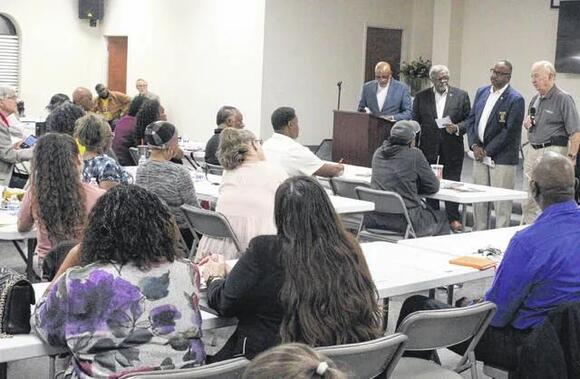
LUMBERTON — Members of the Lumberton community packed the Fellowship Hall at Sandy Grove Baptist Church on Thursday, seeking answers to their questions about a data center ordinance that will go before the Lumberton City Council on Monday.
The draft ordinance would regulate the potential future development of a data center in the city; it does not approve a specific project to develop one. The city’s planning board passed the ordinance in its Oct. 20 meeting, and it is on the agenda for City Council’s 11 a.m. meeting Monday at City Hall.
“If major tech developments are coming to our county, the citizens must have a chance to help dictate the terms, rather than just living with the consequences,” said John Campbell, president of Concerned Citizens for Better Government, one of three groups who organized Thursday’s community meeting. “We’re not here to blindly oppose progress, nor are we here to blindly accept it. We are here as united community to listen, to learn, to ask tough questions and to make sure our local leaders know where we stand.”
The assembled crowd heard remarks from event organizers CCBG, the Unified Robeson County NAACP and the Robeson County Cooperative for Sustainable Development, as well as public commenters. City officials answered written questions for about 40 minutes.
Mac Legerton, co-director of the Robeson County Cooperative for Sustainable Development, suggested that the city should take its time and study the issue, citing Holly Springs as an example of a municipality which has done so for a period of 12 months. He also said that there is “a lot missing” from the ordinance which would make it “comprehensive,” and that the ordinance should also include a Community Benefits Agreement which would outline benefits for the community, not just its government.
“The problem with data centers as an issue of justice is it takes so much science to understand the problem, and it takes so much science to understand the solution. Most justice issues don’t have that problem,” Legerton said. “We can’t rush into these things until we know the science.”
Waiting would also allow the city to work with state and federal legislators as more regulations for data centers are put into place. He also pointed out that the ultimate long-term goal of data companies is for their data centers to be in outer space, meaning that the development of one would not necessarily be a decades-long investment.
The Q&A session included answers from City Manager Wayne Horne, Deputy City Manager Brandon Love, City Attorney Holt Moore and City Councilman John Cantey. The following are among the answers given during the session:
— Location: The draft ordinance is site-specific to the Southeast Crossroads Industrial Park, located near the junction of interstates 74 and 95 in southwestern Lumberton. Only about 100 acres of the site is still available for development, meaning there is only room for a small-scale data center.
— Electrical usage: A small-scale data center would initially use 20 megawatts of electricity, and could expand to up to 50 megawatts. The city’s electrical grid can support one small data center, no more than that, and the ordinance would limit development to one center. There is a substation near the site that could accommodate this usage.
— Incentives: The city is offering no incentives for data center development, Horne said.
— Non-disclosure agreements: No NDA has been signed by any city official.
— Done deal?: The city has received inquiries from three different companies; there is not a specific one they’re “leaning toward,” but this is why they wanted to develop an ordinance now, to create regulatory statutes ahead of possible development, Love said.
— Health issues: Cantey said, from his research, one of the only cases of adverse health effects was years ago in Mississippi from a data center which was burning fossil fuels; technology has evolved and small-scale data centers don’t use fossil fuels.
— Researching other ordinances: Bladen County was already working on its own ordinance, and theirs was vetted with other developers. The city used that as a “springboard” for its draft ordinance, worked with the planning department and city attorney and added more and stronger language, Love said.
— Benefits: It would generate millions of dollars in tax revenue and would likely help to “stabilize” utility rates, Horne said.
— Jobs: Data centers are not necessarily large employers; a small center would likely generate about 20 jobs at first and could expand to as many as 40. But, Horne said, the city has heard from other cities that there have been peripheral effects for local businesses like plumbers, contractors, electricians and maintenance that employ more work to support the data centers, and that alone makes a “huge” impact.
City Council took a trip to Maiden on Tuesday to see two data center locations in that town, about 35 miles northwest of Charlotte. One of the data centers has been in operation for 15 years and the other is under construction, and have had no negative community impact. Both have homes nearby, churches, etc., Horne said. Maiden has the lowest taxes and utility rates in its county, and has been able to build new facilities such as fire and police departments, schools, etc., from the revenue generated.
“We talked with local officials there and asked one question: what are the issues with these two data centers in your community?” Horne said. “(They said) ‘there are no issues, our community has accepted them and we’re glad they’re here. They’re community partners, they contribute to our nonprofits, they help our tax base, they’re good corporate citizens.’ That’s not hearsay, that’s what we heard from (Maiden) city officials.”
Love said that standing outside the operational data center, they could not hear any noise other than traffic noise from a nearby highway.
Cantey, who says he’s torn 50/50 on the issue, added that that type of impact could happen in Lumberton.
“These companies, we would bill them for their electrical usage,” Cantey said. “That electrical usage can bring close to $4- or $5 million a year into the City of Lumberton. So we can put that money back into the community, back into programs, and we can bring on more police officers, more fire departments.”
Four public commenters also spoke during the meeting, each raising their concerns about a potential data center.
Shalonda Regan asked for an independent comprehensive feasibility study to examine environmental, economic and infrastructural impact, and said if such a study has already been completed, it should be made available to the public.
Laura Oxendine asked who doesn’t want a data center, and most of the crowd raised their hand. She pointed out that 40 of the 41 local referenda voted on nationwide on Tuesday which would limit data center development were approved.
“This is serious here. This is not a game,” Oxendine said. “This is not something to patty-cake about. Our natural resources are being depleted at an alarming rate across this nation, and we don’t need to be a part of that.”
Jeff Currie, who formerly worked as riverkeeper of the Lumber River, noted that modern life is causing the base flow of rivers to be greatly reduced over time, and said data center development would only worsen that problem.
“One of our problems with data centers is, they say they don’t need water, but yes they do need water, and they continually do need to replenish water that does evaporate,” Currie said. “They’re going to keep needing it, but we still need it.”
Campbell encouraged those in attendance to also attend Monday’s City Council meeting, even if they do not wish to speak.
“We have concerns,” Campbell said. “Those concerns should be addressed. Why the rush? Why can’t we take time to educate ourselves?”
There was some confusion during the Q&A with city staff over whether or not the draft ordinance has been published on the city’s website. It is available for download on the agenda from the Oct. 20 planning board meeting at https://lumbertonnc.portal.civicclerk.com/event/334/files/agenda/580, under Item F.
Editor’s note: A previous version of this story incorrectly stated Jeff Currie as the current riverkeeper of the Lumber River; he is no longer in that position.
 Add to Preferred Sources