undefined
Posts
undefined
Followers
What to know: Accessing cemeteries on private property
By Kathy Barnes,
2025-11-26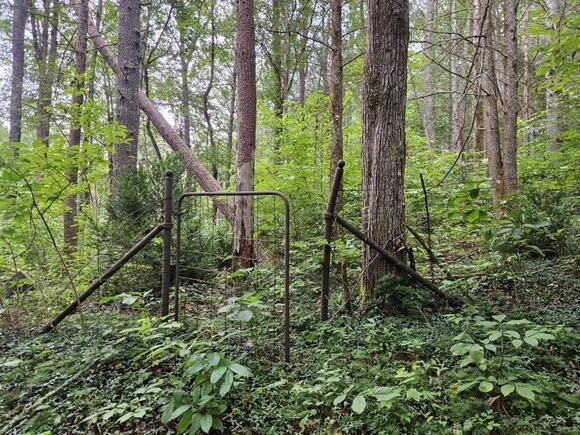
COCKE COUNTY — With the holidays fast approaching, many people make plans to visit cemeteries where their loved ones were laid to rest.
A survey recorded in 1972 indicated at that time there were as many as 450 cemeteries in Cocke County. Many of the cemeteries in the county are on private property.
According to the Tennessee Historical Commission (THC), “landowners must remember that family members have a right to visit the graves of ancestors, even if they are located on private property — this precedent is set under Tennessee Case Law.”
The THC explained that not all graves and/or cemeteries are shown on deeds, but they are still protected. Any property owners or future land buyers have an obligation to protect graves from disturbance when a cemetery is shown on a deed, the THC further pointed out.
Looking for a cemeteryNot all cemeteries are included on deeds. The THC recommends that anyone interested in purchasing property for development should remain aware there is the possibility that cemeteries could exist on the parcel.
Some ways to search for old cemeteries include:
Checking old deeds and property recordsChecking old mapsDiscussing the property with long-time local residentsSearch for indentations or sunken in spots on the ground that seem to be east to westLook for Vinca minor, also referred to as cemetery ivy, growing on the groundLook for headstones, rock fragments or plain stone markers
Obligations if a cemetery exists
If a cemetery does exist on the property in question, the landowner or developer must meet certain obligations.
Construction crews are required to leave a 10-foot buffer around the perimeter of a grave or a five-foot buffer around a crypt according to TCA 46-8-103.
According to the THC, one frequently asked question is: “If I don’t see any headstones, does that mean the cemetery isn’t there anymore?”
The response to that question is “no.” They point out that TCA 46-1-102 indicates a cemetery can be as small as one grave. It can also be a plot designated for future use.
“It is not required to include headstones or other markings. Often a person might consider a cemetery “destroyed” when markers have been removed; however, as long as graves remain, the cemetery still exists,” the THC responded.
TCA 46-4 indicates that a landowner who has taken possession of property with a cemetery on a deed has the “duty to protect graves and crypts,” and those graves cannot be disturbed within a specific area.
The landowner is not obligated to maintain the cemetery on his or her property regardless of whether it is included on the property deed. The landowner does have the right to petition Chancery Court for permission to relocate the cemetery elsewhere, but the cost of relocating the graves will be at the landowner’s expense, the THC pointed out.
The precedent
A precedent established in Walter Hines vs. Tennessee, which was a case held in 1911, implies that “burial lots, whether public or private, are not the subject of trade and commerce, and it is always presumed that they are not included in the sale of land which surrounds them.”
The case spurred from land owned by William Crawford in Tennessee in the early 1800s. He designated an acre of his land to be used for a cemetery.
Crawford and several relatives were buried there. Throughout the years, gravestones were erected and maintained in memory of the family members interred in the cemetery.
After several generations of the property remaining in the Crawford family, it was sold outside the family to Walter Hines. The deed had no mention of the cemetery.
Hines would not allow Crawford’s family to visit the cemetery, and he was convicted of a misdemeanor for denying access to the cemetery.
Sheriff’s input
Cocke County Sheriff C.J. Ball said the sheriff’s department has not had issues with people denying access to a cemetery.
“The statute says that if there is a cemetery there, the descendants of those buried there have access to that cemetery,” Ball said. “Even if that property is sold outside the family, the cemetery still remains and the family has continued access to those graves.”
He also pointed out that a landowner can’t build within so many feet of a cemetery. He said that there was a commercial building being constructed in recent years and there was a cemetery near it.
“They had to go through the State of Tennessee to get a variance approved and to get permission to construct the gas station near the cemetery,” Ball explained.
Discussing how some cemeteries have a deeded right-of-way and others do not, Ball said that if there is a gate over an entrance or if the cemetery is in a secluded place, those wishing to visit the cemetery should contact the property owner.
“It is better to be courteous to facilitate a smooth process,” he said. “Set up a time to access the cemetery if it is in a more secluded area on the property.”
Ball said if someone is not allowed access to a cemetery, or if they find that a cemetery has been vandalized or destroyed, they should contact the Cocke County Sheriff’s Department.
He said if there is vandalism or destruction, a detective will be assigned to investigate, and if laws have been broken, they will refer the matter to the district attorney general’s office.
 Add to Preferred Sources