undefined
Posts
undefined
Followers
Program provides blood on EMS calls
By Jeff Moore,
2026-07-22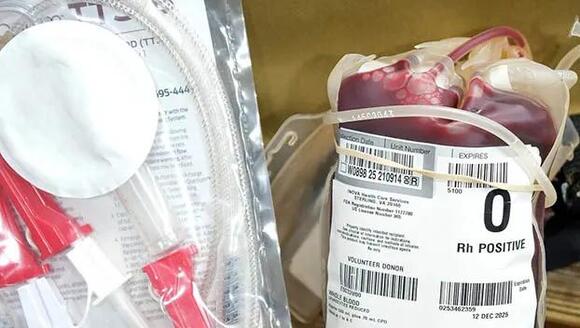
The Buckingham County Department of Emergency Services has launched a new prehospital whole blood program that officials say will significantly improve emergency treatment for trauma patients and others suffering life-threatening blood loss.
The department announced July 8 that two units of whole blood have been placed into service at Station One, with Stations Two and Three each expected to receive two units by the end of the summer. Once fully implemented, all three staffed ambulances will carry two units of blood, making six units available throughout the county.
Department of Emergency Services Director and Chief Cody Davis said the expanded program evolved after county officials reconsidered an earlier plan that would have stationed only two units at the Dillwyn station.
“Initially we considered only having two units of blood in the county, with it being deployed from our Station One in Dillwyn by a quick response vehicle,” Davis said.
However, discussions with the county’s Emergency Services Committee identified several concerns.
“Namely, limited supply in the county, extended mobilization time and equitability,” Davis said, listing those issues. “Thus, our approach was changed and the budget was re-worked to allow for there to be blood on all front-line BCDES ambulances.”
He said placing blood on each ambulance ensures that crews can respond more quickly while maintaining an adequate supply throughout the county.
“In short, all three staffed ambulances will be equipped with coolers carrying two units of blood,” Davis said. “That makes six units of blood available in Buckingham.”
The expanded inventory is especially important because blood supplies are replenished every two weeks from Chesterfield County.
“So, if we deploy a unit or two of blood on a call, we will still have ample stock within the county and/or we are able to deploy blood to multiple patients on a singular call if needed, for something like a mass causality incident,” Davis said.
According to the department, whole blood is especially valuable in treating trauma patients and people experiencing severe, uncontrolled bleeding, particularly in rural communities where transport times to hospitals can be longer.
The blood will travel with ambulance crews on virtually every emergency response.
“Barring any extenuating circumstance, all crews will have the blood with them on all calls for quick deployment,” Davis said.
The primary exception occurs when the first ambulance arriving on scene is staffed only at the basic life support level.
“The biggest cause for the blood deployment being delayed until another crew arrives is if the first arriving crew is staffed at a basic life support (BLS) level only,” Davis said. “In that case, the BLS crew will work to stabilize the patient and rendezvous with an incoming paramedic-level crew.”
The department is stocking Type O whole blood, allowing it to be administered to virtually any patient during an emergency.
Implementing the program required months of preparation and specialized training for emergency personnel.
“Our training consisted of hands-on scenarios, table-top drill and discussion and online courses,” Davis said.
He said training covered proper storage and handling of blood products, identifying patients who need transfusions, administering blood, recognizing adverse reactions and appropriate treatments, reviewing case studies, considering other treatments that may accompany blood administration and additional topics.
“To support this program, we had to purchase special coolers with multiple inserts for each cooler so that we can place a fresh unit into the cooler every 12 hours,” Davis said.
He said each station also received a chest freezer to store cooler inserts, while specialized temperature monitors continuously track blood storage conditions.
“These maintain an internet connection and are constant so that constant temperature data can be recorded and communicated in real-time via apps on our phones,” Davis said.
The department also purchased specialized fluid warmers to warm blood before it is administered to patients.
The program was made possible through partnerships with Inova Health System, the Old Dominion Emergency Medical Services Alliance and Virginia State Police Med- Flight, according to the department.
Emergency services personnel completed extensive training over the past several months through on-shift instruction, online coursework and quarterly training exercises before the program officially went live.
The department also credited the Buckingham County Board of Supervisors for funding the equipment needed to launch the initiative, while recognizing Operational Medical Directors Drs. Debra Perina and Peter Vandersteenhoven for helping develop the program.
Davis said the need for prehospital blood transfusions is greater than many people may realize.
“I want to stress our appreciation to the BOS and Buckingham’s citizens for their support,” he said. “We average 10-plus patients a year that need blood product in the field, so this is no light matter.”
 Add to Preferred Sources