undefined
Posts
undefined
Followers
Drew Cox reflects on midterm campaign, plans to run again in 2028
By RONAK MOHANTY Asst. City Editor,
1 days ago
When Drew Cox, the 2026 Democratic nominee for Indiana’s 4th Congressional District, was campaigning, he met a man who became homeless after being hit by an uninsured drunk driver.
“The guy that got hit had a $40,000 surgery, and this one bill, (he) really couldn’t pay it. One thing led to another, and this guy became homeless because of this,” Cox said.
The story stuck with Cox, even after losing to incumbent Republican Rep. Jim Baird by 8%.
“(I’ve heard) so many stories about people that have very little means at a time when our Congress is full of rich people. The guy I’m running against has $50 million to his name,” Cox said, referring to Baird.
According to Quiver Quantitative, Baird was worth $45.9 million in 2025.
Regarding the reporting that indicated a potential Cox victory if Republicans had redistricted last year, Cox said he was still glad they hadn’t gone through with the redistricting.
“That would have been cool for us to have picked up more seats, but the lines that they would have drawn were so ridiculous,” Cox said. “I’m glad that they didn’t do that. I support a nationwide bill to end partisan gerrymandering. The Republicans don’t support that, and the Democrats do right now, generally speaking.”
Nevertheless, this sentiment echoes that put forth by Republican state Senator Spencer Deery.
“I primarily opposed mid-cycle gerrymandering because I felt like it was not the right thing to do,” Deery said. “But that being said, I also was telling fellow Republicans, ‘Look, be careful what you wish for here, because there’s such a thing as a dummymander.’”
Despite Cox’s defeat, his performance marked a 21-point improvement over Kamala Harris’ performance in the 2024 presidential election, and he said he is already looking toward running for Congress again in 2028.
Cox, a visiting professor for Purdue’s music department, said the campaign is currently working on a post-mortem of his defeat, as many people on the campaign — “pretty much everybody on my campaign,” according to Cox — were political newcomers.
Cox said he wants more experience on his campaign for 2028, and key to that is raising the money needed to hire experience.
He also said holding a town hall in every county in the district was a mistake and that the effort required much time, money and resources.
“Next time we (should) have four (town halls) instead of 18. That’s one big difference … (and) getting a more experienced campaign manager that I can pay,” Cox said.
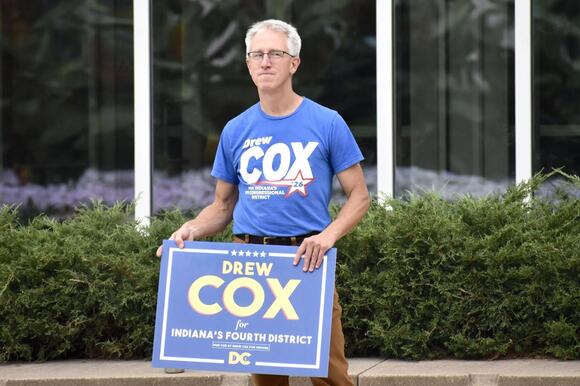
Cox also hopes that a more seasoned campaign team can bring more funding from the national and state Democratic parties — alongside money from the Tippecanoe, Hendricks and Boone County Democratic parties.
“Hopefully they would look at me the next time as an experienced, more viable candidate with more experienced campaign staff, more money, more name recognition,” Cox said. “And hopefully, I would get money from them the next time around.”
One of his policy priorities would be immigration reform in Congress, and he said seeing ICE’s actions was one of the reasons for jumping into politics.
“We can still have a secure border and a humane immigration policy all at the same time,” Cox said. “I’d really like to see the next Congress heavily reform or abolish ICE.”
Cox also called for raising the federal minimum wage from $7.25 an hour to something around two to three times the current value. Cox also said he “really strongly (supports) a nationalized Medicare for all type system in which we could gradually lower the age and put more people on Medicare.”
Cox pushed back against the notion that such progressive policy views were unelectable in deep red districts.
“Abdul El-Sayed won his race. He was the progressive option of the two Democrats in Michigan,” Cox said. “With all the races that just happened in the election, I think that just proved that the Democratic Party needs to move away from Chuck Schumer and Hakeem Jeffries and the establishment move more towards a progressive direction, less corporate direction.”
Cox said he decided to run again because he had only started becoming comfortable running for office toward the end of the election.
“I just felt like I took a very long time to understand what it meant to be a candidate. So toward the end of the election, I was like, ‘Well, man, now I’m just starting to get good at this thing,’” Cox said. “(Specifically) public speaking … but also networking and how to connect with people. (There are) 16 counties in the district, so that’s quite a few relationships, and some of them are more difficult than others.”
 Add to Preferred Sources