undefined
Posts
undefined
Followers
WL City Council approves SK hynix settlement
By RONAK MOHANTY Asst. City Editor,
3 days ago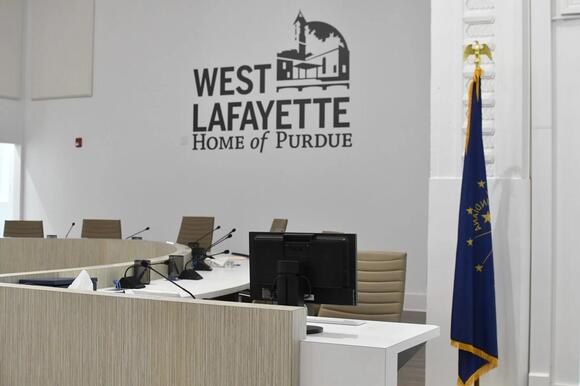
In a meeting that lasted just over 10 minutes and lacked any public comment, the West Lafayette City Council approved settlements for the pair of lawsuits filed over the zoning change that allowed SK hynix to build its multi-billion dollar computer chip packaging facility in the city.
Local residents filed lawsuits after the council approved rezoning in May 2025 and allowed construction to begin on a plot of land just north of Purdue’s campus by Kalberer and Yeager roads. The lawsuits aimed to undo the zoning change.
SK hynix is a South Korean chip giant specializing in the manufacture of memory chips that are in high demand due to the ongoing artificial intelligence boom. The West Lafayette facility will package smaller chips into high bandwidth memory chips.
The lawsuits were filed against the city of West Lafayette, the Purdue Research Foundation and SK hynix. There are separate settlements for each defendant — the city, PRF and SK hynix — with only the settlement with West Lafayette having to be approved in a public forum. The settlements come weeks before trials were set to begin in early December.
Council member David Sanders said the fast approaching trial date “accelerated” settlement talks.
“If the (trial date) had been in January or February, it could have dragged out even further, so I think that the judge should be commended for saying (that) we're going to move this along, and that prompted all of the groups to get together and try to settle it before that happened,” Sanders said.
The settlements with the city were unanimously approved and were nearly identical.
“I think it's hard to find a difference between the two. They were modeled on each other,” said Mark Crandley, the attorney representing the city on the case, to the council.
But one notable difference was that the non-disparagement clause in one settlement expired after two years while the other had no time limits placed on it, though this is likely a result of two different legal teams negotiating each settlement, according to a city official.
The non-disparagement clause means the parties of the lawsuit both agree not to disparage each other publicly.
“It is fairly narrow in this context because we are a public entity, and the plaintiffs do have a right to talk about their city government and their city they live in. It is limited to anything about the litigation,” Crandley said.
Crandley also said the settlements also don’t include any use of public money to pay the defendants — “In fact, it saves the city money” — while also preventing any of the issues in this suit from being litigated again in a future lawsuit.
In an interview after the vote, Crandley called the meeting “a necessary step to finalize agreement,” though he said that the cases had to still be formally dismissed by the courts.
One West Lafayette local in attendance, Zachary Baiel, was more curious to know about the details of the settlement with SK hynix and the PRF.
“Obviously there was nothing really in the city side of the settlement except you dismiss us, we'll dismiss you. We don't disparage each other,” said Baiel, an opponent of the facility. “The meat, if there is any, will be in those other settlements.”
While Baiel wasn’t involved in the lawsuits, he speculated money was likely the biggest concession made as part of the settlements.
“I have no idea. I mean, the easiest way to make problems go away is money,” Baiel said. “I'm not intimately familiar with all the claims, but I know in essence it was, ‘You're ruining our home, it's going to be harder to resell, it's going to be impacting prices.’ Sounds like the remedy of that would be money.”
Baiel called the lack of public comment ahead of and after the votes as “very frustrating.”
While he acknowledged that there was no requirement for public comment to be held, he said “the normal operating procedure for the city council is to allow public comment both before votes and (after).”
Baiel also pointed out that several city officials and council members, including the mayor, lingered after the council’s adjournment — “apparently everyone has time to hang out a bit.”
Nick Schenkel, a member of the city council, defended the lack of a public comment, calling the settlement a “legal issue.”
"It's a legal issue, and I understand it's a legal issue. We want to just trust that our attorney gave the proper work and the proper background, and that we are able to approve it based on his and the mayor's agreement that yes, this is a good (settlement),” Schenkel said.
Sanders said he was surprised by the lack of public comment and is always a supporter of it but said that it is at the discretion of the council to have.
Sanders, who voted against the initial rezoning in 2025, was strongly in favor of the settlement between the city and plaintiffs.
“I think it's all a very positive development. I think it was very ably handled by our lawyer, by our counsel, by the mayor,” Sanders said.
 Add to Preferred Sources