undefined
Posts
undefined
Followers
Historical marker sought in Jamesville
By Deborah Griffin,
17 days ago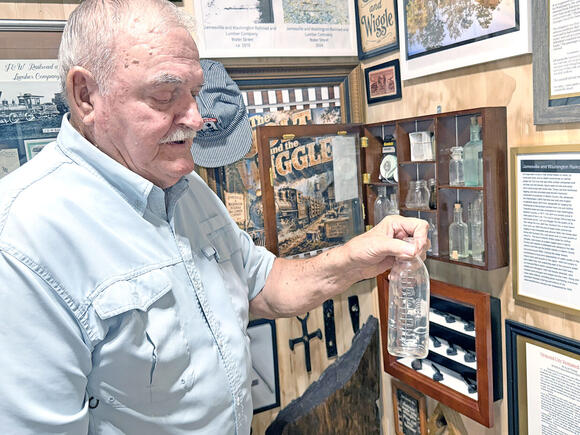
Sometimes, when the wind blows just right, echoing through the woods of Jamesville and out across the Roanoke River, a low, mournful, lonely sound of a “train” can be heard — reminding listeners of what once was.
If Charles “Bo” Dickerson has his way, Martin County will soon have a more permanent reminder than the wind in the trees of a railroad bed that once existed here, connecting the Jamesville river to the Pamlico in Washington.
Dickerson has set into motion a request for a N.C. Highway Historical Marker to commemorate the Jamesville and Washington (J&W) Railroad and Lumber Company that started here in 1869 and closed in 1897.
The track leading to Washington was approximately 22.57 miles long and had one stop off in between. What was once known as Dymond City, a bustling town with a 32-room hotel, eventually died out when the railroad stopped running.
The train made one round trip in a day, said Dickerson.
“It put Martin County on the map big time,” he said. “Also, Beaufort County and even Washington County because of the lumber and produce and grain they hauled for the farmers.”
Dickerson owns land where the Jamesville terminus was located and has established a small museum on his property dedicated to the memory of the railroad company — nicknamed the Jolt and Wiggle (J&W) — for the bumpy ride and frequent derailments the narrow-gauged (36-inch) railroad tracks offered. Some of the old wooden railroad ties can still be seen on the path leading to his property.
He has discovered steel beams, along with other discarded paraphernalia, including bottles and railroad spikes. The initials JW on the side of the museum were formed from thrown away beams.
Located just off Water Street, Dickerson purchased some of the land that once served as the railroad terminus which originally sat on 800 feet of waterfront property. At one time there was a wharf, a warehouse, an engine house, a lumber yard and a dwelling for the railroad’s superintendent. There is also evidence of a “wye” on his property which allowed trains to be turned in the opposite direction.
Research shows the railroad provided limited passenger service between the two towns, but its emphasis was on logging and freight, as reflected by its rolling stock in 1887 which consisted of two passenger cars, two baggage cars and 21 freight cars.
Farm products and fish were carried by the J&W from the Pamlico region to Jamesville where they were shipped by steamer, and later by rail to markets in Norfolk and Baltimore. Lumber and shingles manufactured at the sawmills in each of the three towns were also transported to the rivers and shipped to places as far away as Barbados and Jamaica.
According to one article, Tales of Two Lost Cities by Scott Troutman, the mill at Jamesville was the biggest shingle mill in the western world and could turn out 25,000 cedar shingles in a single day. Mostly they were made from virgin bald cypress and Atlantic white cedar, found in the swamp forests near Dymond City.
Dymond City is itself a historic anomaly. The settlement reportedly included lumber and shingle milling, a brick plant, a boarding house, managers’ and workers’ dwellings and a three-story structure containing a company store, post office, and assembly room.
Dickerson has amassed quite a collection of items — much of it found on the property, some in other places, pertaining to the historic railroad.
“I’ve even got the original charter for the railroad company that was made back in 1868,” he added.
His goal is to share his knowledge of the railroad with the people of Martin County.
“I love history — especially the history of Martin County,” he said.
When he began leasing the land in 1998, which he eventually purchased, he started finding relics.
“I found artifacts you wouldn’t believe,” he added. “I got one article in there that’s probably 450 years old.”
He purchased the land three years ago and became serious about unearthing history.
He is anxious to hear back from the state about the historical marker.
“I’m 83 years old and it’s hard for me to change. I’ve been hyper all my life. When I have something to do, I want to get it done,” he said.
Caroline Daniels Johnson, an East Carolina University consulting archivist working with Martin County Historical Society, has prepared a nine-page historical research report in support of obtaining a historical marker for Water Street, near the path that leads to Dickersons’ property, the former railroad bed.
She wrote, “The network connected two distinct waterways. Jamesville furnished access to the Roanoke River, while Washington furnished access to the Pamlico River and its commercial docks. The J&W [was] significant as a rail-and-water transport system built to connect inland timber production with coastal commerce.”
She summarized the historic significance.
“The Jamesville & Washington Railroad (J&W) was a Reconstruction-era railroad and lumber enterprise chartered in 1869 to develop timberlands and connect Jamesville, on the Roanoke River, with Washington, on the Pamlico River. Its history illuminates the relationship between postwar investment, commercial timber extraction, transportation infrastructure, and the rise and decline of industrial communities in eastern North Carolina. The settlement initially called Waring ( later Dymond City) as integral to that history: it developed around company milling, railroad, residential, and commercial facilities and subsequently declined with the railroad and timber enterprise.”
In 2010, the Friends of the Old Martin County Court House used the J&W on its historic ornament, with a drawing contributed by local artist and businessperson, Bailey Phelps from Jamesville. In its description of the ornament, they included the following text: The J&W prompted the development of a sawmill village known as Dymond City.
This community included laborers and skilled workers from England, Ireland and principally Pennsylvania, which was the headquarters of the English stock company financing the J. and W. Many were Quakers and worshipped on the third floor of the building housing the company store and post office. Lightfoot, Fisher, Nolan and Bissell were the most influential names connected with the local settlement.
The J. and W. began shutting down operations in the 1890s due to lumber running dry and competition increasing from new railroads in the area. The last scheduled passenger service occurred on January 25, 1892. Over time, Dymond City was gradually abandoned and its buildings consumed by forest fires.”
 Add to Preferred Sources