undefined
Posts
undefined
Followers
‘Come and learn about your state’: Spring Hope museum features colonial NC exhibit
By Corey Friedman||,
2026-01-26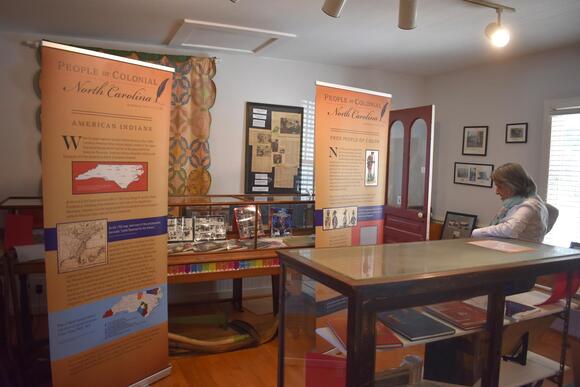
SPRING HOPE — A traveling exhibit on North Carolina’s colonial history is in its final week at the Spring Hope Historical Museum.
The 400 W. Main St. museum will feature “The People of Colonial North Carolina” through Monday, Feb. 2. A traveling exhibit produced by the North Carolina Department of Natural and Cultural Resources to commemorate the United States’ 250th birthday, the display opened in Spring Hope on Jan. 14.
Ro Broyles, board secretary for the Spring Hope Historical Association, which owns and operates the museum, is serving as curator of the special exhibit.
“Take time out to come and learn about your state,” Broyles said. “If you’re new to this state, come and learn about North Carolina. I don’t know where everybody’s level is as far as their knowledge of North Carolina, but I hope that everybody takes away at least one little thing.”
The display “highlights the complex and often conflicting paths different communities took in the fight for freedom and survival,” according to a Department of Natural and Cultural Resources synopsis. “Through maps, rare documents and illustrations, the exhibit offers a look at how the American Revolution impacted everyday lives.”
NASH COUNTY CONNECTION
Consisting of seven panels described as “standing banners,” the exhibit tells the history of American Indians, enslaved Africans, free people of color, English and Scottish colonists and Swiss and German colonists. The panel dedicated to free people of color includes a photograph of Nash County resident Joel Taborn’s 1820 application for a Continental Army pension.
“Joel Taborn, a resident of Nash County, enlisted in the North Carolina Continental Line in 1776,” the exhibit text reads. “Identified in his pension application as ‘being very young and (a) person of color,’ he was first employed as a servant by the officers of his company before joining the armed ranks. Taborn fought at the Siege of Charleston and the Siege of Fort Ninety Six in South Carolina.”
The Spring Hope Historical Museum is open from 11 a.m. to 3 p.m. on Mondays, Wednesdays and Fridays and from noon to 3 p.m. on Saturdays and Sundays. Daily attendance varies.
“We get about 50 or 60 when we open up an exhibit and when we close an exhibit,” Broyles said. “On Sundays is when we get people. Sometimes we get alumni. We get families coming to visit, grandchildren coming to visit, which is nice. They want to show their grandchildren. That’s the nice thing about the museum: We are the repository of the history, the lore of Spring Hope.”
MUSEUM SEEKS SUPPORT
Historical association President Gay Sturgeon, long considered the driving force behind Spring Hope’s museum, suffered a stroke last year.
“This year has been very sad for us,” Broyles said. “It has not been a normal year because of Gay. We have been trying to find our way because she did it all and we just helped. This year has been a hard year for the museum.”
Supporters can help the association and museum in a variety of ways.
“We’re always looking for members. Donations are always appreciated. We just want the people to realize that we’re here,” Broyles said. “We’re here to provide a service. People can not just come and see the exhibits that are on, but there’s also a lot of resources in this museum as far as genealogy. Families have written their family histories. And, guess what? We have them here. We have pictures from when Spring Hope first started. We have so many resources right here.”
Those resources include a model railroad diorama of Spring Hope circa 1910 built by Paul Gross, who used historical land records to make the miniature village authentic.
Other items on permanent display include memorabilia from Southern Nash High School and news reports on the successful integration of Nash County’s formerly segregated public schools.
RESOURCES FOR ALL AGES
“The People of Colonial North Carolina” exhibit includes a children’s corner with toys, books and worksheets highlighting Revolution-era life for the future Tar Heel State’s youngest residents.
“We would love it if the schools would participate and we could have students who could come and be docents and help us and get community service hours and just learn about the history of their town,” said Broyles.
More community participation could help the museum meet its goal of hosting more temporary exhibits and special programs.
“We want to go back to the golden days of this museum when we had so many programs,” Broyles said. “This museum had so much. COVID kind of stopped that and since then, we never picked it back up.”
For more information about the museum, visit SpringHopeMuseum.com or call Broyles at 239-222-7233.
After its run in Spring Hope, the colonial North Carolina exhibit will be displayed at Rowan-Cabarrus Community College and the Rowan-Cabarrus Library from Feb. 4 to March 6. Following March and April stops at the Alamance Battleground State Historic Site in Burlington and at Waxhaw Town Hall, the exhibit returns to eastern North Carolina from April 16 through May 29, where visitors can see it at the Johnston County Museum in Smithfield.
 Add to Preferred Sources

