undefined
Posts
undefined
Followers
Water fees shaping Colorado housing development
By Nicholas Fogleman,
9 days agoWhen homebuilders talk about rising housing costs, they often point to land, labor and materials. Increasingly, they are pointing to water.
Water fees now make up the largest share of development charges in metro Denver communities, adding tens of thousands of dollars to the cost of new homes and forcing a difficult question: Who should pay for growth?
Housing developers and advocates argue that it is time to re-evaluate the “growth pays for growth” model, and they say a rebalancing of how growth is funded could benefit the community.
Fees are growing
Before construction begins on a new home, developers pay one-time fees intended to cover the impacts new development places on public services and infrastructure.
Permit fees authorize construction; impact fees help fund roads, parks, police and fire services; and system development fees support utilities, including water and sewer systems.

In metro Denver, those charges range from roughly $36,000 to nearly $100,000 for a 2,400-square-foot detached home and can account for as much as 15% of the home’s final closing price, according to a study by the Home Builders Association of Metro Denver.
The regional average is about $73,000 and that is before land, labor and materials are accounted for.
System development fees for water services make up the largest share of that total.
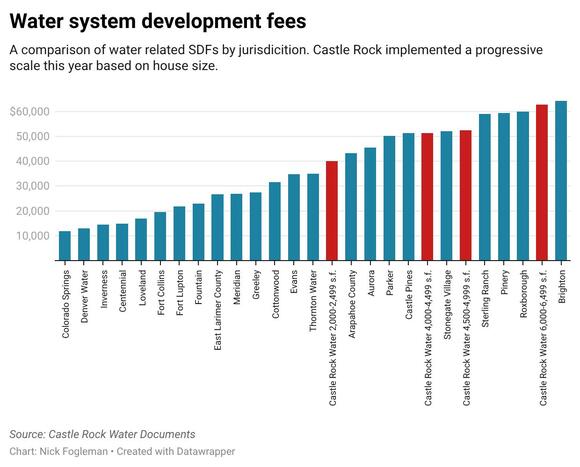
On average, water fees account for roughly 60% of development charges, ranging between $20,000 and $78,000.
Morgan Cullen, director of government affairs for the HBA, said these development fees have increased 8% over the past year and have more than doubled in some communities during the past five years, putting pressure on new housing supply and homebuyers.
“Developers are putting up a lot of upfront capital and making significant investments, only to have the financial landscape on a particular project completely change over that time period. Eventually, that gets represented in the final housing price,” Cullen said.
Growth pays for growth
When Colorado’s Taxpayer’s Bill of Rights passed in 1992, it helped cement a philosophy that has shaped growth across the state for decades.
Since state and local governments generally need voter approval to raise taxes, municipalities have looked to new development to fund the roads, parks, utilities and water systems needed to serve residents, sparing existing residents from tax increases.
For years, the system largely worked. Colorado grew rapidly, builders pulled permits, local governments collected development fees, and utilities expanded infrastructure.
Now, builders and housing advocates are increasingly asking whether a financing system built during decades of expansion still functions as intended when growth slows and the costs of housing, labor, infrastructure and water all rise at the same time.
“TABOR preempts local governments from imposing new taxes to help support new development costs within their localities,” Cullen said. “I think what we’ve seen over the years is that it’s much easier for local governments to increase impact fees on new homeowners that don’t yet live in the community than it is to increase revenue from residents that live there.”
For water providers, the logic is straightforward.
Castle Rock Water Director Mark Marlow said system development fees allow new development to buy into existing infrastructure while also helping finance future infrastructure and water supplies needed to serve growth.
“At the end of the day, the way we try to structure everything is that growth is paying for growth,” Marlow said, emphasizing that the utility does not decide the rates but rather calculates them based on the cost of services provided.
Rising costs affect everyone
Water providers, homebuilders and housing advocates face a similar problem and agree that prices are increasing.
According to a statewide Housing Needs Assessment, construction costs increased 44% between 2019 and 2024, outpacing the average single-family home sales price increase of 37%.
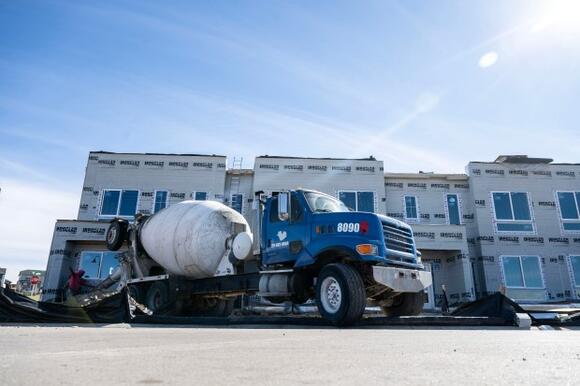
Nationally, increased material costs, with recent tariffs estimated to cost an additional $10,900 per home; a shortage of skilled labor, resulting in an estimated loss of $2.7 billion from higher carrying costs due to longer construction times; and higher commercial financing rates have significantly increased construction costs, limiting supply.
According to the National Association of Home Builders, for every $1,000 increase in the median price of a new home, an additional 1,699 Colorado households are priced out of the market.
The same cost pressures driving up housing prices are also driving up the cost of water infrastructure.
The future of water
Every year, Castle Rock Water completes a fee study that calculates expected future permits, which drive revenue, against expected expenses related to infrastructure expansion and long-term water needs associated with growth.
The provider then makes adjustments each year to ensure that fees cover the costs of service.
“It is a very complicated process,” Marlow said. “When you’re dealing with new development, it’s not like you just go to the grocery store and say, ‘I need to buy water for one single-family home.’”
The utility is pursuing a long-term transition to a 100% renewable water supply and expects to spend more than $1.6 billion on capital improvements during the next 40 years.
Among the projects are a $27.5 million pipeline connecting Plum Creek to Rueter-Hess Reservoir, nearly $60 million in desalination infrastructure and participation in the estimated $1.1 billion Platte Valley Water Partnership, a regional project that would transport renewable water from northeastern Colorado to the south metro area.
“The cost of renewable water supplies, the cost of the infrastructure and construction has gone up in extremely large amounts over the past five to 10 years,” Marlow said. “The overall trend, quite frankly, is growing faster than inflation.”
Unlike private businesses, water utilities cannot simply stop investing when costs rise. Infrastructure projects take years, if not decades, to plan and complete.
“People expect the water to be on every day,” Marlow said. “It requires a lot of planning because any project takes a decade to build.”
Water is quietly shaping Colorado housing
The challenge for utilities is that infrastructure costs continue climbing even as housing production slows.
Colorado permitted an average of roughly 25,700 homes annually during 2019 and 2020 before reaching more than 30,000 permits in 2021. By 2025, permits had fallen to about 17,400 homes.
In Castle Rock, residential permits dropped from 1,167 in 2022 to 393 in 2025, with roughly 295 projected for 2026.
For utilities, that means fewer new customers helping fund increasingly expensive infrastructure.
For builders, it means rising costs are being spread across fewer homes.
Housing advocates argue that the funding model is placing an increasing burden on prospective homebuyers while making development more expensive.
As construction costs and home prices rise, local governments have continued to increase development fees to help pay for rising infrastructure costs needed to accommodate growth.
Higher costs can ultimately be reflected in home prices or make projects too expensive to build, reducing the number of homes constructed and the permits generated by new development, limiting municipal revenue.
As costs continue rising, officials face pressure to increase fees further.
The result, critics argue, is a cycle in which the funding model becomes increasingly dependent on the very growth it may be discouraging.
Cullen described it as a “self-defeating prophecy.”
“If you figure out a way to diversify your revenue, it would make a city’s budget a lot more resilient to cost changes,” Cullen said. “I think there’s been an overreliance on impact fees for far too long, and we can’t just keep increasing them because at some point homes become too expensive and people can’t afford to purchase them anymore.”
The housing effect
For many buyers, the most frustrating aspect of Colorado’s housing market is that the homes being built often do not match the homes people say they want.
Gracy Weil, a project manager and development researcher, said builders are struggling to meet demand for less expensive housing.
“Builders want to build what is in demand,” Weil said. “What’s in demand is cheaper housing, but there is only so cheap you can build a house right now.”
The result, advocates say, is a market where demand for attainable priced homes remains high while supplies increasingly favor more expensive products.
The statewide Housing Needs Assessment found that “more housing units are available than at any time since the post-Great Recession period; however, the prices of those homes have kept many households on the sidelines and unable to purchase them.”
Castle Rock experiment
Even communities committed to the growth-pays-for-growth model are experimenting with new approaches.
While many communities continue relying on traditional fee structures, Castle Rock recently changed how it calculates water system development fees in an effort to better align costs with expected water demand.
The town commissioned a study examining which housing characteristics most closely correlated with water use.
The strongest predictor was finished livable square footage.
As a result, Castle Rock implemented a new fee structure based on home size rather than water meter size.
Under the revised system, homes are grouped into square-footage categories in roughly 500-square-foot increments. Smaller homes generally pay lower fees, while larger homes pay more.
The change also addresses a long-standing concern among builders that flat fees can disproportionately affect smaller homes.
Under traditional meter-based systems, a 1,500-square-foot home and a 4,000-square-foot home may pay similar fees despite placing different demands on the system.
Cullen said that can make it more difficult to build smaller, less expensive homes because the fixed fee represents a larger share of the overall project cost.
“That was something the HBA fully supported,” Cullen said. “It gives builders more flexibility to build different types of product.”
As development costs continue rising, Cullen said those flat-fee structures can unintentionally encourage builders to construct larger homes better able to absorb the additional expense.
“A lot of times when you’re building a smaller-square-footage product, it makes it much harder to absorb those impact fees if it’s just a flat fee all the way across,” he said.
Community benefits
Housing advocate David Pardo, a lead with Yes in My Backyard Denver, said anti-growth sentiment often misses the benefits that extend beyond new residents and said rebalancing the system would lead to greater satisfaction for communities.
“New developments are paying for things that, at the end of the day, benefit the whole community,” Pardo said. “When the money gets paid and goes into a park or a police station or water infrastructure, the entire city benefits from that.”
“If municipalities are saying, ‘Our budget is changing,’ it’s a TABOR issue.” If they say we’re short on money, rather than doing what we do all over Colorado all the time, which is to find an extra fee to put on the newest homebuyers, it’s fair instead to raise the taxes on everybody.”
Pardo argued that the current mechanism of raising costs for new housing deprives communities of the benefits he sees with more attainable housing, including diverse neighborhoods, a larger tax base and a greater sense of community.
“When you have a doctor living right next to the nurse, living right next to the grad student, that’s vibrancy,” Pardo said. “When there is no housing for teachers or waitresses, you’re going to get traffic.”
Increasing taxes through voter-approved measures has happened in tax-averse communities like Castle Rock.
In 2024, voters approved a sales tax increase to fund police and fire departments, including new employees and an ambulance.
In an October Town Council meeting, Castle Rock Town Manager David Corliss said that in many ways both existing residents and future residents support infrastructure.
“I’ve moved away from the phrase, growth pays for growth,’” Corliss said. “I always add a qualifier, growth helps pay the costs of growth.’”
“We had to ask the community for a sales tax increase in order to help stabilize our long-term funding for the police and fire department as they grew to meet all of our demands because it was a top priority and growth was not paying those operating costs sufficiently,” Corliss added. “But I don’t think we wanna ask voters for a tax increase to be able to reduce our impact fees. I don’t think it’s gonna proceed very well.”
Affordability crisis
Colorado’s affordability challenges cannot be traced to a single cause, and reports say they continue to get worse.
The state’s Housing Needs Assessment found that a household now needs roughly $153,700 in annual income to purchase the state’s median-priced home and that 2014 was the last time the median household could purchase a median-priced home without spending more than 30% of its income on housing.
Weil said that while system development fees make up only a portion of a home’s final sale price, interest rates, labor shortages, material costs and tariffs all add costs that eventually show up in the price of housing.
“Each one of these factors chip away at affordability,” Weil said.
 Add to Preferred Sources
