undefined
Posts
undefined
Followers
Ethics Commissioner Discusses Scope of North Dakota Development Fund Inquiry, Potential Next Steps
By Jonathan Starr,
5 days ago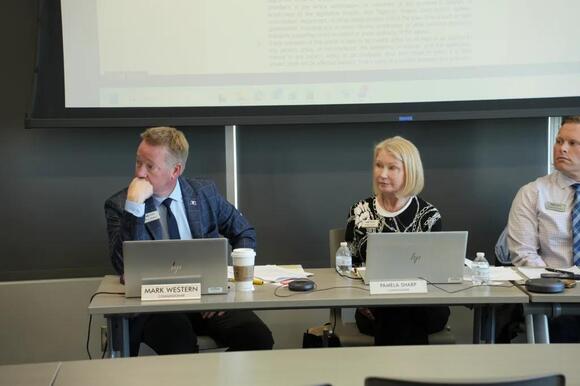
The North Dakota Ethics Commission is examining potential conflicts of interest involving the North Dakota Development Fund, but Commissioner Mark Western says the commission has not yet determined whether its inquiry will lead to a formal investigation or findings involving individual board members.
In an interview with The Dakotan, Western discussed the commission’s decision to open the inquiry, the documents it is seeking and the questions that remain unanswered following a performance audit of the Development Fund.
“I don’t know where the facts may lead us, but it seems reasonable to want to look at the underlying source documents to determine if anything else is appropriate at this juncture,” Western said.
The inquiry follows a September 2026 performance audit conducted by Eide Bailly, which examined Development Fund activities from 2019 through 2024 and raised concerns involving potential conflicts of interest and insider transactions.
Western said the commission decided to act during its October meeting after learning the North Dakota Attorney General’s Office had declined to investigate further because of a conflict of interest.
Commission Seeking Additional Records
The commission has requested organizational documents from the Development Fund and underlying audit materials from the State Auditor’s Office.
Those records could help determine whether additional investigative steps are necessary and whether individual board members should face further scrutiny.
Western emphasized that the commission is currently conducting an inquiry rather than a formal investigation.
“I don’t want to have a conclusion in search of documents,” Western said. “I want to sincerely look at what the facts are and see where it leads us.”
He said the performance audit does not provide sufficient information to identify which board members may have participated in particular transactions or decisions.
“The Eide Bailly performance audit is written in such a way where it doesn’t state which board member did this or whether there was a vote on that,” Western said.
“I don’t know what I don’t know at this point.”
Questions Surrounding Board Members
One unresolved question is whether the Ethics Commission has jurisdiction over individuals who have resigned from the Development Fund board.
Western said determining that will depend partly on when the alleged conduct occurred and who served on the board at the time.
“Don’t know yet, because at the end of the day, I don’t know when the alleged conduct has occurred. I don’t know who or what individuals were on the board at the time of the alleged conduct,” Western said.
The Development Fund’s organizational structure also presents questions about the commission’s jurisdiction.
Although organized as a nonprofit corporation, the fund was created under state law, uses public money and is governed by a board appointed by the governor.
Western said he believes board members qualify as public officials under the commission’s jurisdiction.
“I think that the members of the Development Fund board of directors who use public money in a entity created by state statute, it would seem to me that they would logically be part of the regulated community and considered public officials for the purposes of this inquiry,” Western said.
He acknowledged that the question has not been definitively resolved by a court.
Financing Pause Unlikely to Affect Inquiry
The Development Fund recently announced a temporary pause on new financing transactions, but Western said that decision is not expected to affect the commission’s work.
“Our charge is to look at the underlying issues that were raised by the performance audit. And that was from 2019 to 2024,” Western said.
“In my mind’s eye, our inquiry is limited to the conduct outlined in the performance audit.”
Western also said the commission has not determined whether the Development Fund will voluntarily provide all requested materials.
If cooperation becomes an issue, he said the five-member commission would need to determine its next steps.
Findings Expected to Be Made Public
Western emphasized that the commission’s responsibility is to follow the evidence rather than assume wrongdoing occurred.
He also distinguished the commission’s work from a criminal investigation, explaining that determining whether someone violated a criminal statute is not the commission’s responsibility.
Whatever the outcome, Western said the public should ultimately learn what the commission finds.
“Our responsibility is to just go where the facts are that is within our authority,” Western said.
“And then at the end of this, if there’s something here, we publish it, and the policy makers and the people of North Dakota make their choices on what that means. And if there’s nothing there, we publish that also.”
 Add to Preferred Sources
