undefined
Posts
undefined
Followers
County faces deadline to remove nitrogen from sewage
By Chris Porter,
2 days ago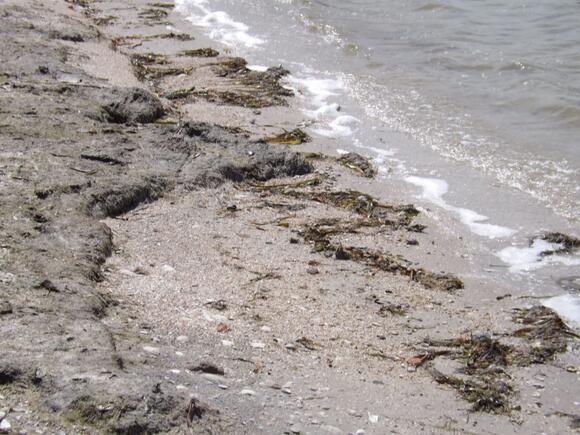
A blue-green algae bloom, identified as lynbya wollei, a “filamentous algae,” dries out along the shoreline of Indian Mound Park on Lemon Bay in 2019. The algae grew into large brownish mats along the shorelines of Lemon Bay that year.
Filamentous algae piled up in mats along the shoreline below Ponce de Leon Park in Punta Gorda in 2020.
Photo provided by Betty Staugler This green filamentous algae (snot grass) was seen growing on the edge of the bar at Pirate Harbor.
PORT CHARLOTTE — A way to prevent algae from damaging Florida’s coastline is to spend millions, perhaps billions of dollars, to better treat discharge from sewage treatment plants.
Florida’s Department of Environmental Protection decided in 2023 that those facilities would have to start removing most nitrogen and phosphorus from sewage in areas of impaired waterways.
The list of impaired waterways includes Charlotte Harbor.
The deadline is 2034.
That means Charlotte County’s water and sewer utility is facing two pressure points — a dramatic increase in population, and meeting the new state requirements.
The state labeled Charlotte Harbor waters as impaired for nitrogen in 2020. Nitrogen is a product of human and animal waste along with fertilizer.
High levels of nitrogen entering the harbor through rivers and other runoff shows a dramatic increase in algae that kills sea grass and impairs sea life habitat.
A deadline for accommodating population growth is harder to predict. The county uses population statistical model predictions provided by consultants, Charlotte County Utilities spokesperson Stu Gooden said.
Algae blooms are an increasing problem worldwide, spawning the acronym HAB or harmful algae bloom.
In Florida, the infamous algae is red tide. Its blooms can lead to massive fish kills and makes beach trips uncomfortable. The last major red tide in Southwest Florida was in 2018-19.
Also that year, a freshwater mirco-algae called blue green coming out of Lake Okeechobee ravaged Fort Myers downtown where the Caloosahatchie River meets Charlotte Harbor salt water.
More recently in Charlotte County, stringy macro-algae labelled filamentous plagued the harbor, stretching from where the rivers Peace and Myakka meet, down the coast toward Lee County and up the coast toward Sarasota.
Mats of algae that stretch deep below the surface are believed to have contributed to a 29% die off of sea grass in the harbor between 2018 and 2024 with decline probably continuing, said Kate Rose, Charlotte County Sea Grant agent for University of Florida.
The sea grass supports clams and small fish in the harbor. It is considered a measure of the health of the harbor. Its loss also damages the state’s large sport fish economy.
About 40% of treated sewage in Charlotte County is injected underground. The rest is sold for golf course and subdivision irrigation. These customers are required to keep it in special ponds and prevent overflows in rain events.
SOURCES OF SEWAGE
Nitrogen levels in the form of ammonia are increasing in the harbor, according to recent reports in the Water Atlas posted by the Coastal and Heartland National Estuary Partnership. CHNEP is charged with monitoring the levels of bay pollutants.
But measuring nitrogen is a difficult way to assess impairment, Rose said, because the algae gobble it up as soon as it arrives. This makes loss of sea grass and other marine life — and the increase in algae — more reliable indicators of nitrogen impairment, she said.
Not too long ago, Rose said, the consensus was that big storms hitting Florida’s coast every few years were a major cause of nutrient pollution by churning up decaying matter of plants and animals in the wake of the storm and releasing nitrogen.
But this year’s drought brought up uncomfortable evidence that the nitrogen levels continue to rise in areas nearest to human population, she said.
Specifically, algae continued to increase near where the Myakka and Peace rivers join at Charlotte Harbor. This is near human development.
“It’s dry, and we’re still having (algae) blooms,” she said.
So the exact understanding of what types of pollution cause the biggest problems remains elusive.
“One thing we do understand is that if you can reduce the amount of nutrients in the water, things get better,” Rose told The Daily Sun.
Rose said she is optimistic that the new advanced water treatment requirements will help the county improve water quality at the same time as it accommodates the surge in population.
“I think advanced water treatment is a great solution,” she added. “We’ve seen it work in Tampa. We’ve seen it in Indian River.”
TREATMENT PLANTS
Several plants in Sarasota County are already online with advanced water treatment. One in Lee County just started.
With the expansion of the East Port plant, Charlotte County is in line.
The East Port plant is off Harborview Road near the Peace River. It will be the county’s first treatment plant to lower nitrogen levels, CCU staff told commissioners at a recent meeting.
That improved and expanded plant will begin operations in early 2027, Gooden said. Three more plants will follow, before 2034. They are the Burnt Store plant handling burgeoning development south of Punta Gorda to the Lee County line, West Port and Rotonda.
Gooden said he did not have a figure for the estimated cost upgrades, but several years ago, CCU officials estimated the county had $1 billion of improvements needed for water and sewers, due to a long period of inattention in earlier years.
CCU projects are funded not by property taxes but by customer rates and connection fees, sales tax dollars and federal and state grants.
In 2019, recognizing the backlog of capital improvement projects, commissioners voted to raise water and sewer rates equally by 7% for three years in a row. The cost for sewer improvements is higher than water, but commissioners decided to raise rates equally to not overburden sewage customers. They cancelled another two years of 5% increases after a public backlash.
This fall, they started raising rates again with a 3.5% increase. The plan is to raise rates 3.5% every year, unless the Florida Public Service Commission index comes in at a higher rate.
Connection fees for new homes or septic-to-sewer households are also increasing dramatically, reaching as high as $17,596 per connection for low-pressure systems, up from $11,201 in 2019.
Charlotte County has had some of the highest water and sewer rates in the region, which commissioners said reflects how spread out the population is, and the large percentage of seasonal residents and small retirement households. The county also took over the ailing General Development utility decades ago and has been paying off that inflated purchase.
These costs are what it takes, Rose said, to keep the community environment healthy.
“It’s expensive to be a human being,” Rose said.
The state’s new nitrogen requirement requires that levels drop to an average below 3 mg/L. A report from July shows level reaching 18 on some days. CCU did not answer questions about the current levels.
Costs for upgrading the systems are spread out between 50,545 sewer customers. Gooden did not provide an average customer bill, saying there is no typical customer.
Some critics of the county’s water quality efforts say improved sewage treatment will not come in time to address the damage.
For that reason, they argue, the county should back off its extensive septic-to-sewer plan, which commissioners have hailed as a water quality initiative.
Rob Robinson, a Cape Haze resident and marine biologist, say while the sewage treatment plants are releasing high nitrogen, what is the point in forcing people to abandon their septic systems and pay to hook into the sewer system?
The county’s plan is based on removing the oldest, most outdated systems located closest to the waterfront.
Robinson said scientists at Florida State University have developed more precise techniques to measure which septic systems are actually causing harm.
“I really feel like they need to use better science,” Robinson said of commissioners.
FSU hydrogeology professor Ming Ye said his team has completed two studies of Florida septic systems identifying how nitrogen travels in different soil types. They are currently studying Charlotte County septic systems, with results expected soon.
“The nitrogen load from septic tanks is indeed a big unknown, and we try to estimate it from a modeling perspective. Our experience is that, since the load varies substantially in space, we will have to study the load site by site,” Ye stated in an email to The Daily Sun.
Gooden said the utility does not agree that the septic-to-sewer plan should be altered or abandoned until advanced water treatment arrives.
What remains unclear is whether improving technologies for handling waste and other pollution will keep up with the growth in Florida’s population.
Robinson said if the county uses the rules set in its comprehensive plan for development, it will help. That includes sending people out to evaluate wetlands proposed for development, rather than relying on developer reports.
With increasing development, there is increasing pressure to develop on top of wetlands, he said, and those wetlands are what protect Charlotte Harbor.
Planning Director Shaun Cullinan said the county uses wetland maps also to identify vulnerable areas for any development over a half acre. Staff do conduct site visits on properties seeking permits below a half acre.
“Certain determinations and enforcement responsibilities fall under the authority of other agencies,” he stated, such as final determination of wetland boundaries.
To those who say halt all development, Rose tentatively disagrees.
“Closing the door behind me is not my style,” she said. “I think we’re capable of meeting all of our needs, if we cooperate … If we can get aligned, then we can do it.”
 Add to Preferred Sources
