undefined
Posts
undefined
Followers
NO765MN group requests Houston County commissioner support
By KAITA GORSUCH,
2026-08-19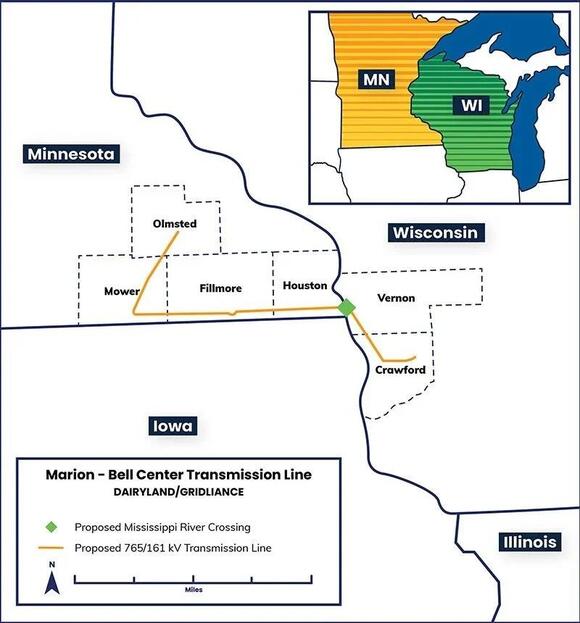
Members of the NO765MN group met with the Houston County commissioners during the Aug. 18 board meeting to request their support during the next Minnesota Public Utilities Commission public comment period.
NO765MN is a group of southeast Minnesota farmers, landowners and residents who oppose the “Gopher to Badger Link” Transmission Line.
The Gopher to Badger Link Transmission Project is proposed to help develop a “new, 765 kilovolt (kV) ‘back-bone’ transmission line … and the Gopher to Badger Link is part of a series of proposed new regional transmission projects across the Upper Midwest to support the energy system as it grows and evolves,” according to the project’s website.
The Midcontinent Independent System Operator has proposed several projects as part of a Long Range Transmission Planning (LRTP) portfolio. The Gopher to Badger Link is part of LRTP Tranche 2.1, approved in 2024.
Public comments
As part of the filing process with the MPUC, the public is welcome to leave comments on the project’s Certificate of Need application. In February, Houston County submitted Resolution 26-08 to the MPUC, formally opposing the project until it is proven that the project is the least impactful alternative, no reasonable lower-voltage or non-wire alternatives exist, the project complies with the county’s Comprehensive Land Use Plan and local environmental, agricultural and socioeconomic impacts are minimized as much as possible.
“We’ve been advised that comments should be directly pertinent to need and alternatives,” said Charlie Wray, NO765MN member, “and the most effective comments are those that have documentary references with them.”
The commissioners had received a reply to the resolution from the Applicants, but it was full of “nonanswers,” Commissioner Cindy Wright said during the Aug. 18 meeting. With the next comment period coming up, Wray suggested the county’s comment be more specific.
“(In the resolution) you talk about you haven’t gotten any answers about human health, and I would respectfully request that you expand upon that,” he said. “You could say something to the effect that the applicants had not used any peer review research to rebut (retired physician) Dr. Ben Johnson’s comments in the docket that happened to cite recent research.”
As both a resident and the former county public health and human services director, John Pugleasa said he has concerns with the potential impacts this project may have on the groundwater and karst geology in Houston County.
The transmission lines will be on 200-foot tall towers on drilled pier concrete foundations, ranging from 5 to 7 feet in diameter and depths ranging between 15 and 50 feet. Pugleasa said he has reached out to people he worked with at the Minnesota Department of Health to ask about the impacts of these bases.
“It’s like crickets. Nobody seems to be very interested,” he said. “That disappoints me because we pushed the ag producers in our communities, not just in Houston County, but the Department of Health isn’t as equally motivated to push the power company.”
Pugleasa said the board has a “unique opportunity” to question some of the state agencies and make them “do their due diligence” to conduct an independent study of the impacts the transmission lines have.
“Make them show their work. We had to show our work when we were in grade school when we came up with an answer,” he said. “I think if you have a conflict of interest because you’re paid as a staff person for the power company or through MISO, that should at least beg another question: is there an independent study that supports those findings?”
Green energy
State agencies that have responded to Pugleasa have said the Gopher to Badger Link project is a green energy initiative, and while Pugleasa said he supports green energy, he doesn’t think this is a green energy project.
“Even if it is, shouldn’t they be equally concerned with it being a green transmission?” he said. “The only way they can show that it is is to actually do the research to see how it will impact the land, the environment and the people who live in proximity to the line.”
Commissioner Eric Johnson said he wonders what will “feed this line.”
“If this is going to be a green energy project, it’s going to take solar and wind to feed that. That’s going to affect our land use in the counties along the line,” he said. “That’s going to have an everlasting effect on our land use, and that’s what worries me a lot. It’s going to change our landscape … if that’s true.”
Our cost, their benefit?
Wray also said the county should address in its comment MISO’s benefit-cost analysis. Tranche 2.1 is reported to have a benefit-cost ratio “ranging from 1.5 to 3.5,” meaning every dollar invested results in $1.50 to $3.50 back.
“Their independent market monitor, which you also have the comments of him that analyzed this project, says that no, it’s closer to 0.4-0.7.” Wray said. “When the Certificate of Need came out, MISO still had a 1.5 to 3.5 benefit-cost ratio, so they have not been dissuaded at all. That would be one comment that could be quite pertinent from the Houston County Commissioners saying that you (MISO) have not reconciled this.”
Commissioner Kurt Zehnder said he has asked project representatives how the Gopher to Badger Link will benefit Houston County residents, and he has not received an answer.
“If the cost share goes to residents of Houston County to pay for it, why am I paying for something? I might as well go out and buy a new car for you, and then you just drive it, and I don’t see nothing of it,” he said. “It’s just ridiculous, and I am publicly, adamantly against this. I stand with you people because answers aren’t being given, and that honestly pisses me off as a resident.”
Part of the stated need for the Gopher to Badger Link is for meeting the “growing electrical demand.”
The NO765MN group cited MiEnergy CEO Brian Krambeer’s message in the August 2026 MiNews magazine.
“For nearly two decades, the electric utility industry experienced very little growth in electricity sales,” Krambeer writes. “Over the past 10 years, our (MiEnergy) energy sales have averaged less than one-half of 1% growth.”
Kyle Johnson, a landowner and farmer from Crooked Creek Township, urged the Houston County commissioners to remain “engaged, alert and skeptical.”
“This county must urge the Public Utilities Commission to decide based on proven need and real benefits to Minnesotans,” he said, “and not vague ‘strengthen the grid’ marketing slogans, all while signs point to data center loads, which is a net negative. … There is ample evidence to show the cause for the county to demand the state of Minnesota to utilize the precautionary principle and slow this process to where safety can be proven, and/or to demand safer alternatives.”
Kyle Johnson called on the board to “mobilize its legal resources” and act “in defense of its citizens.”
“If we fail to take this seriously at an existential level, we will be remembered for being on watch as this novel industrial hazard is thrust into our peaceful communities,” he said.
He said the other state agencies aren’t being looped in as much as expected because this seems to be an “expedited” and “neutered” process. Kyle Johnson asked the commissioners to “demand a response” from the MDH to show its “duty, oversight and function of this novel stressor,” to engage with the Minnesota Pollution Control Agency to “demand support” to analyze the project and to consider local ordinances that “protect health and environment in Houston County” that are “under threat” from the proposed line.
“Please continue to stay engaged. I recognize this is a lot of work and is a difficult and uncomfortable process,” Kyle Johnson said. “I think we need to remain creative and remain bold.”
Wright said in the board’s original public comment, the county asks Dairyland and MISO to provide information and answers to the questions asked in the resolution.
“Because we’re hearing a lot of the one-sidedness of what the industry itself is pushing out,” she said, “maybe we need to address with the Public Utility Commission somehow in our comments that this is what we expect as a local government board.”
She asked for the local groups to continue to update the Board of Commissioners on what they are doing.
 Add to Preferred Sources
