undefined
Posts
undefined
Followers
Ohio lawmakers OK recovery housing rules despite industry objections
By DANNY ELDREDGE,
7 days ago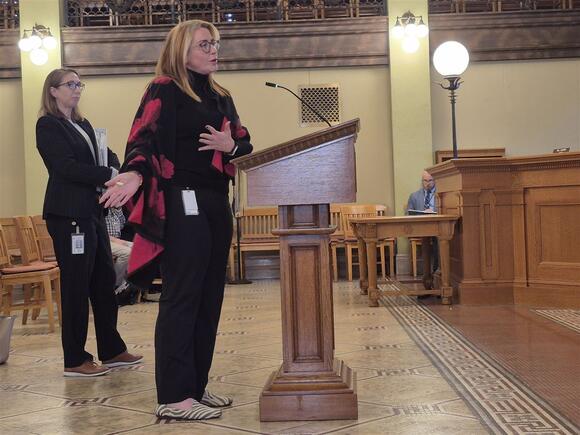
COLUMBUS — The Ohio Department of Behavioral Health can continue enforcing its new certification program for addiction recovery residences, state lawmakers decided Monday.
Gov. Mike DeWine signed an executive order in August establishing a statewide certification program for the industry. The emergency rules created under that order are now permanent following approval by the Joint Committee on Agency Rule Review.
The governor, Ohio Department of Behavioral Health Director Tia Moretti, and state legislators said the rules are necessary because the lack of appropriate state oversight has led to the proliferation of shady operators that are more interested in collecting payments than helping those recovering from addiction.
Before the emergency rules took effect, recovery houses only needed to receive accreditation from Ohio Recovery Housing or Oxford House. Those organizations were also in charge of investigating alleged misconduct by the recovery homes they accredited.
Leaders of Ohio Recovery Housing, Oxford House, and other industry representatives urged the committee to block the rules for exceeding statutory authority and creating an adverse impact on business.
Kelly Manns, director of quality for Ohio Recovery Housing, said the rules are redundant and will unnecessarily increase compliance costs for the facilities.
“Recovery housing in Ohio is largely provided by nonprofit organizations, faith-based organizations, family centered programs, peer-operated homes, and rural operators that typically function with limited administrative infrastructure and narrow operating margins,” Ms. Manns said.
“Unlike health care or licensed-treatment providers, recovery housing operators are not funded through Medicaid reimbursement or commercial insurance payments because it is housing,” she continued. “As regulatory obligations increase, so do costs.”
Ms. Manns said some recovery homes are already closing because of the emergency rules, and more could follow if the rules become permanent.
Paul Stevens, senior adviser for state policy and public affairs for Oxford House, said the rules could cause all of his organization’s recovery homes to close because of its peer-led model.
“It requires that there be off-site staff available 24/7,” Mr. Stevens said. “There is no staff.”
Opponent testimony was also provided by Jeffrey Kamms, executive director of the Road to Hope House, which houses up to 241 men, women, and parents with children in Erie and Lorain counties.
Mr. Kamms said the new rules would increase his organization’s costs by $170,000 per year.
“The increase is over $700 per bed per year,” he said. “We are a large organization, so that’s probably a smaller cost than for 80 percent of recovery homes in the state of Ohio.”
Supporters stand their ground
Ms. Moretti said the behavioral health department appreciates the work of Ohio Recovery Housing and Oxford House — which is why their contracts weren’t terminated.
However, she said, the role played by those organizations was inappropriate.
“Having both the regulator and the accreditor in one body was a conflict that I could not answer for,” Ms. Moretti said.
Oxford House facilities would not close under the rules, she added, because they were amended to ensure the peer-led model is allowed to continue.
“Will change be scary? Yes, absolutely,” she said. “But are we trying to run something as great as Oxford House out of our state? Absolutely not.”
Ms. Moretti said all kinds of industries require national accreditation and state certification, and recovery houses shouldn’t be any different.
“That is a standard of excellence — whether you’re looking at a health department, a lab at [the Bureau of Criminal Investigation], a coroner’s office, a treatment facility, or an Oxford House,” she said.
“The goal is not to be overly cumbersome and costly,” Ms. Moretti continued. “We do have the opportunity to help with waivers, but most compliant providers would not meet in front of us to re-up their certification for another two years, giving us plenty of time to do education and engagement.”
State Sen. Theresa Gavarone (R., Bowling Green), chairman of the Joint Committee on Agency Rule Review, also pushed back on opponents’ arguments several times during the hearing — saying she is aware of an accredited recovery home that was mouse-infested and covered in feces.
“Don’t people in recovery deserve some basic safety and health standards?” Ms. Gavarone said.
Testimony in favor of the rules package was also provided by Olivia Morrin, chief operations officer of Team Recovery in Toledo. She said her organization has more than 200 recovery housing beds in northwest Ohio.
Ms. Morrin said the rules provide basic protections for residents and create a healthier environment for recovery.
“Residents deserve safe living conditions, respect for their rights, and clear expectations for themselves and recovery housing operators,” she said. “We support a statewide certification framework that establishes these standards and holds recovery housing operators accountable.”
House Bill 58
Before the governor signed his executive order in August, the Ohio House unanimously passed legislation in February that would implement many of the same recovery housing rules.
The Senate Addiction and Community Revitalization Committee scheduled a vote on House Bill 58 for Wednesday, so the recovery housing bill could be headed to the governor’s desk later this week.
However, Ms. Moretti said it was important for lawmakers to approve the department’s rules immediately because the state is dealing with risks to public health and safety.
“We do have accredited homes that are, for all intents and purposes, accredited, but still in disrepair,” she said.
“And if we have a narrative that folks are going to go out of business because they have the eyes of the state on them as well or because they can’t make $1,000 dues, what do they do when a load-bearing wall comes short and there are six lives in that house?” Ms. Moretti said. “I’m worried about the lives of these folks.”
 Add to Preferred Sources