undefined
Posts
undefined
Followers
Ohio data centers generated $9.1 billion in 2025, but industry faces voter backlash
By DANNY ELDREDGE,
9 days ago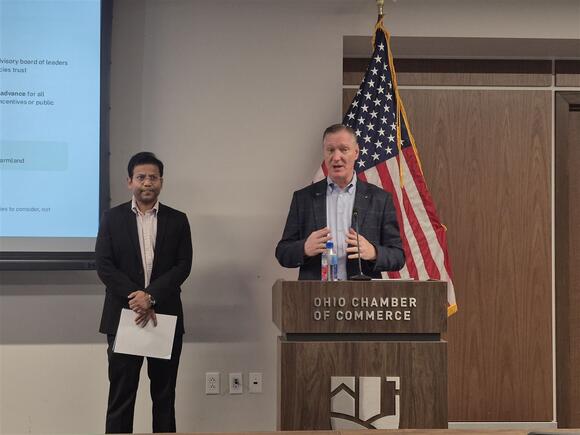
COLUMBUS — The Ohio data center industry contributed approximately $9.1 billion to the state’s gross domestic product in 2025, according to a new report commissioned by the Ohio Chamber of Commerce Research Foundation.
A research team led by SRC EvalMetrics President Saurav Roychoudhury found that the data center industry supported about 69,600 jobs through ongoing operations, construction, and related economic activity.
Of those jobs, 14,257 are direct payroll jobs with the data center industry. However, only 1,100 to 1,800 payroll employees worked at the actual data center facilities.
“The 14,257 direct jobs reported above measure employment in Ohio’s broader data-processing, hosting, and computing-infrastructure industry,” the report says.
A total of 26,145 jobs were related to construction and equipment spending.
Researchers expect data center companies to spend approximately $109 billion on construction and equipment from 2025 to 2030 — resulting in an average of 42,800 jobs per year.
“There is a massive amount of investment,” Mr. Roychoudhury said. “This creates a huge construction wave.”
Steve Stivers, president and CEO of the Ohio Chamber of Commerce, said the data center industry has the potential to strengthen Ohio’s economy for years to come.
“As we think about our economic future, we need to be focused on attracting investment, but we also need to make sure our communities are are positioned to benefit from it,” Mr. Stivers said. “That means understanding the opportunities these projects bring and thinking strategically about how local leaders can leverage them in meaningful ways to improve the lives of their residents.”
Response to voter backlash
While they celebrated the economic benefits of data centers, Mr. Roychoudhury and Mr. Stivers acknowledged that Ohioans overwhelmingly voted against data center development in communities across the state on Election Day.
In addition to the 10 charter amendments banning the construction of large data centers, Mr. Roychoudhury pointed to at least 12 other local ballot measures where Ohio voters rebuked data centers and elected officials associated with them.
Mr. Roychoudhury said he worked with Amanda Woodrum, co-executive director of ReImagine Appalachia, to create a community benefit agreement framework for data center companies to follow when seeking to build facilities in Ohio.
First, he said, data center companies should engage with stakeholders early in the process.
“If your neighbor is building an addition to their house, you want to hear it from the neighbor — not from the sound of a bulldozer in the morning,” he said.
Issues that should be discussed by all parties include energy use, water consumption, noise, land use, public infrastructure costs, and the effects of rapid technology turnover, according to the report.
Business model needs work
Mr. Stivers said voters clearly disapprove of the current business model employed by data center companies.
“It’s never too late, but I think the industry does need to change its current business model. I think that’s the real lesson of 2026,” he said. “I don’t believe it to be an existential issue today, but if the business practices don’t change I think it will be an existential issue.”
Mr. Stivers said Ohioans do not like long-term nondisclosure agreements, and they are also concerned about energy costs, water use, and whether residents are actually receiving financial benefits from data centers.
“The companies themselves, not just the developers, need to lean into the communities and have real conversations to understand what the needs of the communities are, and then create a real community benefit agreement,” he said.
Mr. Stivers said it is OK that some communities are rejecting data centers, noting those decisions create certainty for businesses.
“They can always say no at any time,” he said. “It would be great to have them hear folks out, but that’s up to every community. They get to make the decision they want to make.”
Lyn Cox, a Monclova Township resident and regional leader of Conserve Ohio, said the Ohio Chamber’s views are shortsighted.
“Would it be too much to ask for the industry to adopt the slogan of ‘do no harm?’” Ms. Cox said.
“Right now there is excessive air, water, light, and noise pollution. We have high voltage line EMF exposure,” she continued. “The health costs are expected to be astronomical.”
Asked if he would support Conserve Ohio’s proposed 12-month moratorium on data centers, Mr. Stivers said that is not his organization’s preference.
“We would prefer to get these rules of the road set pretty quickly,” he said, noting the incoming Acton administration could propose data center policies in the state budget.
Mr. Stivers said he does not expect the Ohio General Assembly will take action on data center issues during the lame duck session, but anything is possible.
Legislative leaders discuss data centers
Legislation addressing data centers failed to reach the finish line before state lawmakers left for their summer recess, and it’s not clear whether House Bill 646 will be revived during lame duck.
Ohio House Speaker Matt Huffman (R., Lima) said he supported most of H.B. 646, but he wanted to eliminate the data center sales tax exemption. The bill would have limited the exemptions to 50 percent.
“I don’t think the public approves of — and I don’t — this special sales tax exemption for these builders,” Mr. Huffman said, noting Gov. Mike DeWine acknowledged that sentiment when he paused the data center tax break in May.
Mr. Huffman said lawmakers attempted to repeal the data center tax break in the state budget, but Mr. DeWine vetoed that line item. He and Ohio Senate President Rob McColley (R., Napoleon) said their members would consider overriding that veto in the coming weeks.
Ohio House Minority Leader Dani Isaacsohn (D., Cincinnati) said the data center industry may not be able to rehabilitate its reputation at this point.
“Thankfully, it is not my job to improve the brand of data centers. There are a lot of people who are wasting a lot of money at the moment trying to do that,” Mr. Isaacsohn said.
“It would have been a lot easier for them, a year ago, to just do the right thing,” he continued. “Invest in communities that you want to go into, build relationships, and do it in a transparent way — rather than the opposite of that.”
 Add to Preferred Sources