undefined
Posts
undefined
Followers
Strong winds from the northeast make Toledo-area algae even more gross
By TOM HENRY,
2026-09-28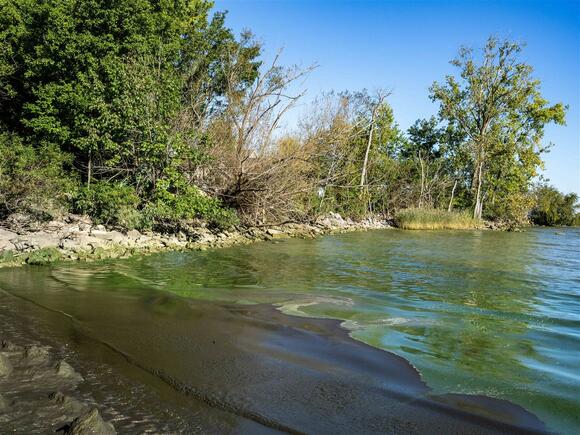
Western Lake Erie’s 2026 algal bloom is still going strong in the Toledo area as October looms.
Water at several locations, including Maumee Bay State Park and Bay Shore Road in Oregon, has taken on a particularly thick, green hue in recent days.
The bloom was already in a prolonged peak.
But the appearance and texture of it became intensified by strong winds from the northeast.
Those winds pushed more of the bloom from the open lake toward the western shoreline, experts said.
Elevated toxins have been found but have remained at levels that water-treatment plant operators have been able to handle.
“The green lapping water started about a week ago and continues,” said Sandy Bihn, founder of the Lake Erie Waterkeeper activist group.
As a waterfront property owner along Bay Shore Road, she has a front-row seat to the situation.
She said it is “gross, thick, putrid green water” that suggests to her that the battle against algal blooms is far from over.
Justin Chaffin, Ohio Sea Grant/Ohio State University Stone Laboratory research coordinator, said last week’s strong winds from the northeast “concentrated the HAB [harmful algal bloom] into the Maumee Bay area, but the sloshing effect might push it further out into the basin.”
The Toledo area usually gets more algae than other parts of Lake Erie because it is warmer and shallower than water to the east.
Water around the Lake Erie islands often mirrors what is happening in the Toledo area after a few weeks each summer.
Not so on Monday.
“The water around the islands has very little noticeable cyanobacteria today,” Mr. Chaffin said.
Satellite view obscured
In its latest update released Monday afternoon, the National Oceanic and Atmospheric Administration provided little evidence of the problem being faced in the Toledo and Oregon areas.
The bulletin said its latest satellite imagery, taken Sunday, was obscured by cloud cover and winds above 9 mph.
Therefore, it didn’t get a full picture of the bloom’s extent.
But it saw enough to determine that at least part of the bloom “has moved offshore into the center of the western basin, from Monroe to north of East Sister Island.”
University of Toledo Lake Erie Center Director Tom Bridgeman concurred with what Mr. Chaffin said about northeast winds exacerbating problems in the Toledo area, at least in the short-term.
“Also, it made it hard to go out and sample the open lake,” Mr. Bridgeman said.
His UT Lake Erie Center crew usually samples open water near Toledo every Monday, weather-permitting.
Mr. Bridgeman said this year’s peak has lasted longer.
“At least until a week ago, the bloom was remarkably bright green and ‘healthy’ looking, which is unusual for mid-September, at least it used to be,” he said.
Lingering blooms
Lake Erie algal blooms have been arriving earlier and staying later because of climate change, although they vary from year to year.
Two in recent years, in 2022 and 2024, lingered into November. At least one of those was believed to have been two separate blooms that overlapped.
Rick Stumpf, an oceanographer in NOAA’s National Centers for Coastal Ocean Science in Silver Spring, Md., leads the agency’s forecasting and tracking efforts.
Despite what people in the Toledo area are seeing now, he said, the 2026 bloom is still on track to be a moderate-sized algal bloom on the whole, nothing that rivals the 2011 record or the 2015 runner-up.
NOAA’s severity index is based on biomass only. It is mainly focused on the size of the bloom during its peak 30 days.
On June 25, at its annual forecasting event on Gibraltar Island, NOAA predicted this year’s bloom would be a 3 to a 4.5 on its 10-point severity index.
Reagan Errera, a research ecologist in NOAA’s Great Lakes Environmental Research Laboratory in Ann Arbor, said no “major encounters with the bloom” were immediately reported by the team collecting another round of samples on Monday.
The reported toxin level near Monroe on Saturday was around 0.18 ppm, which is below the recreational contact limit and not a problem for water-treatment plant operators to manage, she said.
Mr. Bridgeman said more sampling was to be done Monday afternoon in the Toledo area.
Ohio Department of Health records, generated with help from Mr. Chaffin’s research group, show the highest reading for toxins near Maumee Bay State Park was 80.72 ppm on Aug. 28, which is considered high. Toledo officials said in a previous interview their water-treatment plant operators were aware of elevated toxin levels back then, and were able to adjust for it in time.
The latest reading, recorded Sept. 15, was only 24.4 ppm.
In Lake Erie’s Sandusky Bay, chlorophyll values have been high, giving the bay a green hue, and a “mixed community of cyanobacteria” has been found, said George Bullerjahn, a Bowling Green State University emeritus professor whose research focus has for years been on Sandusky Bay.
“Nonetheless, microcystin toxin levels have remained very low, similar to most years since 2020,” he said. “So, considering western Lake Erie as a whole, Sandusky Bay has been comparatively benign this year.”
 Add to Preferred Sources