undefined
Posts
undefined
Followers
UTMC offers new commercial ventilator weaning system
By ERIC TAUNTON,
2026-09-13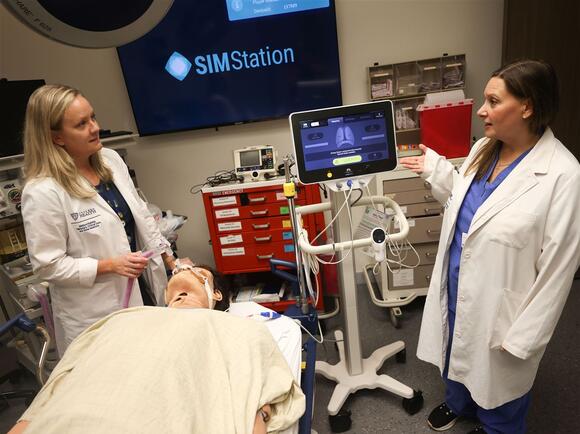
When someone is put on a ventilator, it can be a struggle to come off one, local doctors said.
Dr. Jill Cherry-Bukowiec, trauma surgery and surgical critical care physician at the University of Toledo Medical Center, said the longer a patient is on a ventilator, the weaker their diaphragm muscles can become.
“Patients that are really sick come into the hospital and sometimes need to be intubated,” Dr. Cherry-Bukowiec said. “When that happens, especially to older patients or patients that need the ventilator for a long time, their muscles start to atrophy or stop working as well.”
To wean patients off of ventilators faster, the medical center has started to offer the LungPacer AeroPace Neurostimulation System.
The system is an FDA approved technology that sends electrical pulses to the phrenic nerve, which supports the diaphragm, to exercise it, allowing the patient to recover from a ventilator faster.
The medical center is the first in the region to offer the neurostimulation system commercially, Dr. Cherry-Bukowiec said. Other hospitals including Cleveland Clinic have tested the technology in a research capacity but haven’t offered it to patients.
“We’ve been in this field for a long time,” said Dr. Melissa Kukiela, director of respiratory care at UTMC. “To be able to have just one more tool in our toolkit to get off the ventilator, [we’re] like, ‘Sure let’s do it.’”
A ventilator is a rescue therapy that takes over breathing for a patient when they can’t maintain adequate breaths on their own, the doctors said. The hope is always to take patients off of a ventilator as soon as they can but that doesn’t always happen.
Patients that are on ventilators long term have increased risk for pneumonia, irritation, and have more difficulty weaning off of a ventilator.
Eligible patients are people not improving, have underlying respiratory diseases like chronic obstructive pulmonary disease, or COPD, or are deemed unlikely to be able to wean off of a ventilator.
“Every day that you’re on the ventilator, the more likely you’re going to have trouble getting off of it,” Dr. Cherry-Bukowiec said. “If you start looking like you’re not going to be able to get off it, we need to start working that muscle.”
The pair of doctors compare diaphragm weakness to not working out after several weeks.
“If you don’t work out a lot or you stop working out, your muscles don’t have as much strength,” Dr. Cherry-Bukowiec said. “When you are older or sick, that muscle gets used up really fast and your body uses it for energy. The only way to really stop that is to allow your body to work on actually using your muscles like you would for when you go work out and do reps.”
Dr. Eduardo Mireles-Cabodevila, director of the medical intensive care unit at Cleveland Clinic, said the clinic has been doing research on the neurostimulation system.
“What this does is essentially when you’re depleted, what it does is it can help the muscle contract,” Dr. Mireles-Cabodevila said. “Essentially, we can tell the muscle how much to contract and keep it active and if a muscle is contracting, then it doesn’t become weak.”
The stimulation system features a specialized central-line catheter and console that sends low voltage pulses to the phrenic nerve, Dr. Cherry-Bukowiec said. Doctors and nurses conduct an electrocardiogram test and X-ray to find the phrenic nerve.
Once the nerve is located, a small incision is made on the left side of the neck and the catheter is inserted to reach the phrenic nerve. Once it reaches the nerve, the physician sets the machine to a certain intensity to stimulate the diaphragm.
Dr. Kukiela said though UTMC only has one unit, it can still help multiple patients daily.
“The nice thing about this is, with it not being continuous like a ventilator … we can use it for multiple patients,” Dr. Kukiela said.
 Add to Preferred Sources