undefined
Posts
undefined
Followers
Proposed Islamic Center in Berkeley County Sparks Heated Opposition
By Nikki Gaskins Campbell,
2 days ago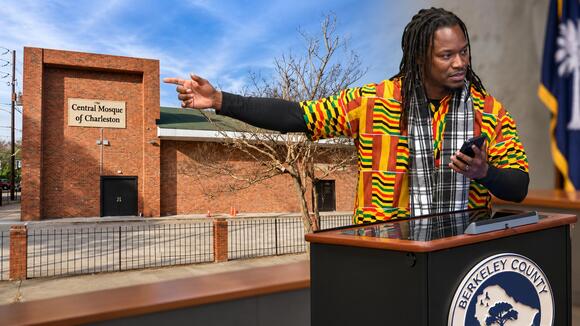
BERKELEY COUNTY, S.C. — Plans to build a new Islamic center in Berkeley County have sparked heated opposition, drawing a large crowd to Monday night’s county council meeting, where residents clashed over religious freedom, community values and the future of a proposed development along College Park Road.
Although the project was not on the council’s agenda and no vote was scheduled, residents packed the meeting to voice their concerns, with the overwhelming majority of speakers opposing the proposal. The tense public comment period included interruptions, particularly when a handful of residents spoke in support of the Muslim community.
The Central Mosque of Charleston plans to construct the Islamic center at 1013 College Park Road in Summerville. According to Berkeley County property records, the organization purchased the 12.56-acre property earlier this year for $2 million.
On its website, the mosque describes the proposed facility as a place for Islamic worship, religious education, youth programs and community gatherings.
“Imagine a place where our children learn the Quran, families pray together, and our community grows stronger in faith,” the organization states in an online fundraising appeal.
The mosque is seeking donations to help finance the project, which it says will serve the area’s growing Muslim population.
However, the proposal has ignited a contentious debate among residents, with some raising concerns about traffic, infrastructure and neighborhood compatibility, while others expressed broader opposition to Islam itself.
Residents voice strong opposition
Among the most outspoken opponents was Summerville resident Kellyanne Moran, who warned council members that their political futures could be at stake if they failed to act.
“We will not become another Michigan,” Moran said, referencing Dearborn, a city with a large Muslim population.
“Islam is not simply a religion. It is a political ideology with a long history of expansion. They do not want to co-exist. They want to conquer,” she claimed.
Moran urged elected officials to protect the community’s schools, neighborhoods and way of life, warning that residents could organize campaigns to replace council members who failed to address their concerns.
Rhonda Pereira also strongly opposed the development, arguing that an Islamic institution would conflict with what she described as the nation’s Christian identity.
“This is South Carolina, United States of America. Residents didn’t ask for a mosque,” Pereira said. “We are a Christian country.”
Pereira also raised concerns about Sharia Law, claiming the proposed center could eventually threaten American legal and cultural traditions.
Those assertions were not accompanied by evidence that the proposed Islamic center intends to operate outside U.S. law or establish a separate legal system.
Phil Manard, a naturalized American citizen originally from France, described his experiences traveling throughout Europe and expressed fears that similar cultural changes could occur in Berkeley County.
“This so-called cultural center is merely the first step,” Manard told council members, predicting that additional property purchases could eventually create a larger Muslim community.
Corey Masterson of Ridgeville also voiced opposition, arguing that Islamic beliefs were incompatible with Western culture.
“It’s not fear-mongering. It’s not Islamophobia. It’s reality,” Masterson said.
Ken Felsher of Summerville warned that the development could eventually threaten traditions such as public prayer and reciting the Pledge of Allegiance.
“Islam promotes Sharia Law and this is counter to the United States Constitution,” Felsher claimed, arguing that an Islamic educational center should not be permitted in Berkeley County.
Other residents focused on what county officials could legally do to limit the project.
Nancy Corbin acknowledged that stopping the development might not be possible but urged council members to explore their options.
“I don’t know the legal ramifications of whether or not it can be built. I don’t want it to be built, but I don’t know if it can be stopped,” Corbin said. “If it can’t be stopped, it has to be contained.”
Supporters call for religious tolerance
Despite the overwhelming opposition, several speakers defended the proposed Islamic center, urging residents to respect religious differences and constitutional protections.
Martin Levison shared his personal experiences visiting the Central Mosque of Charleston, describing its members as welcoming and deeply committed to their faith.
“I have spent time with people of the central mosque. I have shared in prayer with them and have to say that I was just as welcomed, it was just as holy, it was just as sacred and as moving as when I shared prayer with all of the Christian churches I’ve attended,” Levison said.
He encouraged residents to look beyond religious differences and recognize their shared values.
“What really matters here is our commonality, and so much of what we think is different is really simply just misinformation,” he said.
Abraham Kemmerlin also defended the Muslim community, invoking Christian teachings to encourage tolerance.
“Jesus says to love your neighbor as yourself and do to others as you would have them do to you,” Kemmerlin said. “Tonight, I would ask you to extend that same fairness to your Muslim neighbors.”
He also described the controversy as a matter of equal treatment under the Constitution, pointing to existing Christian institutions in the community.
“Same freedom, different faith, one Constitution,” the speaker said.
The supporter argued that Muslims should have the same opportunity to establish a house of worship as Christians and accused opponents of religious bigotry.
County officials say no proposal is before council
Despite the passionate testimony, Berkeley County Supervisor Johnny Cribb emphasized that council members were not considering any formal action on the development.
“We don’t even have anything in front of us as a county council to vote on, so there is anger and animosity on something that hasn’t been done,” Cribb said.
The distinction is significant because the property is currently zoned R-1, a residential classification that allows places of worship under existing county regulations.
Berkeley County Councilman Tommy Newell, who represents District 4 and chairs the Committee on Operations, acknowledged those limitations while suggesting other aspects of the project could face scrutiny.
“Under the current R1 zoning regulations, the construction of a place of worship is a permitted use; however, we may have the leverage to challenge and restrict any proposed school or residential components of the project,” Newell said.
The proposed center’s website references Islamic education and youth programming, but the information provided does not establish whether the project includes a formal school, residential development or other facilities that could require additional county approvals.
Online petition gains more than 1,000 signatures
Opposition to the development has also extended beyond the council chambers.
As of Tuesday night, more than 1,000 people had signed a Change.org petition titled “Halt mosque construction and extremist neighborhoods.”
The petition urges Berkeley County Council, the Planning Commission and the Board of Zoning Appeals to preserve the property’s existing zoning and reject requests that would allow large-scale institutional, educational or multi-use development.
Unlike some of the religious objections raised during Monday’s meeting, the petition focuses primarily on land-use concerns.
Organizers cite existing congestion along College Park Road, potential traffic increases, noise, stormwater runoff, parking and the development’s compatibility with surrounding residential neighborhoods.
“While we respect the rights of all property owners, the proposed scale of development raises significant land-use, infrastructure, and quality-of-life concerns for our surrounding residential community,” the petition states.
The petition also calls for comprehensive traffic and environmental impact assessments before any land-use changes are considered.
Among the concerns is the possibility of amplified outdoor broadcasts and large gatherings. However, the mosque’s publicly described plans do not establish that outdoor loudspeakers or amplified calls to prayer are proposed.
Muslim civil rights organization condemns rhetoric
The controversy drew a response Tuesday from the Council on American-Islamic Relations (CAIR), a national Muslim civil rights and advocacy organization, which condemned what it described as anti-Muslim rhetoric during Monday’s meeting.
In a statement issued November 17, CAIR said the comments reflected a troubling pattern of religious prejudice that portrays Muslim Americans as outsiders in their own communities.
“We condemn the bigoted anti-Muslim comments offered at the meeting to discuss a planned mosque in South Carolina,” said Nicole Fauster-Bradford, CAIR’s community advocacy director.
“The right to worship, establish houses of worship, educate our children and contribute to our communities is not reserved for members of any one faith.”
Fauster-Bradford also rejected suggestions that Islamic institutions are incompatible with American society.
“A mosque is a place of worship, community service, education and fellowship. It should have the same right to exist as any other American house of worship,” she said.
The organization pointed to broader concerns about anti-Muslim discrimination nationwide, reporting that it documented 8,683 anti-Muslim bias complaints in 2025, the highest annual total since it began publishing civil rights reports in 1996.
CAIR also reported 17 incidents targeting Islamic places of worship during May, June and July, compared with six during the same three-month period the previous year.
Those figures are based on complaints and incidents documented by the organization.
What happens next?
For now, the proposed Islamic center remains a source of division in Berkeley County, even though no formal proposal was before County Council on Monday night.
The Central Mosque of Charleston continues to promote the project and solicit donations, while opponents are organizing through public meetings and an online petition.
Whether the development will require additional zoning approvals, variances or other land-use decisions will depend on the specific plans submitted to county officials.
The dispute has also raised a larger question about how Berkeley County will balance neighborhood development concerns with the constitutional rights of religious organizations.
Berkeley County is already home to one mosque. Masjid Muhajirun Wal Ansar is located at 1020 Old Highway 52 in Moncks Corner.
The post Proposed Islamic Center in Berkeley County Sparks Heated Opposition first appeared on The Berkeley Observer.
 Add to Preferred Sources

