undefined
Posts
undefined
Followers
As Genesee County's population shrinks, need for aging services to rise
By jfbeck_99_272012,
2026-10-07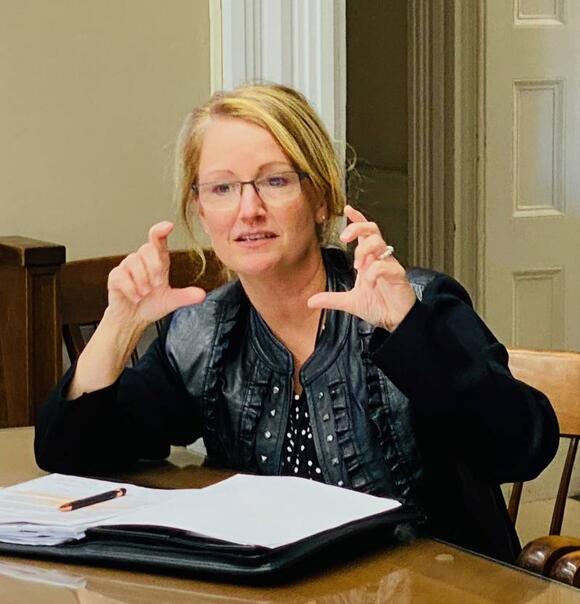
Photo by Joanne Beck
Households led by someone aged 65 or older have a median income of $48,512, which is about a third below Genesee County's median level of more than $84,000, according to Jessica Riley’s Office For the Aging annual report.
And although there are young families throughout the county, demographics show that the population is getting older, Riley said this week.
“If we just look nine years out from now, we'll have a 21% increase in our county of adults age 65 and over. We'll have a 50% increase of individuals 85 and over. And so, as we age, the need for aging services certainly increases as well,” she said during a Human Services meeting with county legislators. “So we want to maintain our footprint. We want to grow awareness. So in nine years, that person that doesn't need me today, my hope is they're engaging with us and doing Tai Chi. So when they do need something nine years from now, we have our relationship.”
Riley used to teach Tai Chi, an internal martial art rooted in ancient Chinese traditions, and it’s a favorite exercise, she said. Beyond the specific movements, the OFA staff really wants to focus its efforts around “awareness and making those engagements,” she said.
“Then, when you look at the median household income, which is in the next section, a lot of the work we do is not with the individual that’s the household at $48,000 a year, right — 26% of our adults age 65 and over, 26.1%, are on Medicaid in our county," she said. "And so we’re typically working with somebody who is Medicaid eligible, but very often not, just over that Medicaid eligibility. But still, inflation and the cost of living present some challenges.
"And so the average individual who might have $48,000 household income would meet the HEAP benefit guidelines — $4,659 a month to qualify for HEAP," she said. "So there are benefit programs that are helping individuals outside of those that are on Medicaid.”
New York State’s Office for the Aging county projections indicate that Genesee’s total population will decline slightly between 2025 and 2045, while the number of older residents will climb, her report states.
The numbers of those 85 and older especially are likely to increase demand for in-home assistance, caregiver support, transportation, and other services that help people remain safe and independent, it states.
That means that out of a projected total population of 56,328 in 2045:
- Age 60+ will be 19,234, up from 17,480 in 2025 (10% increase)
- Age 65+ will be 15,504, up from 13,016 in 2025 (19.1% increase)
- Age 85+ will be 3,362, up from 1,630 in 2025 (106.3% increase)
The OFA has not added nor discontinued any programs during the past 12 months, Riley said, but rather, it has focused on extending the reach of existing services and exploring new ways to serve residents.
Projections for 2026 showed a continued demand for core services, including 4,500 aide hours, an increase from 1,904 in 2025; 936 transportation trips versus 892 in 2025; 4,216 NY Connects service units, up from 3,903; and 55 nutrition counseling hours, compared to 10 last year. There was a drastic reduction in Farmers Market coupons — from 1,200 to 400 this year — due to the state’s Agriculture and Markets Department cuts, Riley said.
The Office for the Aging’s proposed 2027 budget includes a salary and fringe benefit expense increase by $90,735 that includes filling a vacant meal site manager position and adding a grant-funded program assistant position. Equipment funding remains consistent with 2026 and is expected to support ramps that improve home safety and help prevent falls.
Staffing includes 22 full-time equivalents, said Riley, who added that she has been in this current role as director for 18 months since Sept. 3.
Contractual expenses decrease by a net $16,738, reflecting changes in projected consumer-directed home care and home-delivered meal services. Budgeted revenue increases by $125,947 and includes federal funding of $479,797, state funding of $1,664,563, other contracts and grants, gifts and donations, and rental income totaling $378,189, and contributions of $85,891.
Looking ahead, there is uncertainty about future funding for aging services, including the possible effects from changes to Medicaid funding, she said. No such reductions are reflected in the 2026 or 2027 allocation schedules. The state and federal budgets will be monitored and assessed for any changes “as they become clear.” The office will continue to cross-train staff and manage costs by limiting discretionary expenses, she said.
“But really, moving forward, my goals for the upcoming year is to continue to strengthen our relationship with our healthcare partners. It's social health, very much tied to clinical outcomes as that medical health is,” she said. “So, working on some different ways to do that, getting our evidence-based interventions across the county, and just continuing to provide the services in the most rural parts of our county.”
Her longer term goals are to:
- Reach more older adults before a crisis occurs.
- Explore additional congregate meal sites.
- Bring more health promotion programs into accessible spaces throughout the county.
 Add to Preferred Sources