undefined
Posts
undefined
Followers
Texas Spent Millions on a Divisive Reading Program. Will It Pay for an Overhaul?
By Linda Jacobson,
1 days ago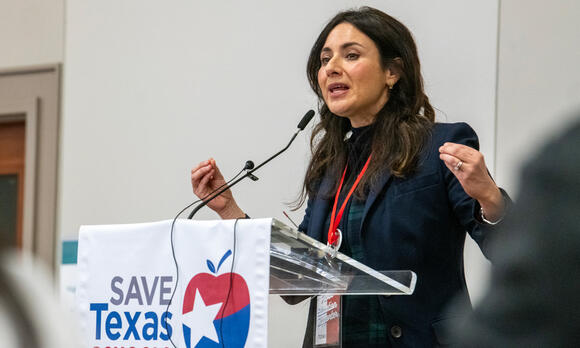
As a state representative, Texas Gov.-elect Gina Hinojosa frequently criticized Gov. Greg Abbott’s administration, including the Texas Education Agency, for using emergency powers to execute huge government contracts with little transparency.
“Someone’s getting rich,” she posted in 2024 as costs to develop a state-owned reading curriculum soared to more than $100 million. Known as Bluebonnet, the controversial K-5 program, she said was “using Jesus to peddle curriculum to parents.”
With stagnant reading scores, education Commissioner Mike Morath, who Hinojosa said she will fire, argues that the religious material, including several Bible stories, is necessary to give students the background knowledge they need to be strong readers. Some district leaders like how it’s structured. But the program has drawn intense criticism from those who say it borders on proselytizing, is filled with errors and downplays other world religions.
Texas Passed a Bible-Themed Curriculum. But Many Districts Aren’t Using It
Now, it could get an overhaul when Hinojosa names a new state chief. State law requires the agency to develop curricula and offer financial incentives to districts that adopt them. But the education commissioner oversees what the materials include and the state board decides whether to approve them. One incoming board member said she’s heard plenty of concerns from parents about the program, but wants to get more input from elementary school teachers.
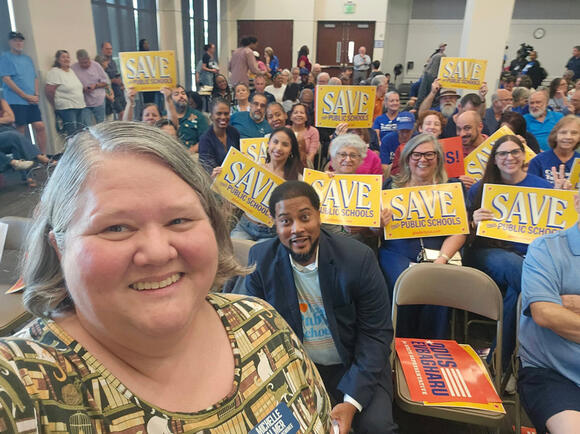
“If the teachers are saying it’s useless, then I think we have to scrap it,” said Michelle Palmer, a Democrat and history teacher in the Houston-area Aldine Independent School District, who won an open seat on the board. She defeated Republican Tiffany Nelson, a former Conroe school board member and strong supporter of bringing Bluebonnet to that district. “Amending it would take a lot of time.”
Hinojosa’s transition team did not respond to requests for comment. But the cost of revising or replacing the units could range from $2 million to $27 million, according to Simba Information, a market research firm that specializes in educational publishing. Those estimates wouldn’t include the K-3 foundational skills lessons or additional expenses like printing, distribution and implementation. What’s clear is that the state won’t have COVID relief funds to pay for any updates, like it did with Bluebonnet.
The state spent $19 million in 2020 to purchase Core Knowledge Language Arts from curriculum company Amplify and then signed an $84 million contract with the Boston-based Public Consulting Group to further revise it and add lessons. Several additional vendors, including the conservative Texas Public Policy Foundation. contributed or reviewed content.
Bluebonnet is among the reforms that have “put Texas students on a path to academic excellence,” said Mandy Drogin, a senior fellow at the foundation. “Any well-educated leader overseeing education would know it is historically undeniable that the Bible has profoundly influenced Western civilization, America’s founding, and the literature, art, laws and institutions that shaped our great nation.”
Who Wrote Texas’s Million Dollar, Bible-Infused Curriculum? The State Won’t Say
‘High-pressure marketing’
A Houston Chronicle analysis shows that spending on the program, including teacher training and printing costs, could reach $1 billion by 2029. That would include the more than $8 million the state is spending to fix errors and copyright violations. Last year, the state extended its contract with Public Consulting Group for an additional year, but it added a clause to allow the agency to withhold funds for any “critical” flaws or failures to secure intellectual property rights.
The updated contract shows that the final payment was reduced by over $1.2 million and the agency told The 74 that it has “no other agency contracts with this vendor for curriculum work moving forward.”
One immediate move a new commissioner could make is to “de-emphasize the high-pressure marketing” of Bluebonnet, said David Anderson, founder of Strive Public Policy Resources, an Austin-based consulting firm.
A TEA document shows that during the 2025-26 school year, Morath partially evaluated the executive directors of the state’s 20 regional education service centers by how many districts they could get to adopt Bluebonnet reading and math.
Those that use it receive up to $60 per student. In Houston, that translates to more than $3 million in additional funding. When the Irving Independent School District, outside Dallas, adopted it last year, officials said the extra money factored into their decision.
Lawmakers could also “remove the coercive financial incentives that leave cash-strapped districts to adopt this curriculum over their better judgment,” said Elva Mendoza, a legislative communications associate with Texas Freedom Network, a left-leaning organization that has been largely critical of the program.
‘Sensitive content’
Opponents argue the lessons gloss over racism and slavery in the U.S. and present biblical material, like the story of Esther, as historical fact. To Rabbi Joshua Fixler, who has three children in the Houston district, which adopted the program in June, the program is “unsalvageable.”
“It is not just problematic because of the use of Protestant Christian texts,” said Fixler, who is part of a campaign to inform Houston parents of the curriculum and how to opt their children out of it. In his view, the materials, across multiple grades and units, reframe religious freedom “as the freedom for Christians to practice their religion in public spaces.”
Third grade lessons on colonial America, for example, emphasize the pilgrims’ and colonists’ struggle to worship how they pleased, but don’t teach students about the intolerance toward those who followed other faiths.
David Brockman, a religious studies scholar with Rice University’s Baker Institute, raised questions about the emphasis on Christianity when he critiqued the curriculum for the Texas Freedom Network.
“Does religious liberty only apply to Christians?” he wrote. “What happens when the so-called religious freedom of Christians tramples the rights and beliefs of other religions?”
Districts have flexibility in using the materials. Some that adopted it took out the more controversial lessons, The 74 reported last year. Others, like Houston, have further supplemented the state-developed materials.
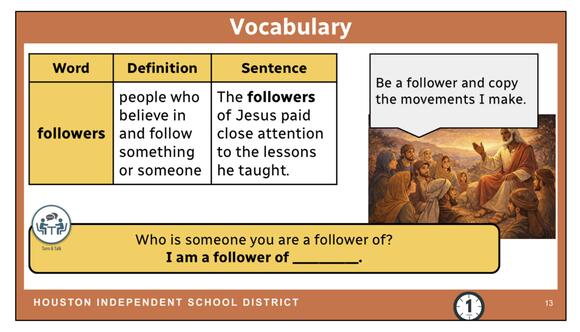
A slide deck covering a first grade text on the parable of the Prodigal Son includes a “sensitive content” warning for teachers that the material “may be connected to family relationships, mistakes, forgiveness and emotional experiences.” The guide also includes a picture of Jesus surrounded by a group of people to illustrate the vocabulary word “followers” and asks students who they follow.
“The slide is ambiguous, and in a very troubling sort of way,” said Mark Chancey, religious studies professor at Southern Methodist University in Dallas. “It does not explicitly call students to be followers of Jesus, but it’s easy to see how young children would naturally gravitate toward that response, given the visual.”
Teachers are instructed to teach any text with religious origins “as literature, not as religious instruction or endorsement,” the district told The 74. But “following a review, the district will ensure that neutral images are used in instructional materials moving forward.”
‘The backbone of your program’
As a literacy program, Bluebonnet is strong on teaching foundational reading skills, prompting class discussions and helping students with their writing, according to a review from the Reading League, a nonprofit focused on the science of reading. But the reviewers said the program doesn’t give teachers a clear roadmap for teaching those basic skills or allow students enough practice time.
“That scope and sequence is really the backbone of your program and what you need to go back to if a student is struggling,” Kari Kurto, national director of policy and partnerships, explained on a recent podcast about Bluebonnet. The strong emphasis on Western civilization could also “leave some students without an opportunity to read and write about experiences that align with their communities’ language and culture.”
That’s why some observers argue for adding more balance to the program, like stories from other religious traditions.
To state officials, the investment is starting to pay off. Those using the K-5 Bluebonnet reading program scored .2 percentage points higher on average this year than those that didn’t adopt it, according to the agency. Districts that piloted the program saw greater gains.
Texas Quietly Began Work on Divisive History Curriculum a Year Ago
But the Conroe district, one of the largest in the state using it, has yet to see growth. While the Houston-area district outperformed the state average in reading, its scores dropped, compared to 2025.
“For the first time in Conroe’s history, we have two F-rated schools, and they’re both elementary schools,” said Destinee Milton, who ran unsuccessfully for a seat on the board this year. With one son still in elementary school, she made criticism of Bluebonnet an issue in her campaign. A former Conroe teacher who now designs curriculum for college courses, she advocates for switching to another state-approved curriculum.
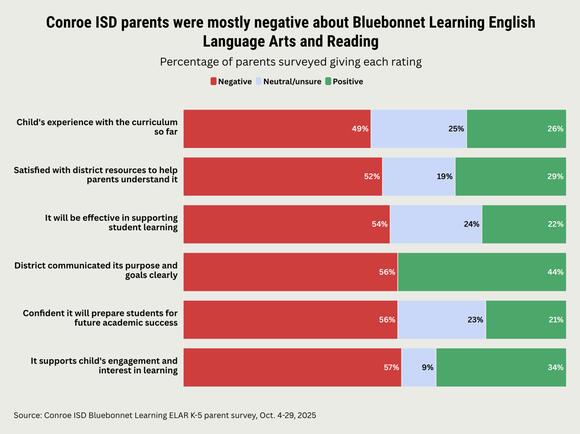
Conroe parents were more critical of Bluebonnet than supportive, according to a survey leaders conducted a year ago. Some wanted more advance notice of the biblical lessons.
“The information sent home is very vague,” one parent wrote. “It has not been communicated how to opt my child out of these lessons either.”
Others were generally unimpressed.
“It is not engaging, the materials are poorly put together, and the vocabulary is random and overly difficult,” one parent wrote. Another said, “My child hates it so much I’m about to pull him out and homeschool.”
Melissa Semmler, a Conroe board member, said one of Bluebonnet’s strengths is that it creates consistency across schools and takes the burden of preparing lessons off teachers. But the “curriculum moves quickly,” which makes it hard for students below grade level to catch up, she said.
With extra support, “we can close those gaps and give this curriculum a real chance to work,” she said. But “if this year’s scores keep declining instead of recovering, we have to take that seriously.”
 Add to Preferred Sources