undefined
Posts
undefined
Followers
Microplastics make up 1 in 100 airborne particles sampled at four Michigan schools
By Morgan Sherburne,
3 days ago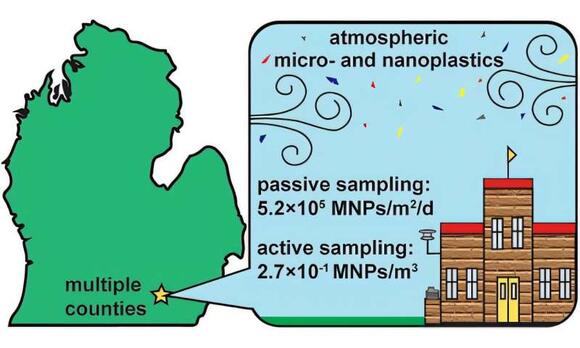
One in 100 of the tiny particles hanging in the air we breathe in Michigan is a microplastic, according to a University of Michigan study. The study tested the air for microplastics in four locations across lower Michigan, all in the parking lots of K-12 schools. It found that microplastics constitute about 1% of particles found in the atmosphere.
"I think that number is shockingly high," said Madeline Clough, recent U-M doctoral graduate and lead author of the paper published in ACS ES&T Air. "One in 100 particles in the atmosphere feels like a hefty burden of plastic."
Clough and colleagues also found that more than 60% of the plastic particles were nanoparticles, meaning that they were less than 1,000 nanometers. About 5,000 of the particles can pack into an area the size of a cell nucleus. Most of these particles come from tires, which outnumbered other types of microplastics by about 3 to 1.
"Tires and driving are the biggest reasons we have plastics in the air," said senior study author Anne McNeil, U-M professor of chemistry. "The smaller particles are the ones that stay suspended in the air longer and travel longer distances, and, unfortunately, are also more dangerous for human health."
To investigate atmospheric microplastics, the researchers set up samplers in both urban and rural school settings. Each sampler remained in place for a month, passively collecting particles. Clough sampled in every month except January and February because particles from precipitation and aerosolized road salts overwhelmed the samplers.
The researchers initially surmised they would be seeing microplastic particles from tire wear in the parking lots, as well as synthetic fibers from clothing as people walked into school. Instead, the researchers were surprised to see particles that likely traveled from farther afield.
"We decided to test parking lots because that's where people are walking and driving," McNeil said. "But because the particles we found are so small, they probably traveled from farther distances. One of the ways we know this is that we were at rural and urban locations and we were close to and far from highways. We sampled in the school year and the summer and in different weather, and none of that made a difference. We saw a similar level of plastics wherever we were."
Using advanced spectroscopy—tools that use light to identify the composition of a material—the researchers were able to see that a few of the microplastics also had road salts attached to them, and that these particles were shaped in such a way that suggests they were broken down on roads before being lofted into the air by more driving activity.
The researchers also found that one of the other plastics they detected—polyethylene, or PE, the plastic that comprises plastic packaging and bags—also had minerals attached to it, suggesting it came from lake water. The findings suggest that plastics find their way into lakes, where they break down and become aerosolized by wave action.
"All of the lake spray-associated microplastics came from samplers in the parking lots," Clough said. "This can tell us a little more about the fate of plastics in the atmosphere—where they've been traveling from and how far they can travel."
The study is one of only a handful to look at atmospheric microplastics in the country, and it's one of the first to be able to look at the smaller nanoplastics. That's because researchers' tools use two different types of light—visible and infrared—to identify the composition of microplastics in their samples.
Using the two types of light in combination, the researchers can identify particles down to half a micron, or about 40 times smaller than previous atmospheric microplastic studies could examine using infrared light alone.
"In the atmosphere specifically, those are in the size range of particles that will actually make it deeper into your lungs than the larger particles," Clough said. "Not much is known about the inhalation risks and what leaching looks like from the plastics. All these plastics have so much more than just the polymer in them. It's important to quantify them so we can better understand what the risk is of inhaling them."
In the next phase of the study, the researchers are collecting samples from a greater variety of locations, including Lake Michigan. McNeil says there are ways people can reduce the amount of microplastics in the atmosphere.
"If we want to lower this source of pollution, we can start by driving less, using public transportation, carpooling and even biking or walking more frequently," she said.
More information: Madeline E. Clough et al., Tire Wear Particles Outnumber Other Atmospheric Micro- and Nanoplastics across Rural to Suburban School Sites, ACS ES&T Air (2026). DOI: 10.1021/acsestair.6c00307
Provided by University of Michigan
 Add to Preferred Sources


