undefined
Posts
undefined
Followers
‘The weight of things we carry’
By none,
17 hours ago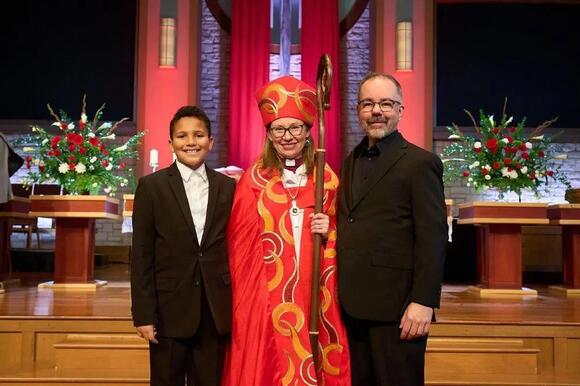
The Rev. Emily K. Hartner and her husband, Ian, didn’t discuss what life would look like if she were elected bishop.
They didn’t know it would occur until the moment it happened.
But occur it did on May 31, 2025, when she became the first woman to become bishop of the North Carolina Synod of the Evangelical Lutheran Church in America (ELCA).
Hartner, 45, was installed Nov. 15, 2025, by the Rev. Yehiel Curry, the ELCA’s first Black presiding bishop. So it was a doubly historic occasion.
Hartner has spent the first year of her six-year term traveling the proverbial “Murphy to Manteo,” although Lutheran congregations are mainly concentrated in the Piedmont.
She’s learned a lot.
We sat down with the bishop at the N.C. Synod Office at 1988 Lutheran Synod Drive, in Salisbury. (The ELCA was founded that year.)
This Q&A is edited for brevity.
Q. I noticed your son often accompanies you when you preach on some Sundays.
A. Our son Oliver, 10, is a fifth-grader. Ian, 43, is a database engineer, and works from home for a small data company in Cornelius. We live in Huntersville, and we’ve been married for 17 years.
(The family has had French bulldogs for years, and last October welcomed Basha, a 5-year-old Frenchie, when the bishop was out of town. She said it was not a complete surprise.)
Q. When did you first suspect that you might be nominated for bishop on the Ecclesiastical Ballot? (See accompanying story for definition.)
A. People started asking if they could submit my name. I spent about a month in discernment and prayer about whether to leave my name in. (A nominee has the option to withdraw his or her name in the voting process.)
My husband encouraged me, but we didn’t know what I was getting into until we were there.
Q. What has it been like to travel throughout the synod this past year and meet congregations? What makes congregations successful, regardless of size?
A. It’s been a joy. It’s my favorite part of the job. Every Sunday is a field trip. The congregations that are successful are the ones that have a clear sense of purpose.
And I’ve discovered persimmon pudding!
Q. What’s the food like?
A. Every congregation has its own food. Every place I go has cake — and they want me to have some.
I give Oliver the option to go with me on Sundays. We chit-chat. We listen to music. We do not have the same taste in music. We’ve started ranking the covered-dish dinners. He is not a picky eater.
His favorite thing he’s gotten to do was to visit a parishioner’s farm and drive the golf cart.
Q. What else does Oliver like to do?
A. He is a goalie on his soccer team. We travel to games within the Charlotte area — two hours away at most. We like seeing Charlotte FC soccer games as a family.
Q. With a young person at home, how do you find that elusive work-life balance, especially in such a demanding job?
A. It’s hard. I’ve found a co-working space near Oliver’s school. Ian and I share drop-off and pick-up duties. Oliver also has soccer practice three days a week, so we divide drop-off and pick-up duties as evenly as possible.
So I feel like it’s integration, not balance. Overnight trips are hard.
I try to be as present as I can be, being intentional about spending time as a family.
Q. What has your first year as bishop been like? What are some things that have happened that you expected? What has happened that you did not expect?
A. I expected to do ordinations and preach at congregations for their anniversaries. The shepherding of the synod was expected.
There are unspoken expectations of the office of the bishop. I’m surprised about what people need from us. What’s unexpected is the weight of things we carry that no one can know about.
Q. There was a bit of a hubbub — in a good and positive way — that you are the first female bishop in the N.C. Synod. Every time I see you in photos with pastors — at ordinations, say — there are always a lot of female pastors in the photo. What is it like to be part of the growing sisterhood of female pastors?
A. We’re not the first wave. The older female pastors cleared the way for us. I’ve never really thought about it. No one ever told me I couldn’t do it. I have been treated very well. I had a few little challenges in a parish, but I’ve been very well respected in this new role.
Q. There are so many women in the ELCA’s 67-member Conference of Bishops — the current figure is 35. So there are a lot of women in the room now. Since taking office, do you find that parishioners are more comfortable with female leaders in the church, or do you feel there’s still work to be done?
A. There is always still work to be done; however, I see a shift in the vast number of female leaders right now. Being a woman in ministry is becoming a norm.
Q. Who are your mentors?
The Rev. Dr. Phyllis Milton, bishop of the Virginia Synod ELCA; and the Rev. Marcus Miller, who’s both a former seminary president, and a former bishop of the Northeast Ohio Synod ELCA. He was also my parishioner.
I recently went with a group of female bishops on retreat at Holy Wisdom Monastery in Middleton, Wisconsin, which was lovely.
We are a part of the southeast region (Region 9) of the ELCA. I’ve leaned heavily on this particular group of bishops for support, advice, and encouragement.
Q. What brought you to Davidson? I know it was an all-male college until 1972. What was your time like at Davidson? (The bishop’s bachelor’s degree is in psychology and French.)
My grandfather graduated from Davidson in 1936, and my cousin was a year ahead of me, so we had a family connection. Its academic reputation appealed to me.
It was 45 minutes from my hometown of Newton, but still close enough that my parents, Sam and Paula Kuhn, could come for my choir concerts.
Q. And then what about Yale?
When I was at Davidson, I received a grant from the Lilly Foundation for the Theological Exploration of Vocation which covered a trial year at seminary. At Yale, there were nine Davidson alums there who had the same grant.
It was formative for me because it was both ecumenical and offered a certificate in Lutheran studies. It was the best of both worlds.
I have a master’s of divinity from Yale, with a certificate in Lutheran studies. Additionally, I have a master’s of sacred theology from the Lutheran Theological Seminary at Philadelphia, now United Lutheran Seminary.
Q. Tell me about the stem cell transplant for your brother Zak.
A. He was diagnosed with AML leukemia in April 2022. He had his stem cell transplant in October 2023, and I was his donor. There was no perfect donor in the whole database, but I was a half-match.
Zak had his entire immune system killed off.
I had a full day of medical appointments at Atrium Health Wake Forest Baptist Medical Center. They drew 27 vials of blood. It was a big medical appointment! I had a heart work-up, and a day full of other tests. I had to take shots that boosted my stem-cell production.
I spent a full day in the hospital, hooked to an apheresis machine. That process took eight hours. The next day, my brother got my stem cells. He is healthy today. And technically, we are twins, because our DNA is the same.
Q. Where do you see the N.C. Synod headed in the next five years? In the next six years after that, should you choose to stand for re-election?
A. We are working on a strategic plan. I see us continuing to lean into collaboration in new and creative ways and partnerships. How can we best support one another, not doing our ministry in silos? We have gifts for the whole church we can share with one another.
 Add to Preferred Sources

