undefined
Posts
undefined
Followers
RI ethics rule limits Roger Williams, Fatima hospitals CEO’s interactions with state officials
By Nancy Lavin,
9 days ago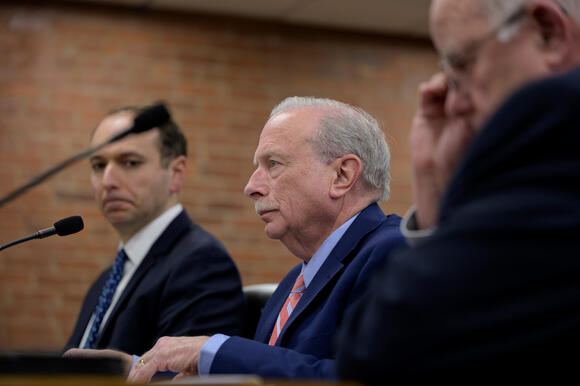
Former Rhode Island Executive Office of Health and Human Services Secretary Richard Charest, center, testifies before the House Committee on Finance regarding the sale of Roger Williams Medical Center and Our Lady of Fatima Hospital on Tuesday, Feb. 2, 2026. Charest is now CEO for the hospitals. (Photo by Michael Salerno/Rhode Island Current)
Former Rhode Island Health and Human Services Secretary Richard Charest should avoid talking business with his former colleagues, as well as other state officials, for the first year in his new, private-sector gig, according to a recommendation unanimously adopted by the Rhode Island Ethics Commission Tuesday.
The seven-page opinion answers the question posed by Charest, who sought advice on the ethical implications of his career change. Charest began work on Nov. 1 as head of CharterCare Health of Rhode Island, the local subsidiary that owns Roger Williams Medical Center and Our Lady of Fatima Hospital.
Before that, he spent nearly five years working for the state under Gov. Dan McKee, and for the last three years, led the massive state health and human services umbrella agency.
RI Health and Human Services head to replace Roger Williams, Fatima hospitals CEO
News of Charest’s transition from government to industry raised immediate questions, including from Rhode Island Attorney General Peter Neronha, about the revolving door clause of state ethics law. The clause limits state officials and administrators from representing themselves before state agencies where they worked for one year after leaving the public sector position.
In his Oct. 19 letter to Jason Gramitt, executive director for the ethics panel, Charest acknowledged the “limitations” that his government work might pose on his new job with CharterCARE. His contract with the hospital owners states that he would not interact with any state agencies until he received the Ethics Commission’s advice, he wrote in the letter.
The advice, presented Tuesday by Teodora Papa, a staff attorney for the commission, follows similar opinions for other former state officials who have transitioned to private-sector roles. Charest should not represent himself or his new employer before any division of the health and human services agency, the governor’s office, or the Department of Administration, for one year.
That includes formal meetings and legislative activity, as well as informal interactions like phone calls and social gatherings.
“It is the content of the discussion, rather than the venue,” Papa said, adding that personal discussions with his former colleagues are not prohibited, only those that apply to business and industry.
Charest is also barred under state ethics law from using any confidential information gained from his government work to benefit his new employer.
Charest, who attended the meeting with his attorneys, did not speak except to confirm he understood the recommendation.
His attorneys, Marc DeSisto and Sarah Boucher of Providence-based DeSisto Law, did not immediately respond to requests for comment following the decision Tuesday.
Otis Brown, a spokesperson for CharterCARE, said in an emailed response Tuesday that the hospital operator encouraged Charest’s decision to seek an advisory opinion.
“We appreciate the prompt response by the Commission and remain confident in his ability to effectively manage and lead our health system in accordance with the Commission’s advisory opinion,” Brown said.
Charest’s appointment to CharterCARE, replacing retiring CEO Jeffrey Liebman, comes at a critical juncture for the newly formed healthcare operator. Since buying Roger Williams and Fatima hospitals from their bankrupt former owner in March, the local entity has struggled to revive the safety-net hospitals after years of financial and operational mismanagement. Contract disputes quickly soured the 1,200 union workers on their new leaders, though a three-year agreement was recently reached, Brown confirmed in an email Tuesday.
Neronha, whose office remains heavily involved in the transition, rejected an initial strategic plan, warning of imminent cash flow problems. After meeting with CharterCARE executives in late October, Neronha gave the hospital operator until Dec. 11 to submit a new plan that includes updated financial projections and input from Charest, according to a Nov. 2 letter from Neronha shared with Rhode Island Current.
Brown said CharterCARE will continue to work with Neronha’s office on the strategic plan, which he called “an ongoing, fluid document that will be reviewed and revised over time.”
Ethics Commission members Frank Cenerini and Emma Peterson were absent from the meeting.
SUBSCRIBE: GET THE MORNING HEADLINES DELIVERED TO YOUR INBOX.
- 4:03 pm Updated to include comment from CharterCARE Health of Rhode Island.
 Add to Preferred Sources
