undefined
Posts
undefined
Followers
Becerra inherits a high-speed headache
By Alex Nieves,
8 days agoWith help from Riley Ramirez and Noah Baustin

ON THE TRACKS: California’s embattled high-speed rail project is already creating a headache for Gov.-elect Xavier Becerra. Whether he succeeds in getting the project on track — or fails — could help define his legacy.
The massive undertaking to connect the Bay Area and Southern California by an electric train has long been mired in controversy due to persistent delays and cost overruns. Its price tag, which began at $45 billion when voters approved a bond to partially fund it in 2008, has ballooned to roughly $126 billion today.
Most recently, former CEO Ian Choudri faced a scandal after a watchdog investigation found the project approved $600,000 in inappropriate expenses that covered consultants’ trips to an escape room, nightclubs and first-class flights. He resigned late last month after Becerra implied in an interview that a leadership shake-up could be coming.
While the Choudri debacle is another black eye for a project that’s been a perennial punching bag for President Donald Trump and Republican lawmakers, Becerra hasn’t shied away from expressing his support for the project, saying during campaign stops that “I'm going to make sure we finish [it].”
The stakes are high for the next governor, who could be the first politician to cut the ribbon on an operating high-speed rail line in the United States. High-Speed Rail Authority staff estimate the project’s initial line between Bakersfield and Merced will open to passengers between 2033 and 2034, at the tail end of Becerra’s tenure if he wins a second term.
Getting to that point will be easier said than done.
Both supporters and critics of the project say that keeping the current timeline — which is already more than a decade behind schedule — from slipping will hinge on whether Becerra and lawmakers are willing to take politically challenging steps. This includes guaranteeing a stable source of funding and passing laws that will inevitably draw opposition.
While Gov. Gavin Newsom and lawmakers agreed last year to set aside $1 billion annually for high-speed rail from revenues generated by the state’s emissions trading program, that pot of funding is likely to decrease in the coming decades and put more pressure on lawmakers to divert dollars to other priorities like housing and clean water.
Ezra Silk, political director for the U.S. High Speed Rail Association, said that without assurances of stable funding, it’s impossible for agency staff to offer the municipal bonds needed to finance it. That mirrors a warning from the Office of the Inspector General for the High-Speed Rail Authority, which said in August that the project could quickly run out of cash.
“It can't be a situation where it's relitigated every year in the Legislature,” Silk said. “You can't run a project like that where every year you're debating whether you're going to pull the plug on this thing.”
Powerful labor unions like the State Building and Construction Trades Council have made it clear that keeping high-speed rail alive is among their top priorities. The project has employed over 16,000 union workers since construction began in 2015, making it the single largest infrastructure project nationwide during that period.
But while labor support means it’s nearly impossible for a Democratic governor to pull the plug on high-speed rail, setting aside the resources to adequately fund it amid competing budget priorities is the harder sell.
“The question is not whether labor support can keep this project sort of stumbling along,” said Lou Thompson, a rail expert who previously chaired the high-speed rail peer review group. “The question is, could labor or anybody else find $100 [billion] to $200 billion to finish it.”
Beyond the funding, lawmakers have so far proven reluctant to rubber-stamp a suite of policy changes that high-speed rail officials say are needed to speed up construction.
That includes a pair of bills that stalled this session, which would require utility companies to quickly move equipment out of the rail lines' path and allow officials to start spending money outside the Central Valley to prepare connections to the Bay Area and Los Angeles. (State law restricts the project from spending outside its initial Central Valley segment, a stipulation agency staff argue limits their chances of attracting outside investors.)
Carter Lavin, co-founder of advocacy group Transbay Coalition, said high-speed rail backers are preparing another push when lawmakers return to Sacramento in December, including a bill that would specifically target PG&E infrastructure like power lines that can take months to years to relocate, slowing down construction and raising costs.
That will almost assuredly spark a fight with the powerful utility, putting Becerra in a tricky political position.
“The decision of whether or not we have high-speed rail is entirely up to state lawmakers and Gov. Becerra,” Lavin said.
Did someone forward you this newsletter? Sign up here!
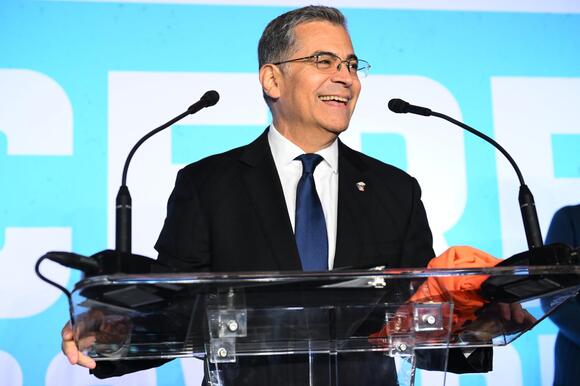
NEW ROSTER: Becerra on Tuesday announced the senior leadership of his transition team. It contains a major win for the environmental justice community.
Becerra’s policy director will be Arsenio Mataka, who recently ended his tenure as the Bay Area Air District’s deputy executive officer for equity and community programs and previously served as Becerra’s environmental adviser at the California Department of Justice. That puts a staffer deeply familiar with green groups’ priorities in prime position to help shape the next administration.
POLITICO’s Jeremy B. White and Lindsey Holdenfirst reported on the list, which includes some names that won’t be too surprising for our regular readers.
Liz Saldivar, who worked for Becerra during his time in Congress and as attorney general, will be the director of transition. Lindsey Cobia, a political consultant who also advised Newsom, and Kyle Layman, who previously worked for Michael Bloomberg and Rep. Raul Ruiz, will be senior advisers. Another Newsom administration alum, Nicole Elliott, will be agency review director, and senior campaign aide Courtni Pugh and Kenneth E. Maxey II will lead external affairs.
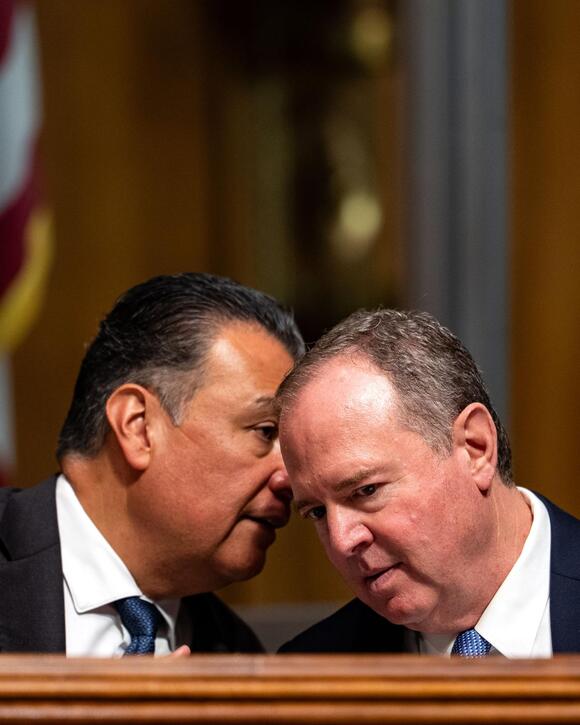
PERMITTING GOES TO WASHINGTON: A major energy permitting bill cleared a key hurdle in the U.S. Senate on Monday night, but it’s getting a frosty reception in California.
Both California Sens. Adam Schiff and Alex Padilla voted against the bipartisan measure, which would place a shot clock on federal environmental reviews and accelerate permitting for some power lines and power plants.
In a statement, Schiff said the bill needs “further improvements before I can support it.” His top priorities include “restoring the billions of dollars in terminated energy projects in California, as well as the offshore wind projects the administration baselessly and illegally canceled”.
That may put him on a collision course with Trump, who on Monday said he supports the permitting bill but that his administration would not approve permits for wind turbines.
Environmental groups are split on the measure, though the opposition include major national organizations such as the League of Conservation Voters, the Natural Resources Defense Council and the Sierra Club.
On Monday, green group California Environmental Voters cited the recent failure of a state environmental review streamlining ballot measure as reason for Congress to “slow down” the permitting bill to “get this right.”
Californians “rejected Prop 45 because they saw it for what it was: a shortcut that would shift power toward developers, sideline communities, rush environmental review, and shield polluting projects from accountability,” Shannon Olivieri Hovis, the organization’s chief strategy officer, said in a statement. “[The permitting bill] asks Congress to make that same tradeoff for the entire country.”
REPORT CARD: The 2026 environmental scores are in, and Newsom failed, according to Sierra Club California.
The group released its annual legislative scorecard Monday, which scores their view of lawmakers and the governor’s performance on 10 key environmental and climate bills.
Newsom earned his failing grade by signing two of the bills the organization opposed, including SB 1370, which streamlines environmental reviews for some wildfire mitigation projects, and vetoing three of the bills the group supported, including SB 954, which would have restricted some of the environmental review exemptions Newsom previously embraced.
Sierra Club California concluded that Senate pro Tempore Monique Limón brought “new, strong environmental leadership” and that the Senate killed many bills that would have weakened environmental protections. Meanwhile, many of the Sierra Club’s priority bills died in the Assembly, “whose leadership continues to be much more moderate on environmental issues than the Senate,” the group wrote.
GLOBE-TROTTER: Newsom and several members of his administration will travel this week to the United Nations climate conference in Antalya, Turkey, to meet with international partners and showcase California’s climate progress on the world stage.
The California delegation attending COP31, which kicked off on Monday, includes first partner Jennifer Siebel Newsom, Natural Resources Secretary Wade Crowfoot, Food and Agriculture Secretary Karen Ross, California Public Utilities Commission President John Reynolds, California Air Resources Board Lauren Sanchez, Land Use and Climate Innovation Director Samuel Assefa and Deputy Cabinet Secretary Sarah Swig.
Other California leaders at the conference include state Sen. Josh Becker, Palo Alto Mayor Vicki Veenker and West Sacramento Mayor Martha Guerrero, along with representatives from the Bay Area Air District.
The Trump administration — for the second year in a row — did not send any official delegates.
SOIL TOIL: Pacific Gas & Electric on Monday announced that it reached a major wildfire safety milestone: burying 1,500 miles of power lines underground.
The company launched its undergrounding program in 2021. Last month, it submitted a proposal to regulators to bury an additional 5,000 miles of power lines from 2028 through 2037. But affordability advocates have been pushing the California Public Utilities Commission to rein in pricey undergrounding work and encourage cheaper wildfire mitigation strategies.
The CPUC has proposed a method for evaluating which powerlines are worth burying, but PG&E doesn’t like it. The firm warned in its Monday announcement that the CPUC proposal could shrink the power company’s 10-year plan to 1,100 miles of buried lines.
TRANSIT DOLLARS: Newsom announced the recipients of $1.3 billion in grants for public transportation projects Tuesday.
The awards from the state's Transit and Intercity Rail Capital program and State Rail Assistance program are headed to 28 agencies statewide, including Metrolink — Southern California’s cash-strapped commuter train operator — and Caltrain’s extension to downtown San Francisco. The grants are funded with revenue generated by the state’s cap-and-invest program.
The grants also include funding for dozens of electric and hydrogen-powered buses to be deployed in the Central Valley and Sacramento, along with dollars for bike and pedestrian projects across the state.
— One community in the Bay Area may be the most vulnerable to El Niño. It’s been described as a “bathtub with no drain.”
— A former California judge is suing Insurance Commissioner Ricardo Lara, alleging that Lara denied her authority to review insurers’ rate-hike requests and fired her after she complained.
— Record ocean temperatures have caused nearly 2,000 seabirds to starve to death and wash up on California shores.
More from POLITICO in California
POLITICO Pro
California policy moves fast, and the stakes are high. POLITICO Pro offers exclusive California policy reporting, expert analysis, and powerful tools to help professionals learn what’s happening, understand what it means, and act with confidence statewide — all on the POLITICO Pro policy intelligence platform. Learn more.
POLITICO Advertising Solutions
POLITICO Advertising Solutions helps organizations reach and engage influential California policy and political audiences. Through custom advertising, sponsorships, and content solutions, we connect your message with decision-makers across the state. To learn more, contact Jesse Shapiro jshapiro@politico.com.
 Add to Preferred Sources


