undefined
Posts
undefined
Followers
‘Proactive not reactive’: Planning commission moves forward with ordinance amendments
By KAITA GORSUCH,
9 days ago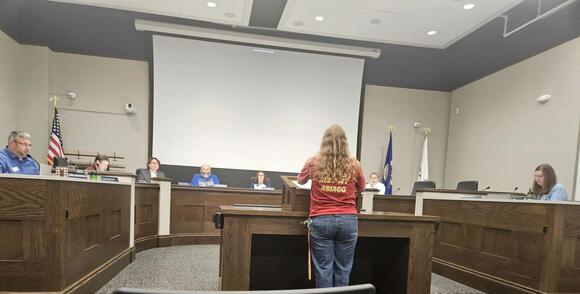
After being asked 100 questions by Owatonna, Northfield and Pine Island residents about data centers, the Owatonna Planning Commission moved forward with recommending its proposed ordinance amendments, including defining and regulating data centers.
“It’s a 0.001% area of what we’re doing,” Community Development Manager Greg Kruschke said about data centers during the open house before Tuesday’s planning commission meeting. “The code was last updated in the ‘80s. There’s been updates through there, but the last major overhaul (was in the 1980s).”
Changes to the Zoning Ordinance include cutting about 50 pages, updating zoning districts, adding a shoreland ordinance and modernizing home occupation standards, among others.
Data centers were defined as “A facility used for the storage, processing, management, and distribution of digital data and information, consisting of servers, networking equipment and supporting infrastructure such as cooling systems, backup power generation and electrical equipment.”
The definition was further broken up to major and minor data centers; major data centers have a capacity threshold of “greater than 5 MW of totaled designed IT load (often expanding to 100+ MW),” while minor data centers have “up to 5 MW of total designed IT load.”
During the open house, Planning Specialist Emma Bransford said Owatonna updated its comprehensive plan a few years ago, and with that comes updating the Zoning Ordinance.
“We want to be proactive, not reactive, and a lot of cities around are more reactive right now,” Bransford said. “It’s such an evolving landscape right now, and it’s really hard to predict the future. We won’t update the zoning code for probably another 10 years. … It is open-ended and we can put what stipulations matter because each situation is unique.”
The public hearing on the ordinance amendments during the meeting lasted over an hour.
“While you have a definition, which is substantially more than what Pine Island had, the definition in and of itself is insufficient and incomplete for a data center ordinance and will not provide the layer of protection that’s actually needed,” Aubree Derksen of Pine Island said. “You need to also remember that whatever is in front of you has exponential impacts that you might have no control over.”
Derksen and six others read the planning commission a list of 100 questions to ask before a data center comes in, which the city needs “solid answers for.” If officials didn’t have answers to the questions, Derksen said a moratorium was needed “so you have time to figure them out.”
“After living the last 13 months in a lawsuit dealing with Google, … I don’t recommend it. The burden that has been placed on residents has been immense and completely unfair,” she said. “You also have to take into account the stress, the mental health impacts on the residents when they have to do all the due diligence that wasn’t done first.”
The complete list of questions is available at stopthepineislanddatacenter.org/blog-1/request-a-moratorium, and spanned topics like understanding what a data center is, vetting the developer, legal preparedness, fiscal analysis/financial risk, infrastructure/utilities, public safety/emergency preparedness, zoning/land use/code readiness, construction impacts, end of life and decommissioning, transparency/process integrity, readiness/due diligence, tribal governments/ecological knowledge and water sustainability.
“Once you include data centers, we are opening a can of worms,” Northfield resident Erik Sahlin said. “If you do proceed with this, please consider this as a regional issue. The kind of debates we’re seeing around Minnesota are happening within each locality … but what we’re really talking about are large regional and statewide impacts.”
Other Owatonna residents shared their concerns outside of the prepared list of questions. Matt Sennett said his concern was what the ordinance allows, not what the city’s intention might be.
“I’m asking the city to slow this process down and get it right,” he said. “At a minimum, every data center regardless of size or zoning district should require a conditional use permit, public notification and a public hearing.”
Melissa Zimmerman said Owatonna can learn from other Minnesota communities that have dealt with proposed data centers.
“Even if data centers never come here, what have we lost by establishing strong protections? Nothing,” she said. “But if one does come and those protections aren’t in place, we may have lost the opportunity to require them. … We need to be proactive, not reactive.”
John Eickhoff, planning commission member, said that while he appreciated the questions the community asked, a lot already were answered in the different regulations the city has in place.
“Some of the questions don’t really apply to us at all, so those felt a little weird,” he said. “But I do appreciate the feedback. Any question, the fact that you’re asking that is helpful.”
Board member David Effertz said he agreed CUPs should be required for all data centers “with the exception of existing businesses.” Kruschke clarified that data centers are permitted “only as accessory uses.”
The planning commission approved recommending the ordinance amendments to the city council as is.
“If we do nothing, we leave the door wide open. If we do something, we’re at least providing some guidelines,” Eickhoff said. “You guys asked a lot of questions, and honestly, if we were to ask every business this for anything that they wanted to do, we would never have any development in this town. … This isn’t a one and done. It is a ongoing process, so even if this does end up getting adopted by the city council, it can still change.”
After the meeting, Derksen and other residents voiced their disappointment in the decision.
“I’m disappointed that they basically took 100 questions and were like, ‘Oh, that sounds weird. That’s irrelevant,’” Derksen said. “When residents come forward and they are living in an impacted community, particularly a frontline community in Minnesota’s data centers fight, and Pine Island is an example of what not to do. If Pine Island is in the room telling you, ‘Here’s what you should do instead,’ you should listen.’
 Add to Preferred Sources