undefined
Posts
undefined
Followers
Roundtable maps housing needs in Williamsport, Saving Grace set to reopen
By Laura Ulrich,
2 days ago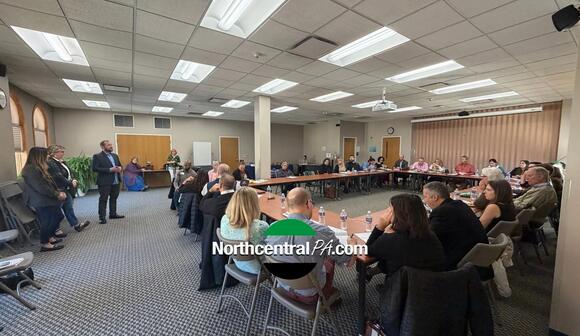
Williamsport, Pa. — State Rep. Jamie Flick brought nonprofit leaders, faith groups, service providers, and local officials together Tuesday at the James V. Brown Library to discuss the immediate need for winter shelter and longer-term approaches to homelessness in the Williamsport area.
A central focus of the group of about 40 was plans to reopen the Saving Grace Shelter. American Rescue Workers Executive Director Ben Hazen said ARW had operated the 24-bed facility independently for about 15 years but could no longer sustain the cost.
“We really wanted to see it continue to meet the needs of the homeless in the area,” Hazen said. “ARW could have made more money selling it to the public, but we believe that it’s needed for the community.”
Shea Madden of West Branch Drug & Alcohol said the organization is supporting the Saving Grace partnership with funding and by helping connect people to substance-use assessments, treatment referrals, and recovery resources. Madden, who also serves on the state’s opioid task force, noted that overdose deaths in Lycoming County have dropped sharply — about 64% — amid local collaboration and that housing stability remains a key priority for the agency.
YWCA leadership and collaboration
YWCA Northcentral PA CEO Amber Morningstar said her organization stepped forward after staff urged action because the vacant building sits nearby.
“Homelessness is not any one nonprofit organization’s problem, and the solution doesn’t lie with just one organization,” she told the group.
Under the partnership taking shape, ARW would provide the building and handle operations and maintenance, the YWCA would manage daily shelter operations and supportive services, and West Branch Drug & Alcohol would provide financial support along with connections to substance-use assessments and treatment.
The groups are working toward a Dec. 1 opening.
Morningstar said the YWCA will put out an Amazon wish list for bedding, towels, hygiene items, and other supplies needed specifically for the shelter. She also announced a Community Action Day on Nov. 30 from 9 a.m. to 4 p.m. so volunteers can help deep-clean, rearrange furniture, stock the kitchen, and get the building ready.
“It’s a large facility, so roll up your sleeves, wear some sneakers if you’re willing,” she said. She added that taking on the shelter means a large annual operating deficit for the YWCA and that the organization does not want the new work to come at the expense of existing programs.
Mayor encourages YIMBY attitude
Mayor Derek Slaughter said codes had been “probably the number one issue” people called him about regarding shelters. He reported that the city recently outsourced codes, zoning, and building-code work, which he expects will streamline the process.
Slaughter added he generally prefers local control, but thinks housing is one area where limited state preemption could help, describing it as “the state telling local folks what we can do.”
Slaughter also pitched tiny homes as one possible approach, referencing models used in other cities.
“If I had a magic wand, I'd build a whole bunch of tiny homes right here in the city, and have a formerly unhoused person run that,” he said. He acknowledged the practical resistance that often follows: “When the rubber meets the road, everybody’s like, well, not in my neighborhood. Can it go somewhere else?” He later returned to the point, saying the community needs to move from NIMBYism to “yes in my backyard,” or YIMBYism.
Other local elected officials at the roundtable included Lycoming County Commissioner Mark Mussina and City Councilman Jonah Milliken.
Library sees crisis firsthand
James V. Brown Library CEO Amy Resh described the library’s growing role as a daytime gathering place.
“We’ve been seeing an uptick in unhoused individuals hanging out at the library during the day,” she said.
The library has a new partnership with STEP for mobile resource connections on Tuesdays and Thursdays and helps people with job applications and basic computer skills.
Resh noted that many of those skills are not as basic as they seem: “I know for a lot of us in this room, this sounds absolutely wild, but they don’t know how to use a mouse. They don’t know how to even get an email, or if we help them get one, they’ll come in the next time and say, ‘Do you have my password?’”
A network of helpers in the faith community
Faith communities described playing a direct, on-the-ground role that often fills gaps left by formal systems.
First Church’s Code Blue program served 94 different people last year, and leaders said they are working with other congregations so the effort is viewed as a shared ministry rather than one church’s project.
City Church, across the street from the library, is exploring whether it can open its own Code Blue-style shelter after codes issues previously blocked use of an emergency apartment.
Other congregations, including Christ Episcopal, also near the library, reported offering showers, clothing, small emergency food supplies, and limited financial help for deposits or rent.
Speakers noted that most people seeking assistance are not members of the churches and that requests for larger amounts of rental help have become more common. Several emphasized that churches can provide immediate warmth, basic needs, and connections, but they still rely on nonprofits for case management, treatment, and longer-term housing pathways.
Takeaways
Speakers across the room returned to funding limits, the mix of people in short-term crisis and those with longer-term mental-health or substance-use needs, and the value of on-site or warm handoffs rather than simple referrals.
Overall, the large turnout of leaders and their in-depth discussion showed how deep and widespread concerns for the local homeless population had grown since Saving Grace's closure.
Flick said he is open to follow-up meetings and that his office’s weekly email can help share specific needs or volunteer opportunities to the local organizations and leaders.
 Add to Preferred Sources
