undefined
Posts
undefined
Followers
Tardigrade protein may help humans survive nuclear radiation, aid cancer patients
By Georgina Jedikovska,
2025-02-28
Tardigrades, also known as water bears or moss piglets, are tiny but resilient microorganisms capable of surviving the harshest conditions such as severe drought, radiation, low oxygen environments, and high and low temperatures.
Scientists have long been fascinated by their radiation resistance, especially since around 60 percent of U.S. cancer patients receive radiation therapy , which despite being necessary, can cause harsh and hard-to-handle side effects.
Now researchers at MIT, Brigham and Women’s Hospital, and the University of Iowa believe a one-of-a-kind tardigrade protein could hold the key to protecting cancer patients from radiation side effects.
To test their idea, the scientists injected mice with mRNA encoding this protein and found that it produced enough to safeguard cells’ DNA from radiation-induced damage .
“Radiation can be very helpful for many tumors, but we also recognize that the side effects can be limiting,” Giovanni Traverso, PhD, an associate professor of mechanical engineering at MIT and gastroenterologist at Brigham and Women’s Hospital, and senior author of the study, reveals. “There’s an unmet need with respect to helping patients mitigate the risk of damaging adjacent tissue.”
The science behind the research
Radiotherapy is often used for cancers affecting the mouth and throat, but it can cause significant damage to these areas, making eating and drinking extremely painful. It is also commonly utilized for gastrointestinal cancers, and can lead to side effects such as rectal bleeding.
“This affects a huge number of patients, and it can manifest as something as simple as mouth sores, which can limit a person’s ability to eat because it’s so painful, to requiring hospitalization because people are suffering so terribly from the pain, weight loss, or bleeding,” James Byrne, PhD, an assistant professor of radiation oncology at the University of Iowa and senior author of the study, adds. “It can be pretty dangerous, and it’s something that we really wanted to try and address.”
The researchers explain they have spent years trying to prevent radiation damage. Now, it seems, they have taken inspiration from tardigrades, a group of tiny organisms tough enough to survive space , extreme dehydration, and cosmic radiation.
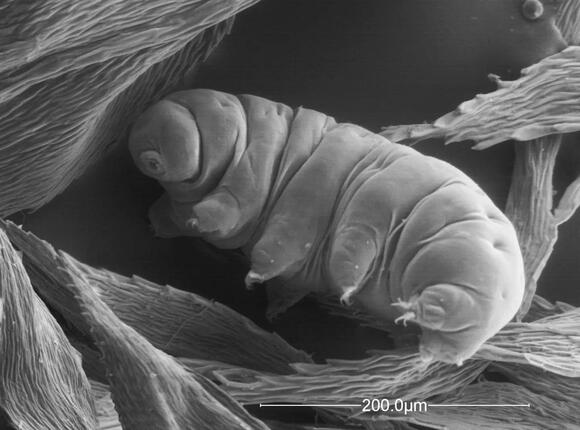
Credit: N. Carrera, Global Soil Biodiversity Atlas
That’s why the team has now turned their focus to a unique protein called Dsup , which binds to DNA and protects it from radiation damage. This highly charged nuclear protein is a major reason why tardigrades can withstand radiation doses 2,000 to 3,000 times higher than people.
The team considered using mRNA – which carries protein information from the DNA to the cell’s cytoplasm – to deliver Dsup to patient tissues before radiation treatment. It would prompt the cells to temporarily produce the protein, thus protecting the DNA during the radiation. The mRNA and protein would then naturally break down within hours, leaving no lasting trace.
To make this work, the team screened polymer-lipid delivery particles, known for efficient mRNA transport. They identified one suited for the colon and another optimized for mouth tissue.
Preventing radiation damage
After these particles successfully delivered mRNA to lab-grown cells, the researchers tested whether the method could effectively protect tissue from radiation in a mouse model .
“We thought that perhaps by combining these two systems – polymers and lipids – we may be able to get the best of both worlds and get highly potent RNA delivery. And that’s essentially what we saw,” Ameya Kirtane, PhD, an instructor in medicine at Harvard Medical School and one of the study’s lead authors, says.
“One of the strengths of our approach is that we are using a messenger RNA, which just temporarily expresses the protein, so it’s considered far safer than something like DNA, which may be incorporated into the cells’ genome,” Kirtane adds.
The scientists injected the particles into either the cheek or rectum several hours before administering a radiation dose comparable to that used in cancer treatment. They were stunned to discover a 50 percent reduction in the amount of double-stranded DNA breaks caused by radiation.
Moreover, the Dsup protein’s protective effect remained localized to the injection site, ensuring that the tumor itself was not shielded from radiation treatment. The researchers now plan to develop a modified version of the Dsup protein that won’t trigger an immune response, as the original tardigrade protein likely would.
If adapted for human use, the scientists believe the protein could offer broader protection against radiation-related harm, including preventing DNA damage from chemotherapy drugs and potentially shielding astronauts from radiation in space.
The study has been published in the journal Nature Biomedical Engineering .
 Add to Preferred Sources


