undefined
Posts
undefined
Followers
UD’s new interdisciplinary science lab is a ‘home of dreams’
By Josh Shannon,
2025-01-09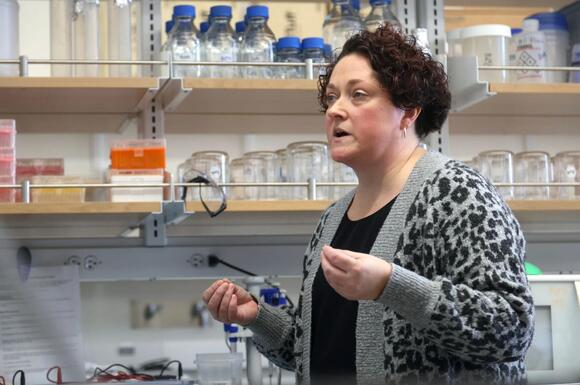
When fire ripped through the University of Delaware's McKinly Laboratory in August 2017, just three weeks before the school year began, the result was “devastating” for the campus, President Dennis Assanis recalled.
Labs were damaged, the university had to scramble to find new spaces for the professors based in McKinly, and departments had their faculty members scattered across the campus, making collaboration difficult.
Nearly eight years later, however, a new state-of-the-art building has risen from the ashes.
“If you think about it, it was a blessing in disguise to ultimately reimagine, re-dream, and build this facility that we have here, which is not a replacement for the previous building, but it is the home of dreams,” Assanis said Wednesday while welcoming guests to the new Building X on Delaware Avenue.
Building X – the moniker is temporary until the university chooses a permanent name for the facility – cost $180 million to build. The state contributed $41 million from the American Rescue Plan Act, and the rest came from university resources and fundraising.
The interdisciplinary building brings together faculty and students from biology, psychology, neuroscience, physics and quantum science. Research done there will focus on human disease, developmental disorders, neuroscience and human behavior.
“We can take charge and control some of the most vexing diseases that we're facing as humankind. We could understand neurological disorders and human behavior and actually try to cure, treat and prevent some of those,” Assanis said. “I'm looking forward to the amazing things that will happen here. This building is an investment in the future of our great state and the economy of our state.”
Many professors have already started moving in to their new labs, and most classroom and lab spaces will be ready for the spring semester. The building will be fully occupied by the summer.
“It's also a great asset, by the way, for the City of Newark. It's really a joy as you go down Delaware Avenue and toward Main Street,” Assanis said. “This building will really be showcasing everything that is happening at this university.”
'Science on display'
The 2017 fire was caused by a construction mishap. A crew was renovating a lab in the basement, and a worker’s Sawzall tool ignited material in the ventilation system, and the fire traveled through the duct work.
“Smoke going through a lab building just ruined so many things,” said Peter Krawchyk, vice president for facilities at UD.
University officials considered repairing the damage but ultimately decided to tear down McKinly and construct a new building in its place.
“You can imagine how science has changed in 50 years. The building was not meeting our needs anymore,” Krawchyk said.
Not only that, McKinly's aesthetics left something to be desired, to put it mildly.
“It was built in the early 1970s and it did an excellent job of replicating a bomb-proof bunker,” Krawchyk noted. “You would not see daylight in probably 80 percent of that building.”
After consultation with faculty members, the design of Building X began to take shape.
At 130,000 square feet, the four-story building is only 8 percent bigger than McKinly. However, a more efficient design allows it to house 66 percent more faculty.
It includes some classroom space, but most of the building is dedicated to laboratories, both research labs and teaching labs for undergraduate students.
“It's very, very important for the university and for the faculty that we have undergraduates in this building, because we want them to be exposed to cutting-edge research,” Krawchyk said.
The building uses an open lab design, with large, shared spaces rather than areas that are carved up into lots of individual labs. That allows for flexibility in the future and invites collaboration, Krawchyk said.
“You may have one faculty member doing a certain type of research three benches away from your research, and they can begin talking and all of a sudden recognize they can actually collaborate and partner on an effort,” he explained.
Many of the labs have large windows, allowing people walking through common areas of the building to see the research happening inside. Krawchyk calls it “science on display.”
“Our buildings are designed to really incorporate the entire campus community,” he said. “We want a history major to walk through the building here on their way to class and look in those windows and see what scientists are doing, or see what their fellow students are doing in a research laboratory setting.”
Building X includes an enclosed bridge that provides researchers easy access to the building next door, which houses a state-of-the-art MRI machine.
Outside, a large outdoor plaza is still under construction but will include benches, grassy areas and rain gardens fronting Delaware Avenue, right across from the Main Street Galleria parking lot.
The right side of the building is brick and designed to resemble the historic buildings along The Green. The left side looks more modern.
“This building sits, in our minds, between the traditional side of the campus and the forward-looking contemporary science side of the campus,” Krawchyk said.
On the roof are solar panels that generate 9 percent of the energy used by Building X.
A space to collaborate
Tania Roth, associate dean for the natural sciences and a professor of psychological and brain sciences, uses mice to study the relationship between caregiver maltreatment and behavioral outcomes.
Roth's lab was located in McKinly, and after the fire, she and her colleagues were split up between nine different buildings across campus.
“You certainly lose a sense of community. It's just so much harder to do anything interdisciplinary and to train students,” Roth said. “So I know I speak for all my fellow psychologists and neuroscientists that we are just so appreciative and so excited to actually come back together.”
The collaborative, interdisciplinary approach to Building X will foster collaborations between researchers, she said.
“Traditionally, biology has been in their space. Physics has been in their space, and psych and brain sciences has been in their space,” she said. “And now we're all married in this building.”
Some of the greatest collaborations she has seen have come from students in one discipline talking to students in another.
“We have lots of social spaces designed to make sure we get the scientists out of their labs and actually talking to one another,” Roth said. “That's how you advance science and that's how you really train the workforce we need.”
Austin Keeler, a biology professor who studies the neurodevelopment of pain, temperature and touch systems, shares a large lab space in Building X with several other biology professors. He studies mice, and his colleagues in the lab work with worms and fruit flies.
Keeler said he appreciates that the new building is tailored to what he and his colleagues need to succeed.
“This building was designed with a lot of input from faculty, kind of from the ground up,” he said. “So there are a lot of features of it that are specific to the research that those faculty need.”
 Add to Preferred Sources