undefined
Posts
undefined
Followers
QA continues to rank high in state, roles out new MSTAR testing
By ANDREA GRABENSTEIN,
2026-09-18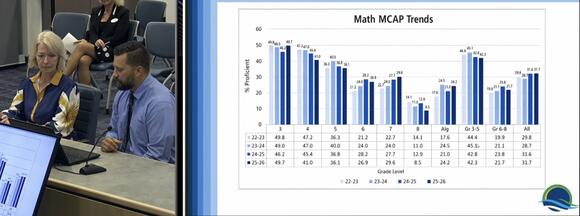
CENTREVILLE — While ahead of many state standardized testing averages, Queen Anne’s County Public Schools (QACPS) is recalibrating its approach to efficient assessment and grading.
District administrators presented the latest standardized testing data and announced a new 1-2-3 proficiency-based grading scale for elementary students to the Board of Education Sept. 2.
Changes are coming to standardized tests for some grades, according to Accountability, Assessment, and Data Management Supervisor Jon Grow and Assistant Superintendent Jennifer Schrecongost, who presented a summary of state data to the Queen Anne’s County Board of Education Sept. 2.
The Maryland System of Testing Academic Readiness (MSTAR) is phasing in systematically to replace the Maryland Comprehensive Assessment Program (MCAP) over a three-year period starting this school year, Grow said.
The Maryland System of Testing Academic Readiness (MSTAR) is phasing in systematically to replace the Maryland Comprehensive Assessment Program (MCAP) over a three-year period starting this school year, Grow said.
Currently slated to affect grades three through eight in English Language Arts (ELA) and math, the new MSTAR test design is fully adaptive with an overall shorter test length and an expanded question bank that measures the newest college- and career-ready standards, he said.
By the 2028-29 school year, MSTAR is expected to be fully integrated across all testing grades and subjects.
Reviewing 2025-26 MCAP data reported by the Maryland State Department of Education (MSDE), QACPS ranked eighth in the state for the Kindergarten Readiness Assessment (KRA) ELA and 11th for KRA math. Overall, QACPS performed above the state average in all categories, he said.
Presenting Maryland Integrated Science Assessment (MISA) breakdowns, Grow said QACPS’ high school 2025-26 proficiency level in biology increased by 2% from the previous year, performing 4% higher than the state average.
In math, QACPS ranked ninth in the state and second on the Eastern Shore. Overall results increased 0.9% for all students, and Algebra 1 showed an improvement of 3.2%, he said.
Math scores are steadily improving, Grow noted.
Eighth grade social studies proficiency increased by 8.3%, compared with a statewide increase of 2.7%.
QACPS’ proficiency level in high school government decreased by 4% after a prior 9% increase, he said, though QACPS continues to perform 11% higher than the state average.
In ELA, QACPS ranked ninth in the state and second on the Eastern Shore, with overall student results increasing by 0.9%, according to Grow.
This marks the first school year for Maryland’s new KRA assessment. Overall, QACPS placed above the state average across all KRA categories.
Recognizing focused efforts are needed to improve academic achievement, Schrecongost said current initiatives include developing a multi-tiered system of support, professional learning and Learning Network Facilitation training, monitoring and walkthroughs, and the return of reading and math specialists.
In other business, Schrecongost noted that this school year introduces a new elementary grading regulation.
Fourth and fifth graders now receive traditional letter grades based on percentages, while pre-K through third grade students receive a simplified 1-2-3 grading scale based on domains rather than an extensive list of standards, she said.
Under the 1-2-3 system, 3 represents established proficiency, 2 indicates developing proficiency, and 1 recognizes beginning proficiency, she explained.
Replacing the trimester system with quarterly marking periods, the implementation of the new grading framework for the current school year aligns elementary school grades with middle and high school practices, according to Schrecongost.
Parents can access the MSDE website for more information.
“Your child’s teacher is always the best source of information about your child’s performance,” she said.
Superintendent Matthew Kibler credited the new system of accountability as helpful for students and families checking grades.
With the system currently in place in fourth and fifth grades, QACPS will continue to study it for potential expansion to other grade levels, Kibler said.
The board also approved:
A one-year extension of the indefinite duration/indefinite quantity contract for surveillance cameras, data system wiring, access controls, and similar low-voltage systems between QACPS and Skyline Technology Solutions through June 2027.
–Three updated policies regarding nondiscrimination, negotiation, and bullying and harassment.
–The 2026 Comprehensive Maintenance Plan.
The Board of Education will next meet Oct. 7 at 6 p.m.
 Add to Preferred Sources