undefined
Posts
undefined
Followers
Monticello's data center debate echoes nationwide
By Mike SunnucksLauren Flaum,
4 days ago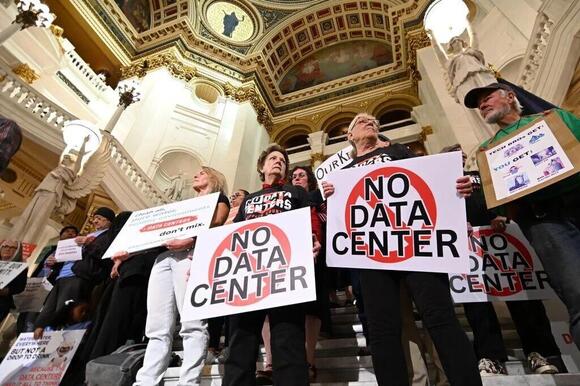
MONTICELLO — As Monticello officials weigh the future of a proposed hyperscale data center development, communities across the country are grappling with many of the same questions — and those concerns are increasingly influencing elections and government policy.
The debate over Monticello Tech LLC’s proposed 547-acre Edmonson Business Center has drawn significant public attention, with residents raising concerns about electricity demand, water consumption, noise, neighboring property values and the long-term impacts of large-scale development.
Those issues have also emerged as political flashpoints nationwide, with opposition to data centers helping fuel calls for stricter regulations, development moratoriums and greater protections for utility customers.
The concerns aren’t limited to Monticello.
Wright County adopted a temporary moratorium on data center development in May, while Otsego followed with its own moratorium in July. Minnesota lawmakers have also enacted measures aimed at ensuring large electricity customers, including data centers, bear the costs associated with their substantial power demands.
In Monticello, the City Council recently continued its consideration of the proposed development following a four-hour public hearing Nov. 9 that drew approximately 150 people. A special meeting is planned for Nov. 30, before the city’s Dec. 8 deadline for acting on the developer’s applications.
The local debate reflects a broader national reckoning over the rapid expansion of artificial intelligence infrastructure.
Democrats’ victories across the country in the November midterm elections gave them control of Congress and a number of governorships, potentially reshaping the regulatory landscape for AI and the massive data centers needed to support it.
A number of Democratic candidates in gubernatorial and U.S. Senate races campaigned on promises of stronger AI regulations and restrictions on data center development.
That contrasts with President Donald Trump, who has championed data center construction as essential to keeping the United States competitive with China and other countries in the global AI race.
However, opposition to data centers has increasingly crossed party lines, particularly in communities concerned about electricity costs, water supplies and land use.
“Local concerns over community development, grid demands, restricted public approval, and energy costs played a prominent role in mobilizing voters,” said Wannie Park, an energy industry veteran and founder and CEO of PADO AI, a Silicon Valley company that works with data centers on their energy needs.
According to exit polling cited in the national report, 76% of surveyed voters opposed data centers being built in their communities, while 56% said AI and data centers were a crucial or major factor in their votes.
Moratoriums spread nationwide
There are already 372 data center moratoriums throughout the United States, along with another 43 permanent bans, according to tracking data from Interconnected Capital LLC.
Data center opponents cite concerns about energy and water consumption, noise levels and land-use impacts, including the loss of farmland.
“I expect more resistance to data centers, and the midterms will likely accelerate that scrutiny. But this is increasingly becoming a non-partisan issue that both parties will need to address,” said Rich “Raz” Razgaitis, a clean water and sustainability expert and CEO and co-founder of FloWater, a Colorado-based water technology firm.
“Americans aren’t saying they are blatantly opposing economic or technological growth,” Razgaitis continued. “What they are saying is there is increasing concern about what that growth means for their communities.”
He said the next major debate over AI will focus on how resources are allocated and who bears the costs.
“The next big battle over AI won’t just be about technology. It’ll be about how resources like water are allocated, who pays for the infrastructure and who bears the consequences,” Razgaitis said.
New York already has a statewide data center moratorium in place, according to the national report. Park expects other states with newly elected Democratic governors to consider similar measures.
Democrats prevailed in gubernatorial races in Texas, Iowa, Wisconsin, Ohio, Minnesota, Arizona, Nevada and Georgia.
Local data center measures, including moratoriums and restrictions, appeared on ballots in 41 jurisdictions across the country, including communities in Ohio, Illinois, Maine, Kansas and Wisconsin. According to the report, all but one passed.
“In Ohio, voters passed bans or restrictions in at least 14 towns, and all five central Ohio communities with data-center measures voted against data centers,” Park said. “In Wilmington, about 80% of voters rejected the rezoning for a data center in four separate referendums.”
Park expects the election results to encourage additional restrictions.
“Following Democratic victories, local governments and communities will likely enact stricter regulatory guardrails and push for additional development moratoriums,” he said.
Electricity costs take center stage
One of the most significant questions surrounding data center development is who will pay for the enormous amounts of electricity needed to operate the facilities — and the infrastructure required to serve them.
That issue has also surfaced in Monticello, where the proposed Edmonson Business Center could eventually require more than 500 megawatts of electricity.
During an Oct. 12 work session, Monticello City Council members heard from Xcel Energy representatives about how large electricity customers are served and the regulatory protections intended to prevent their costs from being shifted to other ratepayers.
Minnesota lawmakers have addressed similar concerns through legislation requiring additional oversight of very large electricity customers and protections against stranded infrastructure costs.
Nationally, utility costs are expected to become an increasingly important battleground.
James Mercer, principal with Metro Colo Advisory, a New York-based data center brokerage firm, said electricity use tops the list of concerns for regulators.
“After (the election), the pressure on AI data centers will come through the power bill, not outright bans,” Mercer said. “Electricity costs tied to data centers became a campaign issue for both parties this year, and nine state utility commission seats were on the ballot.”
He expects newly elected officials to push for stricter utility rules, including long-term contracts, financial guarantees and requirements that data centers pay for their own grid improvements.
“That won’t stop AI data centers, but it will change which ones get built,” Mercer said.
Developers and users willing to cover their own energy costs will have the best chance of moving forward, he added.
“The ones who can’t will meet more resistance,” Mercer said.
Tracking data from Metro Colo show 105 utility filings related to data centers across 45 states, including projects in Wisconsin, Ohio, Iowa and Idaho.
Texas emerges as battleground
Texas, already home to the second-largest concentration of data centers in the country behind Virginia, could become a major testing ground for new restrictions.
The state has attracted significant investment in AI infrastructure, but its newly elected Democratic leadership could change the political environment for future projects.
“If you think the midterm result won’t affect the AI buildout, think again,” said Nic Puckrin, an investment analyst and founder of Coin Bureau, a cryptocurrency firm.
Puckrin pointed to the election of Texas’ first Democratic governor since 1990 and first Democratic U.S. senator since 1988.
Gov. Gina Hinojosa has called for an immediate statewide moratorium on new data center approvals, according to the report.
However, not everyone expects the political changes to halt development.
Sam Tabar, CEO of WhiteFiber Inc., a New York AI infrastructure company, said Texas will remain an important market for data centers.
“The change in governor will not stop Texas from being a major data center market,” Tabar said. “It changes the political conditions around the buildout more than it changes the underlying demand for compute.”
He said developers will increasingly need to demonstrate that projects have adequate electricity, infrastructure and community support before proceeding.
Public trust becomes a factor
Beyond concerns about electricity and water, some industry observers say public skepticism toward large technology companies is contributing to resistance.
The AI boom is being driven by some of the world’s largest companies, including Meta, Google, Microsoft and Amazon, along with prominent technology investors and billionaires.
John H. Cox, founder of the Hear the People Education Foundation, which advocates for grassroots election reforms, said distrust of political institutions and technology companies has become part of the debate.
“The result is that many are expressing this loss of trust in opposition to data centers,” Cox said.
“There’s no question that AI is going to change the world — mostly for the better. It’s that lack of trust that eats at people and causes them to question whether it will turn out well.”
In Monticello, questions about transparency have been a recurring theme throughout the review of Monticello Tech’s proposal.
The developer has not publicly identified an eventual end user for the property, citing nondisclosure agreements with potential customers.
During the Nov. 9 public hearing, council member Charlotte Gabler pressed developer representative Nick Frattalone about the lack of information regarding potential users.
Frattalone said construction would not begin without an end user and explained that obtaining development approvals is necessary before prospective customers can make commitments.
He described the approval process as the “first step in getting an end user,” adding that potential customers need to understand the rules governing a development before moving forward.
More regulation on the horizon?
Democrats in Congress and state legislatures are also expected to pursue broader regulations governing artificial intelligence.
Those proposals could include restrictions on advanced AI development, stronger privacy protections and additional oversight of technology companies.
U.S. Sen. Bernie Sanders, I-Vermont, has called for a national moratorium on new data centers.
Supporters of additional regulation argue that safeguards are necessary to protect jobs, privacy and communities from the potential consequences of rapidly advancing technology.
Opponents contend that excessive regulation could hinder American innovation and give competing countries, particularly China, an advantage.
Trump has promised to veto Democratic proposals that he believes would undermine the nation’s technological competitiveness.
Some industry observers also caution that regulations could unintentionally benefit the largest technology companies by making it more difficult for smaller competitors to enter the market.
Communities want a voice
Christopher Lee, a Las Vegas-based political consultant and founder of Foresight Strategies, said the 2026 elections demonstrated how strongly data center development can resonate with voters.
He believes developers need to do more to explain the potential benefits of their projects, including construction jobs, permanent employment opportunities and property tax revenue.
Lee pointed to Amazon’s efforts to engage communities when developing fulfillment centers.
“They make an effort to connect with the community,” he said.
Still, Lee expects resistance to continue, particularly in smaller communities and rural areas where residents worry about the effects of large industrial developments.
“They want to keep their quality of life that makes their communities uniquely rural,” Lee said.
That sentiment is familiar in Monticello, where residents have spent months weighing the potential economic benefits of a major development against concerns about its effects on surrounding neighborhoods and the community’s future.
With a decision on the proposed Edmonson Business Center approaching, Monticello remains part of a much larger national conversation about how — and where — the infrastructure supporting artificial intelligence should be built.
 Add to Preferred Sources
