undefined
Posts
undefined
Followers
Marietta Parent Challenges Removal of “Flamer” from School Library
By Specialhriggall,
2023-10-13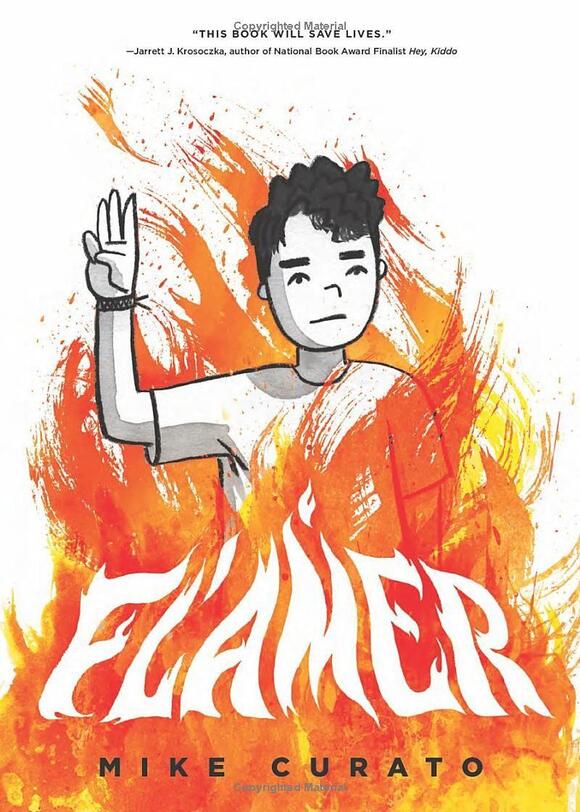
Under a new process created last month by the Marietta Board of Education, a parent has appealed the district’s removal of “Flamer” by Mike Curato from Marietta High School’s library.
“Flamer,” along with “Me and Earl and the Dying Girl” by Jesse Andrews, were removed from the library last month following a complaint from a parent and concerns from Marietta school board members.
Both books had been previously removed from Cobb County School District libraries on the grounds they contain sexually explicit content.
Soon after, the Marietta Board of Education voted 5-2 to adopt a directive ordering Superintendent Grant Rivera to remove “sexually explicit material” from Marietta City Schools.
The directive, however, also set up a process for appealing the removal of a book. Marietta parent Kayla Sargent has now done just that.
Last Friday, Sargent submitted a 16-page appeal to the district outlining why she believes “Flamer” should be available in the library.
“Flamer is neither harmful to minors nor pornographic, by objective definition. When read in its entirety, in context, it is clearly and unequivocally not intended to titillate or arouse,” Sargent’s appeal reads.
Superintendent’s decision expected next week
Sargent has kids who attend Burruss Elementary, Marietta Middle and Marietta High. She previously spoke out against the book bans at a Marietta school board meeting.
Under the timeline set out in the directive, the district has seven business days to review the appeal and investigate. Within 10 business days, the district will inform the parent whether the book has academic value, and whether it will be reinstated.
The directive says that appeals are “subject to full administrative and substantive review” by the school board, and that a final decision by the board will be issued within 30 calendar days of receiving an appeal.
Rivera told the MDJ he plans to issue a decision to Sargent next week.
“We are in that window of time, and certainly I will reply in accordance with the timeline,” he said.
The book, a graphic novel, tells the story of a gay 14-year-old boy who is bullied at summer camp, and how he learns to accept himself.
Argument
In her appeal, Sargent argues that the controversial parts of “Flamer” are intended to convey “fear and horror, not sexual excitement.” She points to other districts, in Wisconsin and Missouri, that have chosen to keep the book on shelves, and critical acclaim it’s received. Sargent argues that the book can serve educational purposes, that its themes align with MCS values, and that the recent directive conflicts with other district policies.
The appeal also includes nine “faculty statements” from individuals who Sargent says work in the district. But the statements are not signed.
Sargent told the MDJ she collected the statements as word circulated that she was working on an appeal, and that she knows all of their identities.
“I heard from probably three times as many faculty as submitted statements,” Sargent said. “And only a third of them felt comfortable to even submit a statement … some of them ran it by their lawyer before they did so because they’re so afraid.”
Asked about the faculty statements, Rivera said, “I am not attempting to identify any specific individuals referenced in the appeal, and their names were not provided.”
The statements defend the book and express concern over teacher morale.
“This witch hunt to find teachers who are ‘indoctrinating’ students is a myth,” one faculty statement reads.
Another statement says adults may be uncomfortable with “the fact that teenagers are sexual beings.”
“But you can dress code them and ban everything and take away all their television and phones and their books, and they’re still going to be sexual beings. Books do offer guidance because not everyone has parents who are comfortable talking about these issues,” it reads.
Yet another statement calls the book “a beautiful story showing the ugliness of homophobia, racism, and domestic violence, while showing friendship and acceptance as well.”
The statements also say things like, “it’s becoming exhausting to teach in MCS in a new way,” and that the board’s recent decisions show “a lack of care and concern for students who aren’t upper middle class, heterosexual, and white.”
“If the MCS is truly a family, then the board and leaders would analyze exit interviews, resignation rates, and find out what is causing current staff members to fear,” one of the statements reads.
Sargent said removing “Flamer” would lead to a slippery slope.
“By removing ‘Flamer,’ which has no sex in it at all, you’re carving out a path to remove all these classics that you say you want to keep,” she said, referencing board member promises to not ban “classic literature.”
Ongoing culture war
Debates over books, sexuality and gender have raged at meetings of the Cobb Board of Education in recent months. Due West Elementary teacher Katie Rinderle was fired by Cobb Schools Superintendent Chris Ragsdale in June after reading a picture book about “moving beyond the gender binary” to fifth graders.
Rinderle appealed her termination and was the subject of a two-day, highly publicized tribunal. While a three-member panel of former educators recommended she keep her job, the school board’s Republican majority sided with Ragsdale and upheld her firing. Rinderle is now appealing to the state Board of Education.
Prior to their removal, four of Marietta’s seven school board members expressed concerns to the MDJ that “Flamer” and “Me and Earl and the Dying Girl” were in the MHS library.
“To me, it’s simple and it’s straightforward,” said Marietta school board member Jaillene Hunter, at the meeting where the directive to Rivera was approved. “You do not need to spend taxpayer dollars to provide sexually explicit material to minor children in K-12 schools.”
Cobb Superintendent Chris Ragsdale, meanwhile, defended his banning of “Flamer,” among other decisions, in a defiant, 20-minute speech at a board meeting last month.
“‘Flamer’ is a graphic novel, so the indecent and highly sexual language is accompanied by illustrations, including those of nude children,” Ragsdale said. “Again, if you do not think there is a problem with students having unrestricted access to these books in a school media center, you are wrong, and hopefully, you do not know what is actually contained in these books.”
In the same speech, Ragsdale said “The sexualization of children can never be defended nor allowed in any context, especially in education. There is no middle ground in this situation, there is no room to flip-flop on where you stand. You are either in favor of providing inappropriate material to children, or you are against it, and I assure you, I am against it, and I will not be moved.”
 Add to Preferred Sources