undefined
Posts
undefined
Followers
Cobb moving forward with on-demand transit expansion
By hriggall,
2026-06-24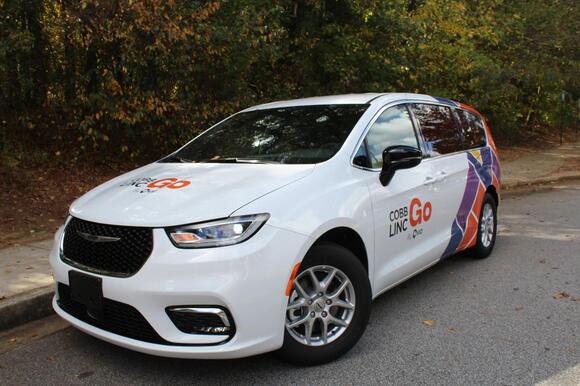
Cobb County commissioners took two votes Tuesday night to move forward with expanding on-demand “microtransit” service in parts of south Cobb, Acworth and Kennesaw.
The Board of Commissioners voted 4-0, with Chairwoman Lisa Cupid absent, to open 30-day public comment periods during which residents can weigh in on the proposed expansions.
Since October 2024, the county’s CobbLinc system has offered CobbLinc Go, an on-demand transit service akin to ride-hailing apps, in a 26-square-mile contiguous zone in south Cobb.
The south Cobb service is in the second year of a two-year pilot program, with an option to extend service for a third year.
The zone includes Wellstar Cobb Hospital, two high schools, several grocery stores, a library and a county recreation center.
CobbLinc plans to expand the south Cobb zone for the third year to northern Mableton, adding five square miles to the zone.
The area being considered for expansion is bordered roughly by Austell Road, Floyd Road and Veterans Memorial Highway.
At the same time, the county is eyeing a new microtransit zone in north Cobb.
The second zone would cover an area of 31 square miles which contains downtown Acworth and Kennesaw, Kennesaw State University, Cobb County International Airport and Town Center Mall.
Tuesday’s vote authorized county staff to conduct “service and fare equity” analyses of the proposed expansions. The studies are legally required for agencies which receive federal funding, such as CobbLinc, when they consider service changes.
CobbLinc Go is operated by a third party, Via Transportation, at a fixed cost. Riders can hail a car in an app, like with Uber or Lyft. Drivers pilot Chrysler minivans that can hold up to five passengers. The service runs 7 a.m. to 7 p.m., Monday through Friday.
Microtransit users who are dropped off at bus stops can transfer to a bus for free. CobbLinc’s 30 route runs along the eastern border of the south Cobb zone.
‘Ridership has been very good’
CobbLinc Go replaced the system’s old FLEX service, and has proved popular in its 20 months of operation.
The old FLEX service saw about 550 riders monthly, per Cobb DOT. In its first full month, CobbLinc Go served 824 rides.
Ridership has grown steadily since then. In the second half of 2025, the service averaged 2,850 monthly riders. Cobb Transportation Director Drew Raessler said at a Monday work session that May 2026 saw 3,300 riders.
The system’s popularity can be seen in longer wait times and more riders in each van, as experienced by an MDJ reporter who tested the CobbLinc Go system on its first day in 2024, then again this past February.
The south Cobb pilot program costs $1.1 million annually to operate, with 70% of funding from state and federal grants and 30% from the county. Raessler believes the program’s popularity makes it likely the state will approve funding for the program’s optional third year.
“They’re very positive on the feedback that we’ve done so far,” Raessler told commissioners. “The ridership has been very good, so we fully anticipate that third year being authorized.”
The north Cobb microtransit zone is scheduled to launch this fall, according to Shelly Weidner, the county’s interim communications director. Commissioners would vote in August on the final service area and funding arrangement.
Last December, the state awarded a $3.84 million grant to help fund the north Cobb pilot program. Cobb is required to match the grant with at least $960,000 in local funds, though it may have to spend more money on top of that to fully fund the program.
At Monday’s work session, Republican Commissioner JoAnn Birrell asked how county staff picked the two expansions, and questioned why Cumberland wasn’t being considered.
“It was based on analysis of where riders are coming to and from,” Raessler replied, adding that the south Cobb expansion will add several destinations to the zone. Among them are the Mable House Arts Center, the South Cobb Regional Library and several grocery stores.
As for the north Cobb zone, Raessler said it was attractive because it contains two downtowns and KSU. It also “takes kind of the … northernmost extent of (CobbLinc) transit and expands it further north.”
Democratic Commissioner Erick Allen noted that Cumberland is already easier to get to via transit than many other areas — half a dozen CobbLinc fixed bus routes stop at the Cumberland Transit Center, and the area is also served by the free Blue Circulator route.
Dollars and cents
Both microtransit zones are being supported by state grants and are short-term pilot programs. Even if popular with riders, the county will need to identify long-term funding sources to keep them going once the pilots end.
As the MDJ previously reported, microtransit, paratransit and the old FLEX service are considered “demand response” transit, and are more expensive and less efficient than buses running on fixed routes.
In 2024, CobbLinc spent $11.13 for every mile a passenger rode using on-demand transit, according to the National Transit Database. Regular, fixed-route buses, meanwhile, cost the system $5.66 per passenger mile.
Implementing a countywide system of microtransit was one of the key pillars of a proposed $11 billion, 30-year transit sales tax that Cobb voters rejected in 2024.
Earlier this year, Republicans in the General Assembly passed legislation that blocks the county from holding another such referendum until 2032.
 Add to Preferred Sources
