724
Posts
551
Followers
Pasadena Media Foundation is dedicated to saving local news. Our publications feature provocative reporting about the Greater Pasadena and Greater Southern California areas.
Composer Chris Walden: The Oscars’ arranger turns 60
By Sheryl Turner,
5 hours ago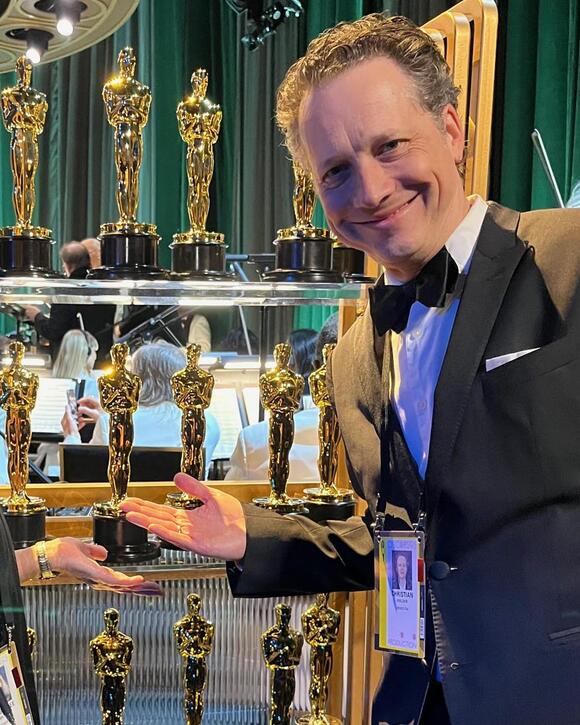
For more than three decades, Chris Walden has been one of the most in-demand—and least visible—figures in American music. As a seven-time GRAMMY®-nominated composer and arranger, he has written more than 1,500 orchestral and big band arrangements for artists including John Legend, Michael Bublé, Aretha Franklin, Paul McCartney, SEAL, Stevie Wonder, Rihanna, Barbra Streisand and Josh Groban, scored more than 40 feature and television films, and served as lead arranger for the Academy Awards, the Kennedy Center Honors, American Idol and the Super Bowl, where he arranged Jennifer Hudson’s National Anthem performance. He has collaborated as arranger and bandleader with jazz artists Diana Krall, Herb Alpert, Michael Brecker, Arturo Sandoval and the Count Basie Orchestra, working closely with producers David Foster, Tommy LiPuma and Phil Ramone. He has conducted the Los Angeles Philharmonic, the Hollywood Bowl Orchestra, Holland’s Metropole Orkest, the Boston Pops, the Philadelphia Orchestra, the Pittsburgh Symphony and the WDR Big Band Cologne, among others.
Born in Germany, Walden composed music for German film and television before emigrating to Los Angeles at 29. He performs on trumpet and flugelhorn, has served as a trustee on the national board of the Recording Academy, and is past president of the American Society of Music Arrangers and Composers (ASMAC). Today he lives in Los Angeles and, for the past seven years, has been lead arranger for the Oscars telecast.
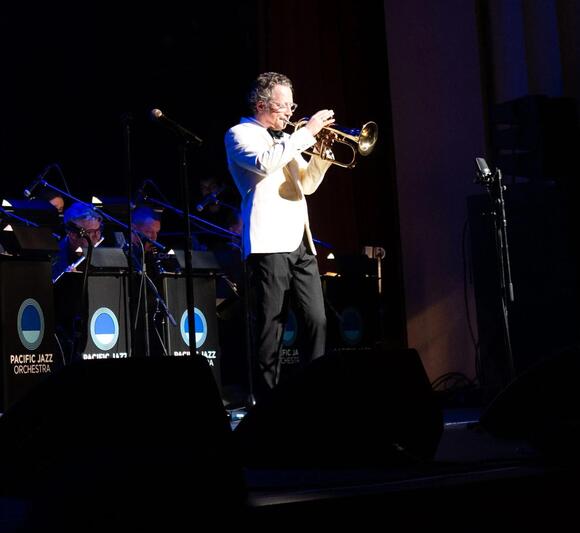
But in 2022, at an age when many of his peers were slowing down, Walden started something new: Pacific Jazz Orchestra, a 40-piece hybrid big band and string orchestra that has since become, in his words and in the words of the critics who cover it, Los Angeles’s only resident jazz orchestra. Variety has praised its performances as ones that “entertain, inspire, and enrich.”
This fall, as Walden turns 60, the orchestra he built is marking the milestone with three high-profile concerts — one already on the calendar for September 19, a birthday celebration October 10; and a tribute to Quincy Jones October 18. In this extensive interview with Local News Pasadena, he reflects candidly on a career built largely out of a small office on the second floor of a legendary recording studio.
From a room at Capitol to working from home
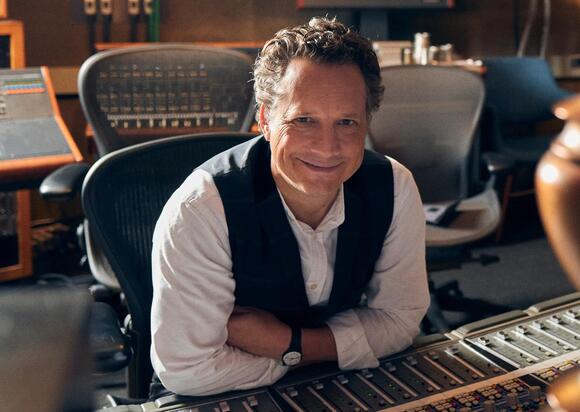
Walden’s creative life has always been tied to the rooms he worked in, and he traces the arc of his career through them: a rented office on Roscomare Road, a writing room in Studio City, and, for years, a room at Oceanway Studios — now United Recording. But Capitol Studios in Hollywood became his true home base after years of asking.
“For years, I had a writing room. It’s Oceanway Studios, which is now United Recording. But most of my work always happened at Capitol, and I kept nudging the studio manager: ‘ Can I have a room at Capitol? Can I rent a room at Capitol?'” Walden recalled.
They always said no. Capitol Music Group owns the building, which in turn is owned by Universal Music. They were not interested in renting a room to an individual. I pleaded my case whenever there was a new operations manager. Finally, a guy came along, said okay, and I was there for six years. They didn’t allow this for anyone else,” Walden said.
Being inside the building, he said, meant being part of its daily life. “I was a good customer; I brought a lot of work to Capitol. I would occasionally walk down to see what else was going on in the studios, and make great connections. The engineer Al Schmidt was working a lot at the time. Sometimes his clients would say, ‘Hey, we need a string arranger, and Al would say, ‘Hey, Chris Walden is in his office here on the 2nd floor.’ I was inspired just walking into an iconic building like this, where you can still feel the energy of all these greats who have recorded here. A great working environment inspires me to write great music,” he said.
“Capitol closed during the pandemic, reopened for a minute afterward, and then closed again because they had to earthquake-retrofit it. They’re going to reopen it finally this fall. In the meantime, I moved to United Recording. But then they closed that studio as well. With no recording happening, it felt weird. I was the only one in the building, turning the lights on in the morning and off in the evening, and I wasn’t meeting anyone. So that’s when I decided to work from home. Now the kids are older and out of the house. So it’s just my wife and me, and we work it out,” Walden said.
A friendship with Quincy Jones
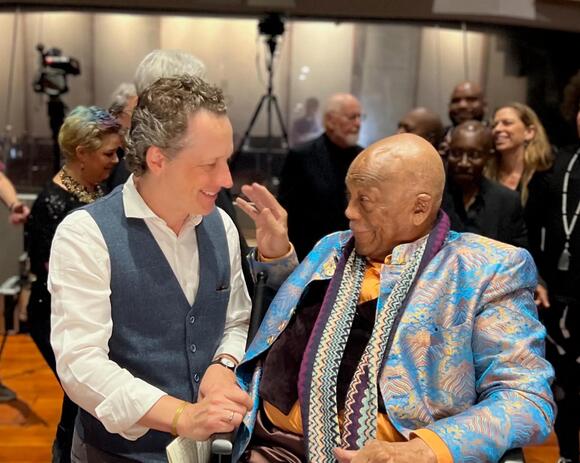
Walden’s connection to Quincy Jones began, fittingly, at Capitol Studios. “The first time I met Quincy was at Capitol Studios. He was recording something, and I happened to run into him in the hallway. We got to talking and became friends,” Walden said.
The friendship grew slowly, built on a shared vocabulary that Jones didn’t often get to use. “He had so many things he was doing – business and film and television and all the magazines he was publishing at the time, but he didn’t have many people to talk with about the craft of arranging. We didn’t talk frequently, but a couple of times a year, he would call me to discuss arranging. He wanted to talk to a fellow arranger, so that was our friendship. It came about bit by bit, and then we would run into each other and always have a great time,” he said.
When Walden founded Pacific Jazz Orchestra, Jones was one of the first people he told. “He immediately said, ‘Let me know how I can support it.’ And I said, ‘The way you can support it is to lend your name and serve on the advisory board,’ and he immediately said yes. I would call him for advice, and he was always a great sounding board. So we miss him now that he’s gone,” Walden said.
Jones’ influence on Walden’s writing goes back to a story about necessity and invention. “He would occasionally tell me his philosophy of writing—one thing he said stuck with me. Back in the 50s, when he was arranging in New York, they weren’t giving string players to black arrangers because, for some reason, they thought black arrangers would not know how to write for strings. That was stupid, but since he wasn’t given strings to write for, he still needed to create a lush sound; out of necessity, he figured out a way to double the flutes with muted trombones to give it the illusion of strings. And that’s something I thought was fascinating. So I took that with me, a technique I sometimes use. Very often, when I write music nowadays, I still think, ‘How would Quincy have written that?'” Walden said.
In honor of his advisor, Walden brings a Tribute to Quincy Jones to Camarillo’s Rancho Campana Performing Arts Center on Sunday, October 18, 2026, with a19-piece big band performing Jones’ early work from the 1950s and ’60s, including selections from The Quintessence, arrangements for Frank Sinatra and Sarah Vaughan, and film scores from The Pawnbroker and In the Heat of the Night. Guest vocalists Nayanna Holley (The Voice, American Idol) and Adam “Aejaye” Jackson join the performance.
Building an orchestra round strings and a shrinking LA session economy
Pacific Jazz Orchestra’s instrumentation — a big band fused with a full string section — sets it apart from virtually every other working jazz ensemble in the country.
“We’re the only orchestra of its kind in this country, a big band with strings. I would say that the only equivalent to us is the Jazz at Lincoln Center Orchestra, which is also a nonprofit resident jazz orchestra in New York. But it’s just a 17-piece band without strings. I modeled the Pacific Jazz Orchestra’s instrumentation after the Metropole Orkest in Holland, which I worked with numerous times as a guest conductor and arranger. PJO is a hybrid instrumentation. It’s not a symphony orchestra; it’s a big band and strings,” he said.
Many of the musicians who fill the PJO chairs also work with Walden on the Oscars telecast, an overlap he sees as a symptom of an industry in transition rather than a verdict on it.
“I don’t know if it’s good or bad; I think it’s just a sign of the times. I’ve been the lead arranger for the Oscars orchestra now for the last seven years. In the Oscars orchestra, I say who I want there, but the rhythm musicians are more determined by whoever the music director is at the time. Still, they come to me and ask, ‘Who do you want?’ So I give them the names of the people that I’ve been working with for decades,” he said.
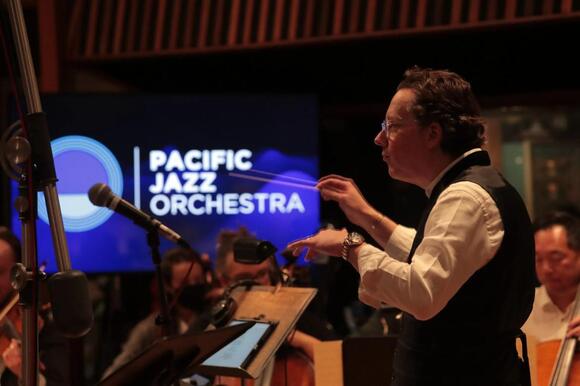
“When I started PJO, I knew immediately who I wanted in this orchestra. It was just natural to ask them if they would participate,” Walden said.
The broader trend, he said, is fewer recording jobs chasing more musicians. “Obviously, recording gigs for musicians in Los Angeles are getting less and less. Now that PJO has been around for four years, we’ve been getting requests from other studio musicians who want to be on the list and would love to play with us. So we have more musicians interested in playing with us than we can actually use, but that’s a good thing for us. It’s maybe a sign, too, that work is dwindling a little bit, but good musicians are doing well,” Walden said.
He is emphatic that the decline predates, and has different causes than, artificial intelligence.
“Before AI became a thing, the exodus of recording orchestras in LA started 20 years ago. It’s mostly because of producers, especially in film and television. Producers don’t want to pay musicians residuals. They want to pay for a recording once and take a buyout. In Los Angeles and elsewhere, the American Federation of Musicians contracts don’t allow a buyout scale. That is why many producers take the music overseas to have it recorded under a buyout agreement so they don’t have to pay residuals to the musicians later on,” he said.
Union structure, Walden said, varies widely from country to country.
“In Germany, we don’t have a musicians’ union. There is a sort of musicians’ union for fully employed orchestra musicians who already have a steady gig, but there’s no musicians’ union for freelance musicians. As a musician, you’re just at the mercy of the producer for whatever he wants to pay you. In the UK, it’s a little bit different: there is a musicians’ union, but it’s different from the US musicians’ union. The UK musicians’ union allows a buyout,” he said.
Choosing venues, building an audience
When Walden launched PJO four years ago, he built its concert calendar the old-fashioned way—in person.
“I approached venues personally and told them about my idea for PJO. Some of them said, ‘not interested,’ and some said, ‘oh yeah, that sounds interesting, let’s try it.’ The Soraya and the Wallis were foremost,” he said, and have become anchors for the orchestra.
“We have had a great relationship with them. We showed that we could actually fill the house, and they hired us back. When I approached them with a new project, they agreed to continue working with us. Audiences are now exposed to a jazz program, so there’s a synergy, a crossover and cross-pollination,” Walden said.
The relationship with the Younes and Soraya Nazarian Center for the Performing Arts at Cal State Northridge continues this month. Broadway legend and seven-time Tony Award winner Sutton Foster joins PJO for an evening of music from Broadway and beyond on Saturday, September 19, 2026, at 8:00 p.m. The concert marks Foster’s Soraya debut and launches both The Soraya’s 16th season and PJO’s fourth season, with Walden creating new arrangements for the occasion.
Foster, who first won a Tony Award in the title role of Thoroughly Modern Millie in 2002, has since originated roles in Shrek the Musical, Mel Brooks’ Young Frankenstein and The Drowsy Chaperone, and she won her second Tony for Anything Goes. She has released three solo albums along with eleven cast albums.
In Pasadena, there isn’t a dedicated late-night jazz club in the way Los Angeles proper does. Pasadena’s jazz life leans toward parks, conservatories, and performing-arts venues rather than a club circuit.
Passing it on: the PJO education program
Walden’s path into arranging began with a formative experience in a German youth jazz program, and it shaped his determination to build an educational arm for PJO from the start.
“We just finished our first-ever educational summer camp, the Summer Jazz Intensive. When I was 19 or 20, I attended a youth jazz program in Germany. We came together twice a year for a couple of weeks, rehearsed, and then did a little tour. I learned so much from that experience, and it motivated me,” Walden said.
“It propelled me into pursuing arranging and composing in jazz, and I always wanted a way to give back that experience. That’s why it was important to me that we started an education program,” he said.
The inaugural camp, developed with Courtney Fortune, put adult PJO musicians in front of the next generation.
“In the summer camp we had the students divided into small combos, like a rhythm section and horns, and we had instructors from the PJO who would come and lead those combos. In the afternoon, I led the whole ensemble, which was 35 students. In a sense, this is creating a Pacific Youth Jazz Orchestra. We are already starting to prepare for next year,” Walden said, adding that further programming is in the works, including a program where PJO musicians showcase educational content in classrooms.
Similar in concept is Pasadena City College’s dedicated Jazz & Commercial Music program with performance ensembles. The Pasadena Conservatory of Music runs its own jazz department, and Boston Court Pasadena regularly programs jazz as part of its “Discover Music” series—everything from PCC student showcases to individual artist concerts.
A career of guest podiums
Long before PJO, Walden built relationships with orchestras across the country, largely through arranging rather than conducting. Of them all, he singles out one for its openness to his ideas.
“I’ve written a lot for American orchestras. The Boston Pops is a unique orchestra. It’s basically the Boston Symphony without the principal players. The Boston Pops are always fun to work with because of the ideas they bring to me about what they want to play and how the arrangement should feel. They gave me enough freedom to do my thing, and I always enjoyed writing for the Boston Pops,” he said.
Other associations never made it to the podium.
“Some orchestras I’ve written for but never conducted, like the Chicago Symphony or the New York Phil. And some orchestras just invited me as a guest conductor, even though I hadn’t written for them. So it’s a bit of a mixed picture of what I do with orchestras,” Walden said.
His years as Diana Krall’s music director put him in front of some of the country’s most storied ensembles, if briefly. “I did get to conduct a lot of orchestras when I was Diana Krall’s music director and conductor. We played with the Philadelphia Orchestra and National Symphony and others. These were not as intense because we rehearsed it in the afternoon, we did the show, and I got on the bus the next day,” Walden said.
Donations, not ticket sales, keep an orchestra alive
Walden is candid about what it will take for PJO to endure. He is clear-eyed that ticket revenue alone will never be enough.
“No orchestra in the US is sustainable from ticket sales. That’s why I started this nonprofit organization so that we can accept donations. From the New York Philharmonic to the LA Philharmonic, none of these orchestras are sustainable; they all rely on donations and cannot survive on ticket sales alone,” he said.
“The ratio is somewhere between 20/80, meaning 80 percent donations and 20 percent ticket sales. That’s sort of the case for most orchestras. We are at 30/70. Maybe in a dream world, it would be fifty-fifty,” Walden said.
Looking ahead five to ten years, Walden’s ambitions?
“For the next five or ten years, I would love to do more concerts. Right now, we’re doing four to six concerts a season spread out across six venues. The original idea was to bring it to all parts of Los Angeles, which can be quite exhausting. Managing six different venues each season is hard. I would love to establish us in two venues that will become our home venues and maintain a steady presence there and our season to grow, maybe to 6 to 8 concerts per season. And for our education program to grow, too,” he said.
Even as the orchestra has exceeded his own expectations, Walden says his day job hasn’t changed.
“PJO’s success has come quicker than I expected. But the main focus of my career is still the Oscars. I still do new recording projects once in a while, even though they have become less frequent. I’m not angry at what the PJO has become and will even be more of a main focus,” he said. “I’m getting fewer gigs, but not because of PJO. I think it’s just the nature of the business at the moment, because fewer artists are recording with orchestras or big bands.”
His film work continues alongside it.
“I did a film earlier this year, called Bad News on the Doorstep, which premieres next year, and I’m in talks about another film I’ll be scoring early next year,” Walden said. Two other projects remain in limbo. “A documentary about prison gangs has been completed but not released yet. I did this documentary three or four years ago. Sometimes you do these films, and they never come out. It’s beyond my control,” he said of the Netflix project.
The other, a Jazz Mass, came from an unexpected friendship.
“The jazz mass was a project by a friend of mine who asked me to collaborate with him. He wanted to create a Jazz Mass, a Catholic Mass with jazz elements in the liturgy. I composed the music for this. We recorded the album three or four years ago, and we actually performed live at the Saint Dominic’s Cathedral in San Francisco. That was a nice project to do, and I’m not even Catholic, but it was fun,” Walden said.
A 60th birthday, under the stars
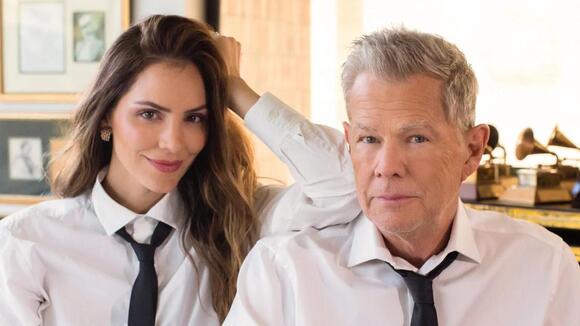
PJO is marking Walden’s 60th birthday with a benefit concert of its own on Saturday, October 10, 2026, at 7:00 p.m., at a historic private estate in Toluca Lake. The evening under the stars is anchored by an intimate concert featuring a stellar lineup of guest artists from pop, Broadway, jazz and classical music: 16-time GRAMMY®-winning songwriter/producer David Foster; film/television/Broadway star Katharine McPhee; GRAMMY®-winning singer and Broadway luminary Joanna “JoJo” Levesque; multi-GRAMMY®-winning classical violinist Anne Akiko Meyers; and R&B/soul singer Adam “AeJaye” Jackson, with additional guest artists to be announced. All will perform with the full 40-piece Pacific Jazz Orchestra, for which Walden is creating original arrangements spanning jazz, swing, Latin, R&B, pop and musical theater; the second half of the program features Walden leading the orchestra’s 17-piece Big Band Ensemble.
“I can’t think of a better way to turn 60 than surrounded by the music, musicians, friends and family I love,” Walden said. “This will be a very special event with remarkable artists in an iconic location.”
PJO supporters for the event include the Herb Alpert Foundation, GRoW @ Annenberg Foundation, the Alesia Alpert Family Foundation, the Natalie Cole Foundation, the Ella Fitzgerald Foundation and more.
Family around the kitchen
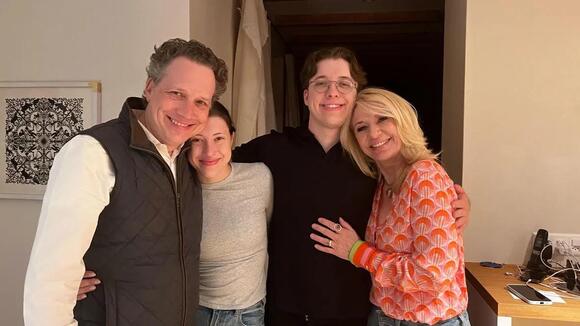
Away from the podium, Walden’s family has spent decades immersed in the same world where he built his career. His wife, a classically trained violinist, stopped performing once the couple started having children, and she turned to photography, shooting many album covers.
“My wife is a classically trained violinist, but she retired from playing violin because it started hurting. All violin players hurt to some degree or another, and she became a photographer,” Walden said.
Their two children grew up around recording studios but didn’t follow their father onto the bandstand.
“Both my children grew up playing instruments and being around recording studios. They learned it through osmosis, but neither became a professional musician. My son works at a music payroll company doing payroll administration and calculating benefits. My daughter, the production manager of the PJO, works with me daily, and with me at the Oscars. She’s a production associate there,” Walden said.
As for downtime, Walden doesn’t pretend to have much. “I like hiking. My wife and I go hiking once in a while. Once in a while I play golf a little bit, but I don’t play enough that I’m good at it,” he said. “I love to cook. I’m the one who usually cooks at home for dinner.” Asked what he likes to make, he didn’t hesitate. “I like Italian food, so I like cooking Italian food, but, of course, there are German things I cook, too.”
Comments
YOU MAY ALSO LIKE
Dianna Carney
“How Has NO ONE Applied?”: Little Mandy Is Still Waiting for Someone to Choose Her
Forever Paws Animal Shelter in Fall River, Massachusetts, says it can’t understand why a small senior dog named Mandy has drawn no interest, posting an emotional plea that begins, “How has NO ONE applied for this girl?! Not a single application, phone call, nothing. What? How? WHY?” The shelter describes Mandy as an affectionate “velcro pup” who “will glue herself to you and never leave,” adding that while she enjoys walks “at a brisk dawdle,” she’d “much rather be in your lap or curled up next to you, as long as she’s touching you somehow.”
Dianna Carney
This 8-Pound Yorkie-Chihuahua Mix is Stealing Hearts & Looking for Love
Prince may only weigh 8 pounds, but this “scruffy perfection” is making a big impression at Forever Paws Animal Shelter in Fall River, Massachusetts. The shelter introduced the small senior pup in a recent post, describing Prince as “about eight years old — an older adult looking for that forever kinda love,” and emphasizing that while he’s tiny, he’s full of personality and ready for a home that can offer time, patience, and consistent affection.
CJ Coombs
Jim DeLillo
One of Wisconsin’s Most Beloved Attractions Is Going Away After 61 Years
Generations of Wisconsin children have walked these darkened streets. Soon, the lights will go out for the last time, but something new is waiting around the corner. This article was created with research and writing assistance from artificial intelligence. Sources and factual claims were independently reviewed against Milwaukee Public Museum materials.
Pasadena Media Foundation is dedicated to saving local news. Our publications feature provocative reporting about the Greater Pasadena and Greater Southern California areas.
724
Posts
551
Followers