697
Posts
538
Followers
Pasadena Media Foundation is dedicated to saving local news. Our publications feature provocative reporting about the Greater Pasadena and Greater Southern California areas.
From Whistler to Warhol, all in one catalog, all on one wall in Pasadena
By Sheryl Turner,
1 hours ago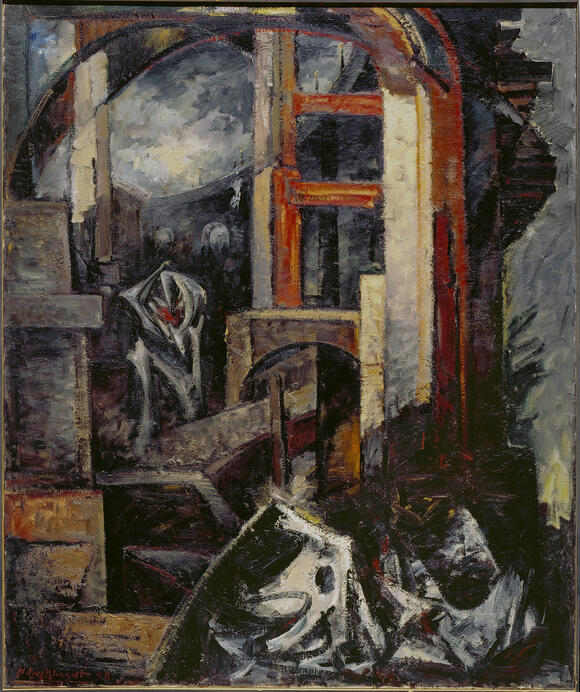
There’s a particular kind of local history that hides in plain sight, not lost, exactly, just uncatalogued, unrepeated, and eventually unbelieved. That’s the territory Jack Rutberg Fine Arts stakes out in ‘A Hidden Story Revealed: Pasadena: L.A.’s Art Legacy,’ the 172-page catalog accompanying its summer exhibition of the same name. Drawn entirely from the gallery’s own holdings, the show gathers 70 works by 60 artists. It uses them to argue something Los Angeles rarely admits about its more decorous neighbor to the northeast: that Pasadena was, for several astonishing decades, where the international avant-garde actually landed first.
The catalog’s cover announces its intentions with a detail from Hans Burkhardt’s 1948 ‘Pasadena Bridge,’ an expressionist take on the Colorado Street Bridge known locally, less charitably, as “Suicide Bridge” that sets the tone for everything that follows: familiar Southern California geography rendered by artists whose reputations were built on rather less parochial stages.
Gallery owner Jack Rutberg opens the book with an introduction that does the real archival labor of the project, cross-referencing his own inventory against the exhibition histories of the Pasadena Art Museum, the Norton Simon, the Huntington, Pasadena City College, and Art Center College of Design. Founded in 1979 with an inaugural show pairing Arshile Gorky and Hans Burkhardt, Jack Rutberg Fine Arts operated on La Brea Avenue in Los Angeles for decades before relocating to Pasadena in December 2022, plenty of time to amass an important collection.
“Pulling back the curtain of a history hidden in plain sight, this publication was born out of our art exhibition, ‘Pasadena: L.A.’s Art Legacy,’ that took on a significance far beyond expectation,” Rutberg writes in that introduction.
“Its genesis evolved through surveying the history of every art exhibition presented at the art institutions in Pasadena: The Huntington in San Marino, the Pasadena Art Museum, the Norton Simon Museum, Pasadena History Museum, Pasadena Museum of California Art, Pasadena City College and ArtCenter College of Design.” The tally he arrives at is the show’s thesis in numbers: nearly 60 of the artists in his gallery’s holdings were, at some point, exhibited by a Pasadena institution, many of them for the first time anywhere in the country.
“In comparing the artists featured in those exhibitions,” Rutberg explains, “we compared that roster with artists represented in my art gallery’s holdings, works we actually offer for sale, to discover that nearly 60 artists in our inventory were by artists featured in those institutions, recent works to those dating back as far as the 17th century. Seventy works comprise the exhibition, each fully describing in what year and in which museum the artist was shown.”
The reaction, he says, was immediate and consistent: “Visitors were taken aback as one could repeatedly hear the same comments: ‘Wow, I had no idea.’ They included art curators, colleagues and frequent museum-goers, all encouraging us to document this remarkable history and this unprecedented exhibition.”
That “firsts” list is where the catalog earns its subtitle. The Pasadena Art Museum, we’re reminded, mounted Kurt Schwitters’ first American museum exhibition, Joseph Cornell’s and Roy Lichtenstein’s first retrospectives, Richard Serra’s first museum show, and, most consequentially for this review, Andy Warhol’s first museum retrospective, in 1970.
Marcel Duchamp’s own first museum retrospective anywhere happened there too, in 1963, an exhibition immortalized by Julian Wasser’s now-iconic photograph of Duchamp playing chess with a nude Eve Babitz in the museum’s gallery. The catalog reproduces that photograph twice, once as an introductory plate, once again as the wall label accompanying two prints by Jacques Villon, Duchamp’s older brother, who also showed at the museum. It’s a smart curatorial move: rather than treat photography as illustration, Rutberg lets Wasser’s picture function as a genuine exhibit, the visual proof of Pasadena’s improbable centrality. Julian Wasser earns his own line in the catalog’s index, cited across five separate pages, a photographer given equal billing with the painters and sculptors around him, which is exactly the kind of small, deliberate gesture that distinguishes this catalog from a standard gallery checklist.
The show’s marquee “unexpected” inclusion, in this author’s opinion, is Man Ray. It would be easy to assume that a Dada and Surrealist figure, best known for his photograms and portraiture, doesn’t belong in a Southern California print gallery’s summer exhibition until the catalog explains why he’s essential to the argument.
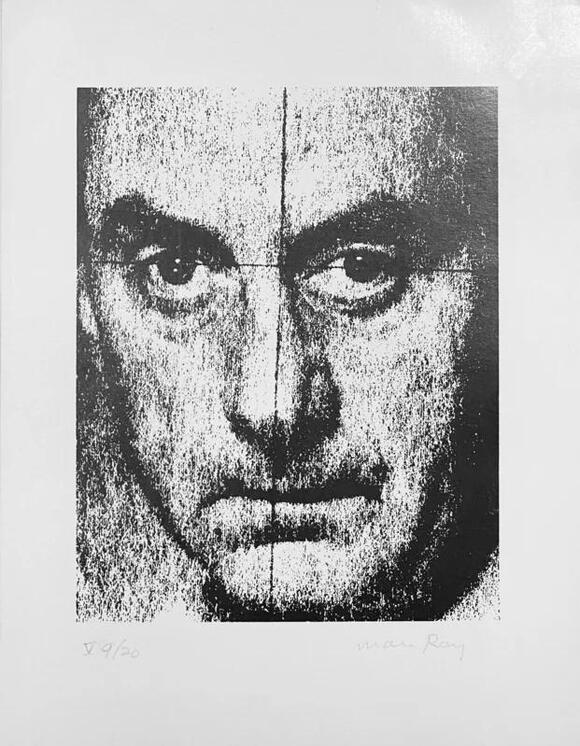
Man Ray fled France ahead of the Second World War and lived in Los Angeles from 1940 to 1951. In 1944, the Pasadena Art Museum gave him his first American museum retrospective. The work on view here is his 1947 lithograph ‘Self Portrait,’ a stark, bisected image from an edition of 100 printed on Japon paper, less a photographic self-fashioning than a graphic one, and a reminder that Man Ray’s California decade is still under-told relative to his Paris years. Placed a few pages from Louise Nevelson’s wood-and-paper assemblage and Henry Moore’s ink drawings, the Man Ray print becomes part of a quieter case the catalog is making throughout: that Pasadena’s museum culture had unusually catholic taste, willing to give major runway to photographers, printmakers, and assemblage artists alongside its painters.
Sculpture, in fact, turns out to be one of the catalog’s genuine surprises.
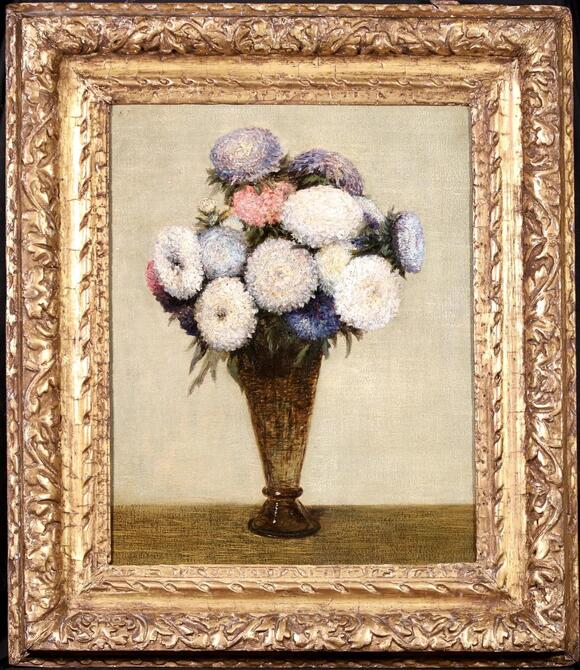
Auguste Rodin, Aristide Maillol, and Edgar Degas all appear, not as marquee names dropped for prestige, but represented by intimate works on paper and small bronzes that the Norton Simon Museum’s Southern California collecting made possible. The Kollwitz’s expressionist prints and Wassily Kandinsky’s Blue Four-era works (by way of Galka Scheyer, the dealer whose 1953 gift of more than 450 works transformed the Pasadena Art Museum’s holdings) round out a section of the catalog that feels less like a commercial gallery’s inventory and more like a compact survey of European modernism’s California landfall. So does the presence of Giovanni Battista Piranesi and Jacques Callot, eighteenth- and seventeenth-century etchers whose inclusion, alongside a newly rediscovered 1887 Henri Fantin-Latour floral still life, ‘Bouquet of Dahlias,’ extends the catalog’s timeline back some four centuries, undercutting any assumption that this is simply a story about postwar Los Angeles.
The two essays reprinted in the catalog’s front matter, David Cross writing in ‘Pasadena Now’ and this reviewer in ‘Local News Pasadena’ both zero in on the same anecdote as the show’s emotional center: Alexander Calder’s childhood a few blocks from the gallery’s current location, where a young “Sandy” Calder built wire figures in his father’s basement studio after watching the Tournament of Roses parade, seeding an interest that would eventually produce the ‘Cirque Calder.’ It’s a well-chosen detail because it does, in miniature, what the whole catalog aims to do at scale: insist that Pasadena’s contribution to art history isn’t a footnote borrowed from Los Angeles, but a point of origin in its own right.
The book itself is more than a checklist bound between covers.
“The publication duplicates the exhibition with an added introduction I wrote offering some general context to this untold story,” Rutberg says. “Additionally, the book serves as a catalog of the exhibition and includes an eight-page graphic timeline with key events spanning 1903 to the gallery’s move to Pasadena in 2023.”
That timeline, and turning each page of all 70 works illustrated, reveals an “Oh wow, I didn’t know that!” moment, much as it does in the exhibition, which has been extended through September.
The catalog closes with an alphabetically organized “Works in the Exhibition” section, each entry a clean, provenance-heavy checklist page facing a plate, followed by a genuinely useful hyperlinked index cross-referencing artists against the institutions and years that first presented them. It’s a research tool as much as a keepsake, and that dual purpose is the catalog’s real achievement. Commercial gallery catalogs rarely bother contextualizing their inventory against forty years of museum exhibition history; this one does, and the result reads less like a sales document than a corrective footnote to the received history of postwar American art. The facts assembled here make a persuasive case on their own.
History You Can Own
For Rutberg, the project carries a charge that goes beyond scholarship.
“It’s humbling and exciting to be able to advance this history that rightly belongs to Pasadena, and that few would believe it was even possible outside the art centers of New York, Paris, Berlin or London,” he says. “Los Angeles has always been the land of possibilities, where everything is possible, but history has never gotten traction, making this book all the more important.” Judging from those who have visited the gallery and previewed the publication, he adds, the response has been closer to gratitude than praise: “The sentiment isn’t one of just congratulations, but one of thanks. That’s fulfilling, to say the least.”
That sense of shared ownership is, in the end, the book’s real argument. “In a time when so much popular focus is placed on contemporary art and momentary celebrity, my hope for the book is to advance the notion that we all can share, be a part of, and participate in our own history,” Rutberg reflects. “It’s become increasingly the case that visitors to the exhibition express, ‘I had no idea I could own and live with such works.’ Our cultural legacy and the survival of museums depend upon that.” As he puts it simply: “Contemporary Art: Past and Present.”
Comments
YOU MAY ALSO LIKE
David Heitz
Cops do more harm than good busting drug dealers, doctor tells Denver council
Yes, Dr. Sarah Axelrath of Colorado Coalition for the Homeless told the Denver City Council Monday. Axelrath, an addiction medicine specialist, said going after drug traffickers doesn’t make people stop using substances. In fact, she said it disrupts “an already potent and unpredictable drug supply.” Demand doesn’t go down after a bust. New players come to market who could be peddling an even more toxic product.
Jim O’Rear
Florida Man’s Poop Fight Goes Completely Off the Rails.
Folks, I’ve said it before and I’ll say it again: Florida is the only place where a disagreement over dog poop can apparently escalate into a felony case, an assault with a scooter, and enough body-cam footage to make Netflix start taking notes.
CJ Coombs
The abduction of 2-year-old Samantha Michelle Kibalo from Suffern, New York by her mother in 2001
Samantha Michelle Kibalo has been missing from Suffern, New York (Rockland County), since February 3, 2001, according to the National Center for Missing and Exploited Children (NCMEC). Her photo above (right) is an age-progressed likeness of how she might have looked at 25, though she would now be 27.
CJ Coombs
Missing since 1981 from Cedaredge, Colorado: Roger John Ellison was 17 when he mysteriously vanished
Roger John Ellison has been missing from Cedaredge, Colorado (Delta County), since February 10, 1981, according to the National Center for Missing and Exploited Children (NCMEC). His photo above (right) is an age-progressed likeness of how he might have looked at 48, though he would now be 63 if alive.
David Heitz
Why some sweltering homeless Denverites avoid cooling centers
The author used artificial intelligence in the crafting of this article. Although the city of Denver has made provisions to open some recreation centers as cooling centers for people experiencing homelessness, in reality it is a non-response.
Excelsior Citizen
Pasadena Media Foundation is dedicated to saving local news. Our publications feature provocative reporting about the Greater Pasadena and Greater Southern California areas.
697
Posts
538
Followers