undefined
Posts
undefined
Followers
Yachats Planning Commission asks city attorney to help it sort required vs. optional land use rules
By Quinton Smith,
4 days ago
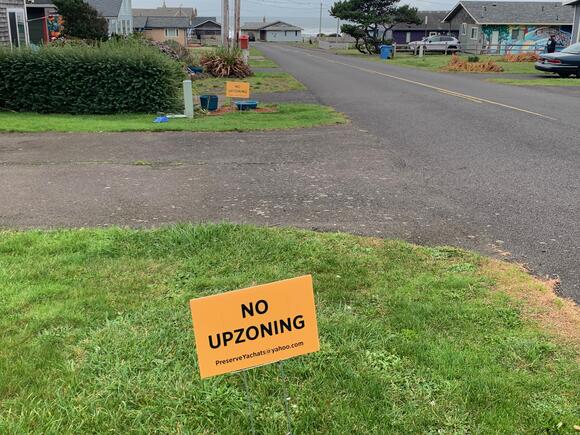
By GARRET JAROS/Lincoln Chronicle
YACHATS – Confusion and disagreements during the Yachats Planning Commission’s monthly meeting Tuesday over what housing code amendments are mandated by the state resulted in a decision to have the city attorney review and clarify them at a December meeting.
Two months ago the seven-member commission voted to have the city’s housing consultant separate state-required changes from optional ones for cities with less than 2,500 residents. The proposed optional changes have drawn concern and pushback from some Yachats residents who believe they would negatively affect neighborhoods, green spaces and property values.
However, because Yachats operates within an urban growth boundary and has a comprehensive land use plan, Oregon law requires the city to update codes to use land efficiently for housing and maintain a 20-year inventory of buildable land.
The consultant, Cascadia Partners, provided the reworked draft Tuesday to delineate required changes, but it too received pushback from Yachats resident Don Phipps who led the arguments against optional changes. Phipps told commissioners Tuesday he believes the draft still includes optional changes – and detailed several – before asking for a third-party review by land-use attorney not affiliated with Cascadia.
“That attorney should answer one clear question in writing for the public record, which provisions in this draft are strictly mandated by Oregon statute for a city of 1,000 residents and which provisions are optional,” Phipps said.
He added that an independent legal opinion would protect the city from adopting legally inaccurate findings and ensure only state-mandated changes are honored by city management.
City manager Bobbi Price told the Lincoln Chronicle on Thursday that while some of the issues raised by Phipps warranted further review, other interpretations – in particular his assertion that Cascadia said a new reviewing framework must be created to shift some land-use decisions and residential planned unit developments to administrative staff instead of the commission – was inaccurate.
“It’s not creating a new body,” Price said. “It’s a definition for the administrative review process. It’s just terminology for the administrative action that’s required by the state. It’s just saying the city planner or designee can do a lot of those Tier Two administrative procedures. It is really a new definition, not a new body. The state mandate is that some of these things become administrative work, not Planning Commission work.”
In a letter to Price, city attorney Ross Williamson said he understands the frustrations of planning commissioners with the erosion of local procedures and commission discretion because of changes by the 2025 Legislature. He said planning commissions across the state will be hearing fewer matters as the workload is shifted to administrative staff.
The administrative changes mandated by the 2025 Legislature and Gov. Tina Kotek are designed to speed up more routine decisions, given the state’s need for more housing.
The Legislature requires a specific administrative process for certain land use decisions, as correctly identified by Cascadia, Williamson wrote. The open question is who should make these administrative decisions, he said, and the assumption is that a policy body like the Planning Commission is no longer the appropriate one for administrative decisions.
“But the statute does not forbid a city from making things awkward, cumbersome, and untimely,” Williamson concluded.
Heeding state law
While there is no timeline for the city to adopt the state-required housing code changes, commission members and city planner Katherine Guenther clarified that any decisions made by the city or commission that are in conflict with state law would be invalid and could result in an appeal or a lawsuit.
Guenther said, for example, the city’s manufactured dwelling code has been out of sync with state law for a long time and because the city and the Lincoln County planning department is aware of that, it has been disregarded. But if similar issues pile up it clearly becomes a problem, she said.
The difficulty in compiling a comprehensive chart of state-required code updates for Yachats, Guenther said, has been regular revisions by the Legislature and how they apply in specific circumstances.
“I wish they color coded everything that only applies to large cities,” she said. “Or only applies to the Portland metro area. It would have been so much easier to sort through this if I could look at something and say, ‘Okay, that definitely applies to every city with an urban growth boundary, regardless of size.’ You have to dig and dig and dig. And this is where I think it’s difficult.”
She added that she does not believe anyone is intentionally trying to sneak anything in under the guise of state-mandated changes and that the city will continue to consult experts including from the Oregon Department of Land and Conservation’s newly created Housing Accountability and Production Office, which is tasked with helping municipalities update housing codes.
One part of the proposed codes refers to the concept of “clear and objective standards,” which Guenther believes will take time to be tested in the courts because what is clear and objective is not always clear.
Commissioner Loren Dickinson said the public comments during the meeting revolved around the review process and “there’s massive confusion as to what is required and what isn’t.” And he proposed a simpler-to-read document than the draft submitted by Cascadia Partners.
“I think something very simple like that would go well with the rest of the community,” Dickinson said. “I’m confused now about what’s required and what isn’t. Whatever is simple that the community can take it and look at it. It would go a long way to resolving some of these questions.”
Price proposed having the city attorney do a formal legal review of what Cascadia provided to determine and then explain to the commission and community at its Dec. 15 monthly meeting what exactly the mandatory code revisions are so they can move forward with clarity. The commission agreed.
In other business, commission chair Marc Sakamoto said his term is up in December and that he will not be returning for another. “Believe it or not, has nothing to do with all this code thing,” he said. “I’ve been thinking about this for a couple years. I’m just not as young as I used to be, and I feel like you need people who can keep up with it, and I’m having trouble keeping up.”
- Garret Jaros covers the communities of Yachats, Waldport, south Lincoln County and natural resources issues for Lincoln Chronicle and can be reached at Garret@lincolnchronicle.org
 Add to Preferred Sources