undefined
Posts
undefined
Followers
Marquette poll director reflects on midterms
By Matthew Baughman,
4 hours ago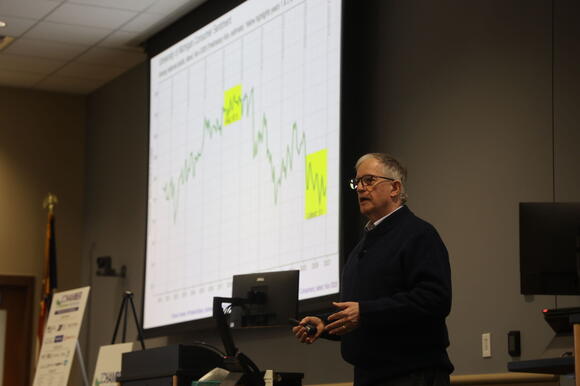
EAU CLAIRE — Results from the midterm election show interesting trends in Wisconsin’s voting landscape, with several results surprising those involved with the Marquette Law School Poll.
On Monday morning, Marquette Law School Professor of Law and Public Policy Charles Franklin spoke at an event hosted by the Eau Claire Area Chamber of Commerce. Franklin has directed the Marquette Law School Poll since 2012.
For him, one of the clearest surprises from the results of the election was the margin of victory in the governor’s race. Following the Nov. 3 midterm election, Democratic candidate David Crowley managed to secure 1,440,993 votes, 54%, against Republican candidate Rep. Tom Tiffany’s 1,227,677 votes, 46%.
Franklin said this election showed that Wisconsin can have a gubernatorial election decided by an eight-point margin instead of historically closer one- to three-point races.
“Eight percentage points is not something I would have told you was likely to happen over the summer,” he told audience members on Monday. “We’ve had such a series of close elections in the state that one-point to three-point wins has become sort of the norm, with exceptions for the Supreme Court elections.”
Looking at election data, Franklin said a significant factor to note from the statewide race is how the Fox Valley, instead of being a historically fairly Republican-leaning area, was more evenly split among voters this time around.
“There have been a little bit of changes in the south-central area,” he added.
“Madison, or Dane County, stands out as this deep blue, but the counties right around it have varied in whether they’re fairly Democratic or maybe slightly-leaning Democratic. Sauk County in particular and Columbia County are both Democratic by a small margin this year, though that’s not always been the case. Sauk has actually swung back and forth across elections.”
At the same time, Franklin said you also see the predominance of Republican votes in the north, largely in counties with smaller population sizes than major urban areas.
During the midterms, 76% of votes in Milwaukee and 69.4% of votes in Dane and neighboring counties were Democrat. These combined to a net Democrat vote of 385,599.
In north and southwest Wisconsin, an area which makes up 18% of the state population and includes Eau Claire County, Democrats only received 48.1% of the votes.
Scott Walker was the last Republican to win Wisconsin’s governor seat, winning by roughly 5.5 points in 2014. Over a period of 12 years, there has been a 12-point shift in the governor’s race.
“Dane County over the last 20 plus years has gone from giving Democrats about a 56 or 57% vote to now an 80% vote,” Franklin said. “Milwaukee County has similarly moved substantially. And when you get that much result in the two biggest population counties in the state, that plays a big role.”
But when looking at the bigger picture, Franklin said almost every county in the state that has a large population center, like Eau Claire, La Crosse and Superior, have seen considerably smaller Republican vote totals than they were in 2014.
“In contrast, where Republicans have gained is in the counties that don’t have major urban centers. And there we’ve seen greater polarization,” he said. “Those mostly rural counties have moved in a more Republican direction over time. But because they don’t have the population, their movement is being strongly overbalanced by the movement in these big population counties.”
Franklin also spoke to what he believes were the forces that drove the overall election. National survey data shows that overall feelings about the economy have been on a downward trend since 2020, which he said put a burden on Democrats to win in 2024.
He also noted presidential approval ratings. While it may not be accurate to say President Donald Trump’s approval has been “collapsing,” Franklin did say polling data suggest it has been moving steadily down over the past two years.
“I think [the results were] driven in part by the very negative views of the economy and of President Trump,” he said. “That was a powerful force all across the country, as we see in those nine Senate seats that Democrats have picked up, and the 45 House seats they’ve picked up. I think that’s clearly not just local forces, that’s a national force at work, and you see it here in Wisconsin.”
Franklin said independents remained the important key swing group in the state. Although they make up about 10% of likely voters, Republicans and Democrats are equally balanced at 45% each.
“In our final poll, independents were going 56% for Crowley, 26% for Tiffany and about 18% undecided,” he said. “The exit polls show that independents voted even a little more heavily for Crowley than our poll showed.”
Democrats also outperformed Republicans on a national scale. Franklin said estimates from their poll said Democrats would have done very well if they gained 36 seats in the House of Representatives. They ultimately picked up 42.
Following the results of the midterms, Franklin said anything can happen with a general election in 2028. He believes that both parties will have two years to redefine themselves.
“This was a widespread, sweeping win for Democrats, but without a single figure representing the Democratic Party,” he said. “This was a win across a bunch of Senate and congressional districts, but it wasn’t led by a single figure the way the Republican Party is currently led by Donald Trump. And so, the presidential primaries, and almost all of 2027, will be the lead up of emerging Democratic leadership voices struggling to define the party and do it in a way that can both get them the nomination and potentially the presidency in 2028.
“On the Republican side, you have a very similar problem with the end of the Trump presidency in 2028. How do Republican leaders want to define themselves and, in the process, define the Republican Party going forward?”
Franklin is still saying anything can happen, but he believes those will be a focus in the coming years.
 Add to Preferred Sources