undefined
Posts
undefined
Followers
Interstellar comet 3I/ATLAS displays ‘extreme negative polarization’ — and that's very unusual cometary behavior
By Mahalekshmi P,
2025-10-06
The interstellar comet 3I/ATLAS had been under thorough investigation since its discovery in July earlier this year. Among the characteristics studied about the comet, it was found that the object had “extreme negative polarization.” With the comet out of view, the polarimetry method was used to analyze the findings and discern this discovery, according to IFLScience. It measured the rotation of plane-polarized light, which looked at how sunlight scattered off the comet’s dust particles. It helped to learn a great deal about distant objects, including the size, shape, and orientation of dust particles that surrounded a comet.

Measuring the Light and Its Reflection
“Light is a wave consisting of a coupled oscillating electric and magnetic fields which are orthogonal to each other in a plane that is perpendicular to the direction of propagation of the wave (in vacuum),” detailed Harvard astronomer Avi Loeb. The level of polarization was determined from the different modes of oscillation of the electric and magnetic fields, according to Orbital Today. In linear polarization, the fields oscillated in a single direction, while in circular polarization, they rotated at a constant rate with the wave traveling in either direction. A minimum polarization of −2.77 ± 0.11% was measured, a value beyond typical cometary ranges.
Numbers in the Extreme Negative
Knewz.com noted that this extreme “negative” polarization meant that light waves reflected by the comet aligned parallel to the scattering plane. It was completely different from the normal cometary behavior. The findings revealed that 3I/ATLAS’s optical characteristics were similar to those of trans-Neptunian objects (TNOs) and Centaurs, icy bodies orbiting far beyond Neptune. The level of polarization indicated asymmetries in its global shape, and these depended on the angle of observation between the Sun, the comet, and the observer. Other findings of water-ice features and a reddish spectral slope hinted at a connection to the outer system’s frozen worlds.
Tentative Results Demand More Data
The degree of polarization was measured to understand the interstellar visitor and also local comets to determine whether they were negative or positive. Despite set categories for polarization and standards of observations, there were a few peculiar objects that stood out. The observations of the interstellar object did not have data on small phase angles, which made the current observation of polarization tentative. The conclusion aligned with the red spectral slope and evidence of water-ice detections. However, further data and observations were needed to confirm the findings, but it was presently out of view.
Hidden Comet to Resurface Soon
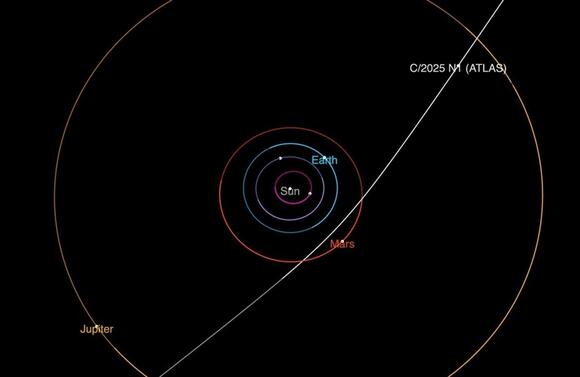
The interstellar visitor comet 3I/ATLAS was discovered on July 1, 2025, when an object moving through the Solar System was noticed. It was moving at almost twice the velocity of previous interstellar visitors ‘Oumuamua and comet Borisov. It was confirmed to be an interstellar comet from its dusty coma and was thought to be extremely larger than the previous visitors. It was later confirmed by astronomers in a study that found it to have a possible “anomalous” mass of over 33 billion tons. The nucleus of the comet was estimated to be around 3.5 miles. During the comet’s travel in our system, it was observed by almost every telescope and observatory.
 Add to Preferred Sources


